投稿者: okinawavia

  • Makishi Fish Market: Seafood, Upstairs Dining and Naha Walks

    Makishi Fish Market: Seafood, Upstairs Dining and Naha Walks

    Makishi Public Market makes a good centrepiece for a food-focused walk in Naha: browse the downstairs counters, choose a meal upstairs and leave time for the surrounding shopping lanes. This guide explains what to eat, how the carry-up cooking system works and what to check before you visit.

    If you searched for Makishi fish market, use this guide to plan your visit to Makishi Public Market, its food stalls and the surrounding Naha market streets.
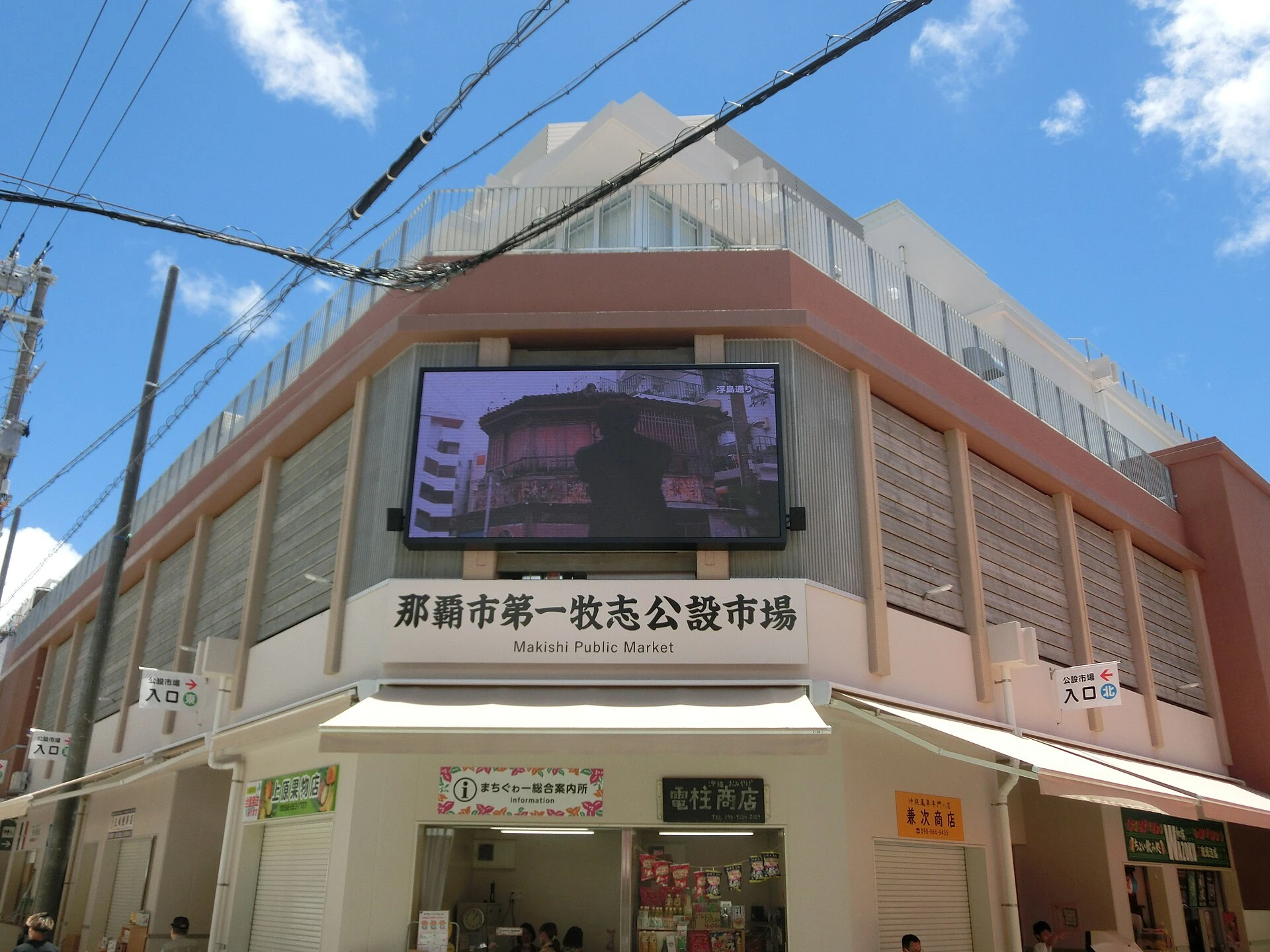
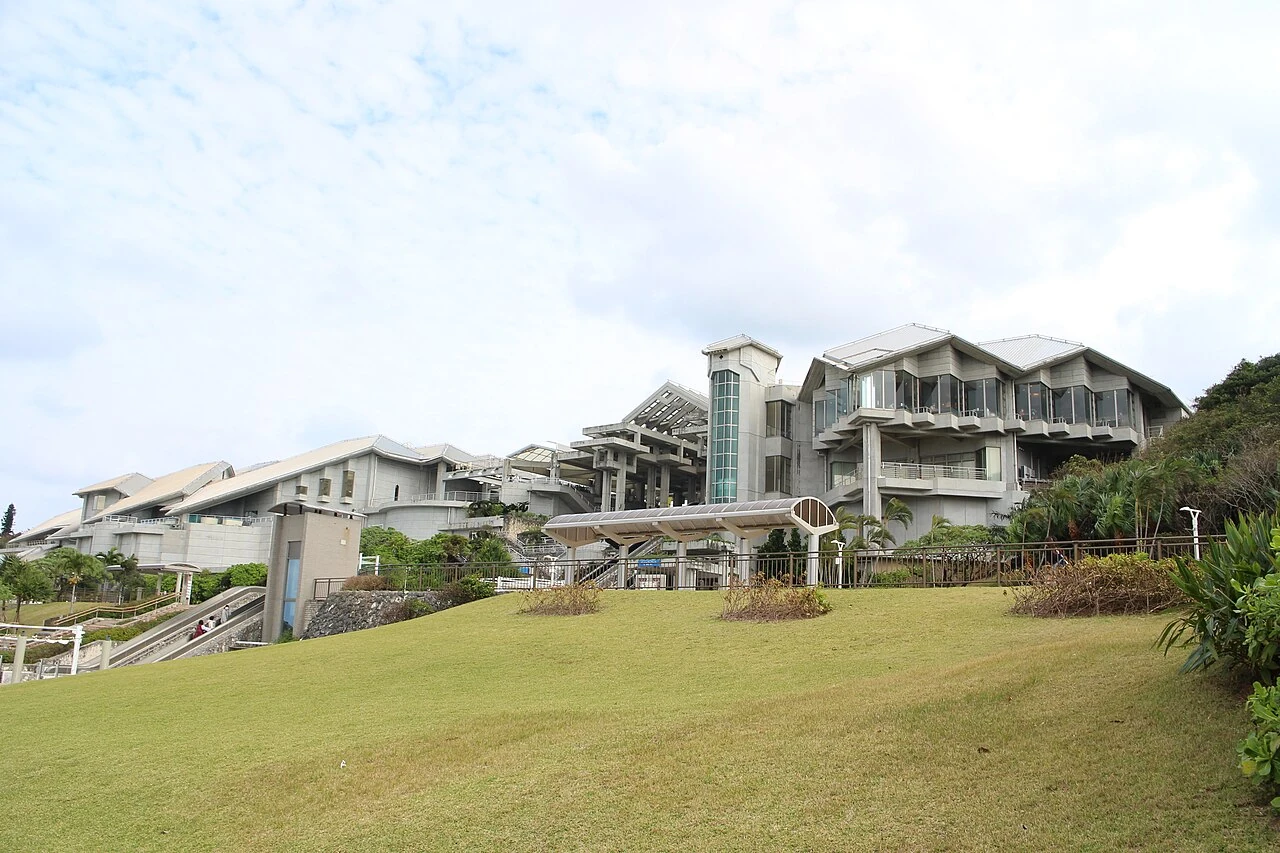
    The rebuilt Naha City First Makishi Public Market building under a blue sky in July 2023
    Makishi Public Market beneath a blue sky

    A MARKET LUNCH, AT YOUR OWN PACE

    For a first visit, plan around lunch and allow roughly 1½–2 hours for browsing and a meal. Choose either a restaurant’s normal menu or suitable downstairs ingredients cooked upstairs. Confirm the ingredient total and the separate cooking charge before buying.

    Practical information checked October 18, 2026. Visit durations and walking combinations are our planning suggestions. Documentary photographs show the market on their stated dates; visible prices are not current quotations.

    What is Makishi Public Market, and where should you start?

    The full name is Naha City First Makishi Public Market, or Daiichi Makishi Kosetsu Ichiba (第一牧志公設市場). Save the address 2-10-1 Matsuo, Naha, rather than a general Kokusai Street pin. “Naha public market” often refers to this market in visitor searches, but the surrounding neighbourhood contains many separate shops and shopping lanes.

    The rebuilt market reopened on March 19, 2023. Photos and directions from the earlier building or the temporary-market years can look quite different. The operator’s facility guide records its establishment in December 1950 and the rebuilding history.

    First floor: browse before choosing

    Start with a circuit of the food counters. The official shop directory and floor map identify fishmongers, butchers, grocers and other businesses. Look at the range, ask what is ready to eat and decide whether you want a few purchases or a meal. A striking display is a reason to ask questions, rather than a reason to order more than your group wants.
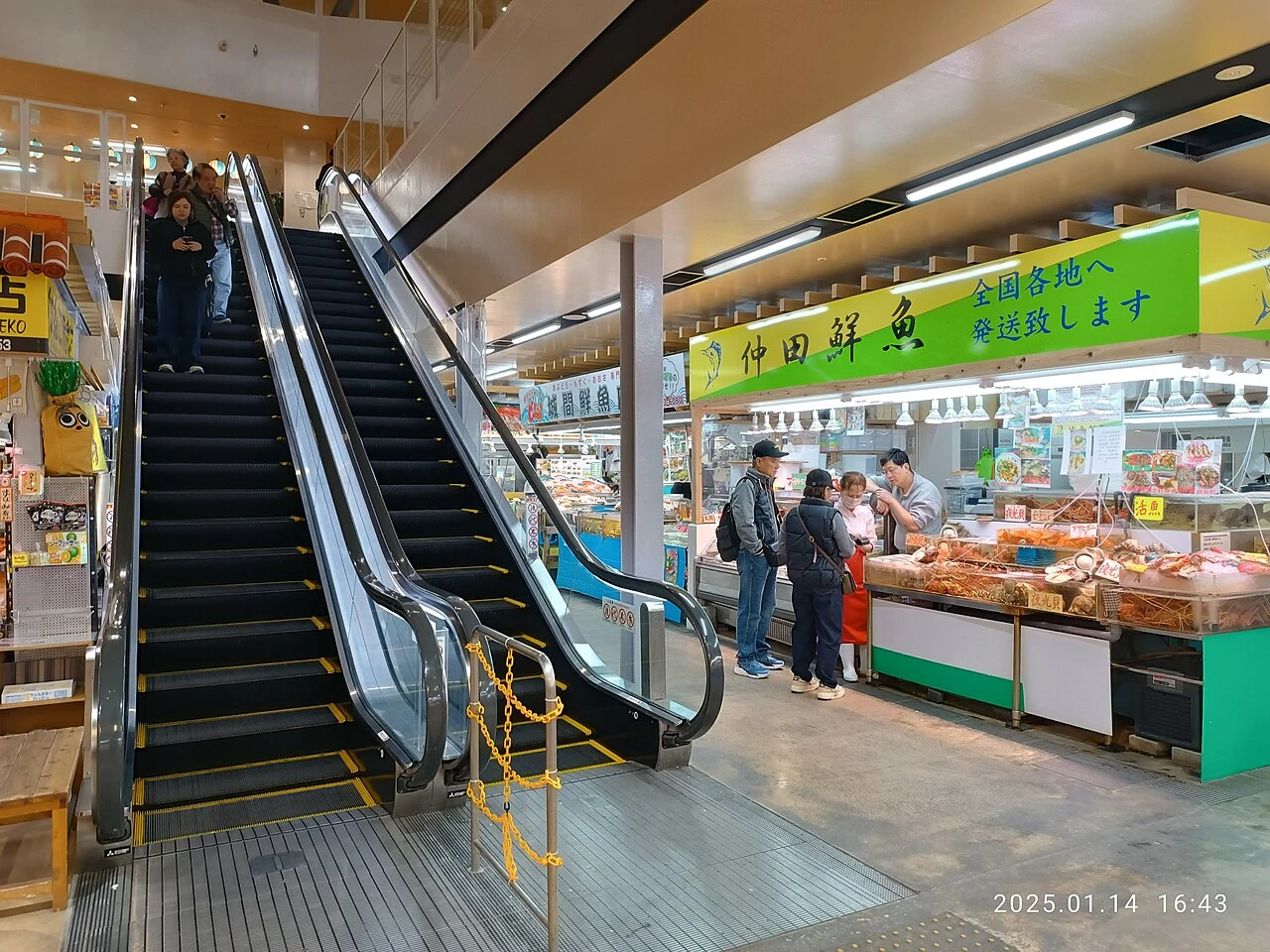
    Escalators and first-floor food counters inside the rebuilt Makishi Public Market
    Food counters inside Makishi Public Market

    Second floor: restaurant menus and carry-up meals

    The upstairs restaurants offer a straightforward alternative to selecting raw ingredients: look at the menu, check the portion and order lunch. If you want the carry-up experience, agree the arrangement with the seller and restaurant first. Knowing these two options before shopping helps you stay within both your appetite and budget.

    Third floor: planned experiences, rather than another food court

    The official map identifies cooking-experience and multipurpose rooms on the third floor. A booked class is a separate activity from asking a restaurant to prepare purchased ingredients. If a class interests you, check its organiser, meeting point, language, inclusions and booking conditions; do not assume a walk-in restaurant order includes a lesson.

    Makishi Public Market opening hours, last orders and closure days

    The market operator publishes the following building-wide guidance. Individual shops have their own service hours, so use the kitchen’s last order when planning a meal.

    What to checkPublished guidanceHow to use it
    Building hours08:00–22:00; shops varyAn open building does not mean every stall or kitchen is serving.
    Carry-up cooking last order19:45 for eligible first-floor ingredientsAsk the vendor and restaurant earlier; only some products qualify.
    Second-floor dining last order20:00 general guidanceCheck the chosen restaurant’s own cut-off.
    Regular closureFourth Sunday each month, except DecemberCheck notices and shop-specific holidays before travelling.
    Address2-10-1 Matsuo, Naha, OkinawaUse the current building’s map pin.

    Is breakfast, lunch or dinner the best fit?

    Lunch is our simplest recommendation for a first visit, because it gives you room to browse before choosing where to sit. A very early arrival needs a specific shop plan: building hours start at 08:00, while the official listings for Tsubame and Honen, for example, start restaurant service at 11:00. For dinner, arrive well before the last-order window and confirm the restaurant is open that day.

    Check the date as well as the weekday

    Besides the monthly closure, the facility guide lists New Year, Lunar New Year and Obon closures, with additional shop differences. A shop’s weekly day off can also fall on a day when the rest of the market is open.

    Date-specific notices checked October 18, 2026: the operator confirms the market closure on Sunday, October 25, 2026. It also announces Kokusai Street traffic restrictions on October 18, 2026, from 10:00 to 22:00 for the Eisa event, including effects around nearby private parking areas. For later visits, consult the latest notices rather than applying these dates to another year.

    How does Makishi Public Market’s carry-up cooking system work?

    Mochiage, often translated as “carry-up” or “lift-up,” means buying suitable ingredients downstairs and having them prepared at a second-floor restaurant. The official how-to guide makes three points clear: ask which ingredients qualify, pay for ingredients at the shop, and pay the cooking charge at the restaurant. Preparation charges vary.
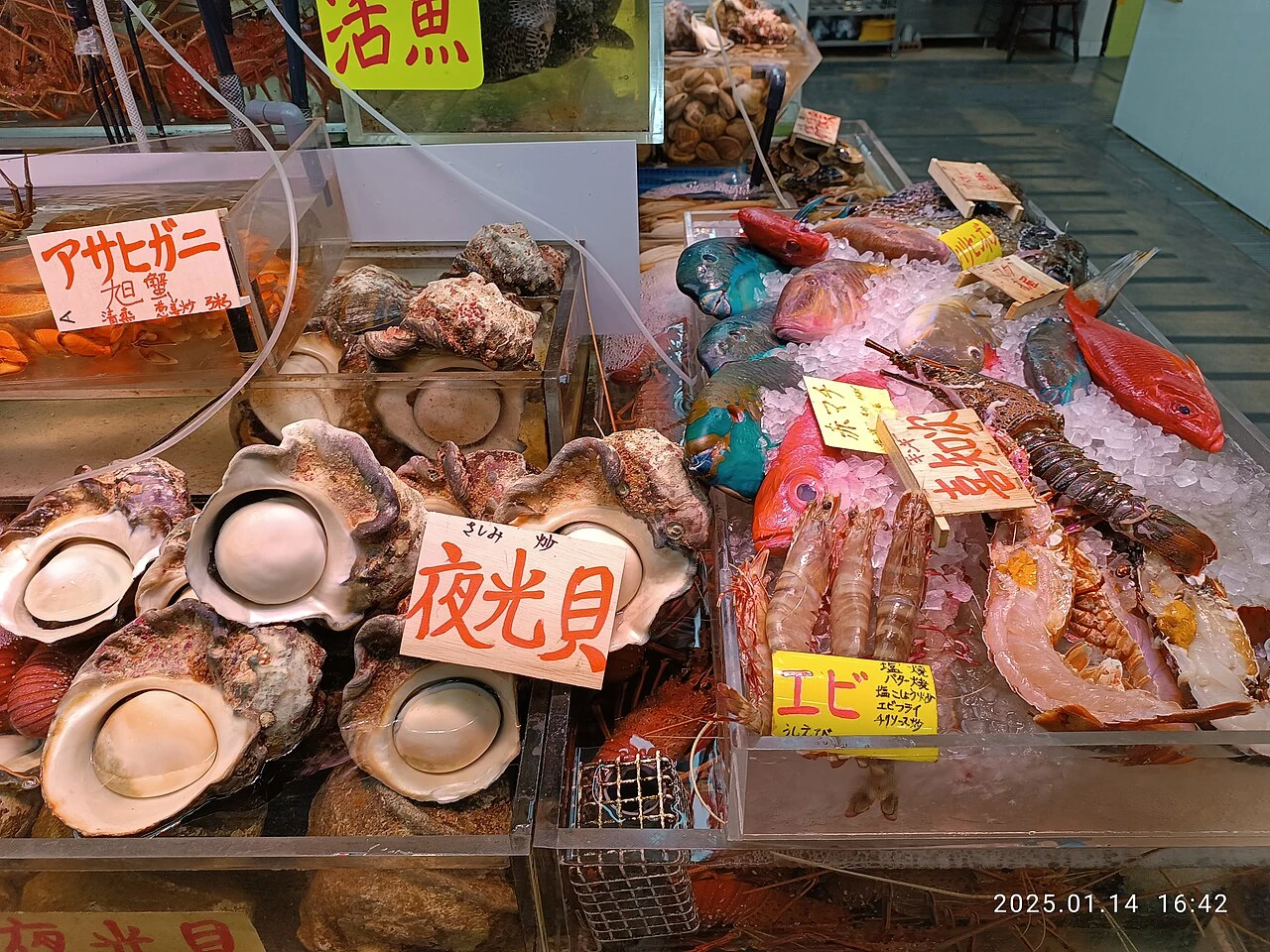
    Shellfish and colourful fish displayed on ice at Makishi Public Market
    Fresh seafood on ice at Makishi Public Market

    Step 1: decide the meal before buying the ingredients

    Tell the vendor how many people will eat and whether you want a light lunch or a shared main meal. Ask which restaurant can prepare the selection. If you have an ingredient restriction or prefer cooked seafood, make that part of the conversation before money changes hands. Keep the order manageable; you can explore the rest of the market without buying a sample of everything.

    Step 2: agree the quantity, unit price and ingredient total

    Ask whether the number on a sign applies to one piece, a tray, a stated weight or the entire item. Have the seller show you the full ingredient amount for your actual selection. When several people share the bill, agree that total as a group. A large shellfish or whole fish can make a different kind of lunch from a small ready-prepared pack.
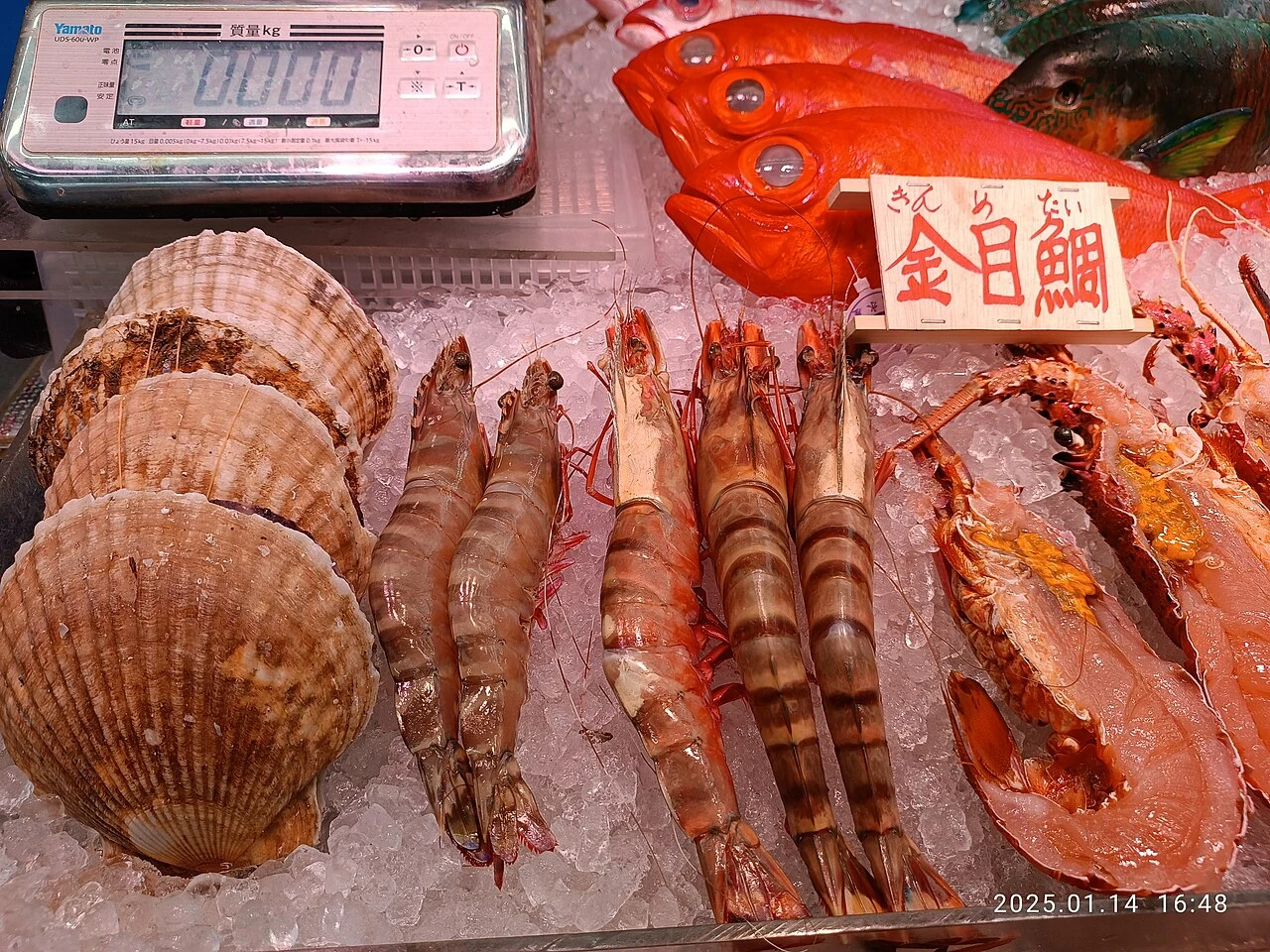
    Prawns and scallops beside a weighing scale at a Makishi Public Market seafood counter
    Shellfish beside a market weighing scale

    Step 3: confirm the cooking method and separate charge

    Ask the receiving restaurant how it proposes to cook each item, what the preparation will cost and whether rice, soup, sauces or drinks are extra. If the quote is per person or per preparation, ask how that applies to your party and selection. Use the restaurant’s answer for the total; a cooking fee mentioned in an old travel blog is not a universal current market price.

    Step 4: confirm the handover and where to sit

    Follow the seller’s instructions for getting the purchase to the agreed restaurant. Check which table or counter to use and roughly how long preparation may take. Keep your receipt or order details with you. Avoid purchasing first and searching upstairs for any kitchen willing to take it afterwards.

    Step 5: pay the two parts in the right places

    The ingredients and restaurant preparation are separate purchases. Before adding side dishes, review what you have already ordered so that the final meal matches your budget. If anything about the arrangement is unclear, pause and ask for the details in writing or on a calculator before proceeding.

    When a normal restaurant order is easier

    Choose the regular menu if you want a predictable dish, are eating alone, have limited time or simply prefer to compare complete meals. You still get to browse downstairs. The carry-up system is one way to enjoy the market; you do not need to use it to make a visit worthwhile.

    What to eat at Makishi Public Market

    Begin with the kind of meal you want, then use the current menus and counters to choose. The options below help you make that decision; availability, ingredients and portions belong to the individual shop or kitchen.

    Your priorityA useful directionAsk before ordering
    A seafood-focused experienceSuitable carry-up ingredients or a restaurant seafood dishPreparation, edible portion, ingredient total and cooking cost.
    A simple individual lunchA noodle dish or a set from a normal menuTopping, bowl size and what the set includes.
    Several local flavoursShared Okinawan dishes and small sidesNumber of servings, broth, sauces and ingredients.
    A lighter stopA small prepared item, peanut tofu or a sweetReady-to-eat status, ingredients and where to eat it.

    Seafood: choose the preparation as well as the display

    Compare the seafood selection with the meal you actually want. Ask about a suitable cooked preparation, bones and serving size, rather than ordering solely by colour or size. If you prefer sashimi, ask for an item specifically sold or prepared for that purpose. A display tank or a photograph cannot answer questions about today’s serving.

    Okinawan meals from the upstairs menus

    Tsubame’s official listing covers Okinawan, seafood and Chinese cooking; Honen lists Okinawan cuisine as well as cooking first-floor seafood purchases. Read their actual menus on arrival and compare a full meal with separate plates. For unfamiliar dish names, our Okinawa food guide explains soba, champuru, rafute and other starting choices.
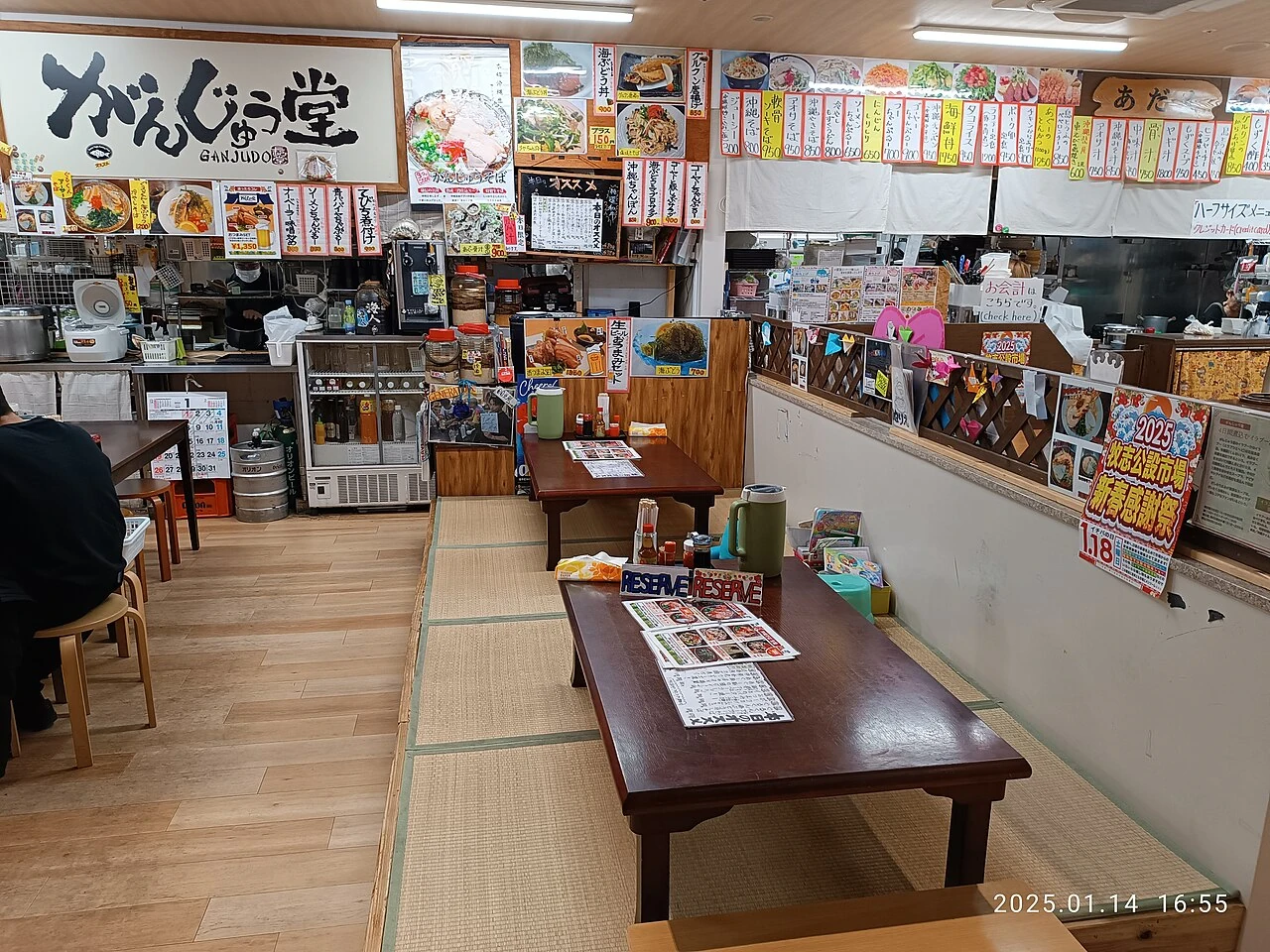
    Second-floor restaurant counters and dining tables at Makishi Public Market
    Upstairs dining at Makishi Public Market

    Peanut tofu, seaweed and smaller purchases

    Two specific directory entries are useful for looking beyond fish: Hama specialises in jimami tofu, and Mozukimu lists mozuku, sea grapes and other seaweed products. Ask whether the item is ready to eat, how the sauce is served and how to store a takeaway purchase.

    Jimami tofu contains peanuts; its name does not make it ordinary soy tofu. If avoiding an ingredient, discuss the actual product and sauce with the seller. A seaweed or vegetable item may also have added seasoning, so the main ingredient alone does not establish dietary suitability.

    Meat counters, sweets and a more varied visit

    The butchers are part of the market’s identity too. They can make the downstairs browse interesting even when lunch comes from a normal restaurant menu. Ask which products need cooking and which are prepared foods, and treat raw-ingredient shopping as a separate decision from ordering a ready-to-eat snack.
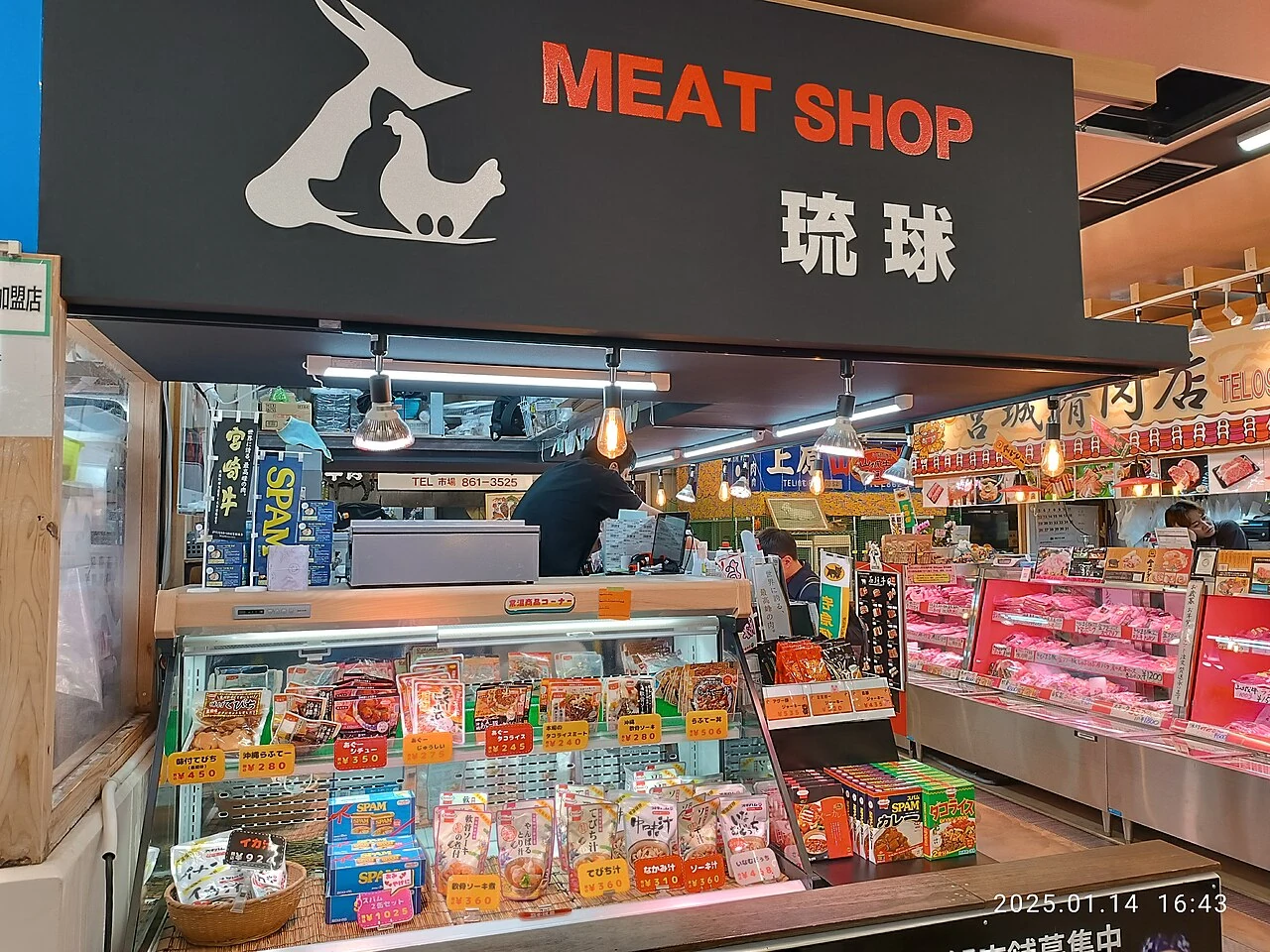
    A meat counter and packaged products inside Makishi Public Market
    A meat counter at Makishi Public Market

    The second-floor directory also lists Ayumi sata andagi and H&B gelato. Check their current service before building your afternoon around a particular sweet. A small snack after lunch leaves more flexibility than buying several full portions before you have decided where to eat.

    Market shops and restaurants to look up before visiting

    These are practical examples from the market’s official directory, checked October 18, 2026, rather than a restaurant ranking or a claim of personal dining experience. Shop schedules add to building closures; reconfirm the chosen business for your date.

    Business / floorWhy look it upPublished shop guidance
    Tsubame / 2FNormal menus plus carry-up cooking11:00–21:00; last order 19:50. Lists Thursday and other closure dates.
    Honen / 2FOkinawan cooking and preparation of purchased seafood11:00–21:00; last order 20:00. Lists Wednesday off.
    Hama / 1FSpecialist jimami tofu shopFrom 09:00 until sold out; Wednesday off. Do not rely on late-afternoon stock.
    Mozukimu / 1FMozuku, sea grapes and other seaweed products08:30–16:30 in its listing. Check market-wide closures too.

    For an early meal outside the building, Potama’s Makishi Market branch publishes an address of 2-8-35 Matsuo and hours of 07:00–20:00, year-round. It is a separate nearby business. Check its own updates rather than applying the public market’s building schedule to it.

    How much does a market meal cost, and how should you pay?

    Build the budget from the actual order

    There is no single useful price for “a Makishi Market seafood lunch.” For carry-up dining, write down ingredients + cooking + rice or sides + drinks + any stated extras. For a normal menu meal, check whether the number includes a full set or one plate. Compare the complete bill for the same number of diners.

    As a concrete nearby snack reference, Potama’s live standard sandwich page listed ¥450 including tax on October 18, 2026, with delivery pricing separate. That is one product, not an estimate for an upstairs market lunch. Recheck the live item and filling when ordering.

    Confirm payment at each business

    The example shop listings above show card, electronic-money and QR-payment options, but that does not establish a single payment policy for every market vendor. Ask at the particular counter and restaurant. Keep a practical cash option and remember that paying for ingredients does not settle the restaurant’s separate preparation bill.

    Shopping to take home
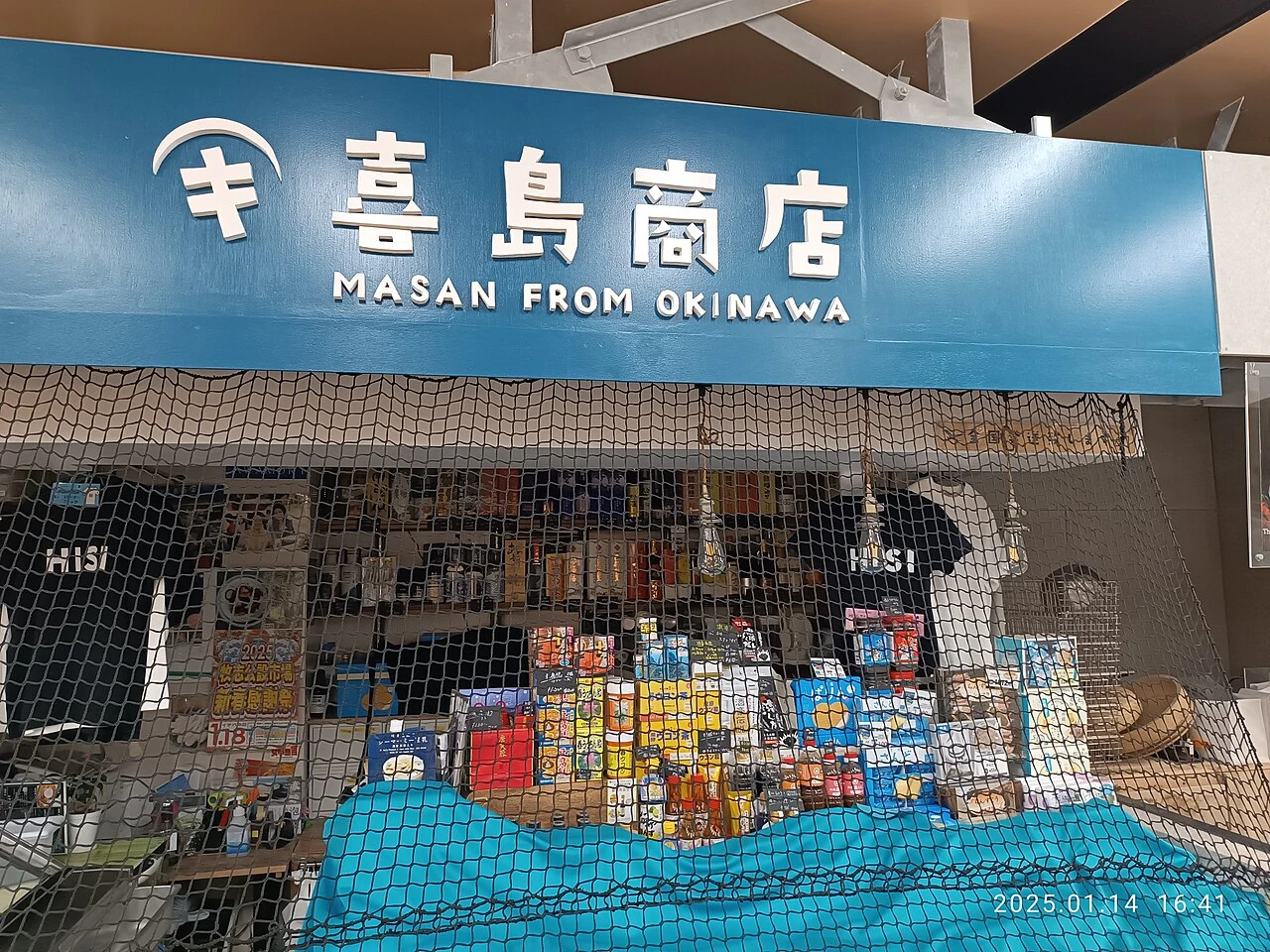
    Packaged foods and drinks at Kishima Shoten inside Makishi Public Market
    Local foods and drinks at the market

    Packaged foods can make a more manageable purchase than fresh ingredients if you are staying in a hotel without a kitchen. Read the label for storage, best-before information and ingredients, and ask how long an item can remain out of refrigeration. Buy for the journey you are actually making. For international travel, check your destination’s official import rules before purchasing food to carry home.

    How to get to Makishi Public Market from Kokusai Street and Naha Airport

    Walking from the monorail and Kokusai Street

    The operator gives approximately 9 minutes on foot from Makishi Station and 10 minutes from Miebashi Station; its facility page rounds the Makishi walk to 10 minutes. Treat those as direct-walk estimates and allow extra time for shopping, crossings or a slower pace. Save the current market map pin and use the official access map to orient yourself among the lanes.
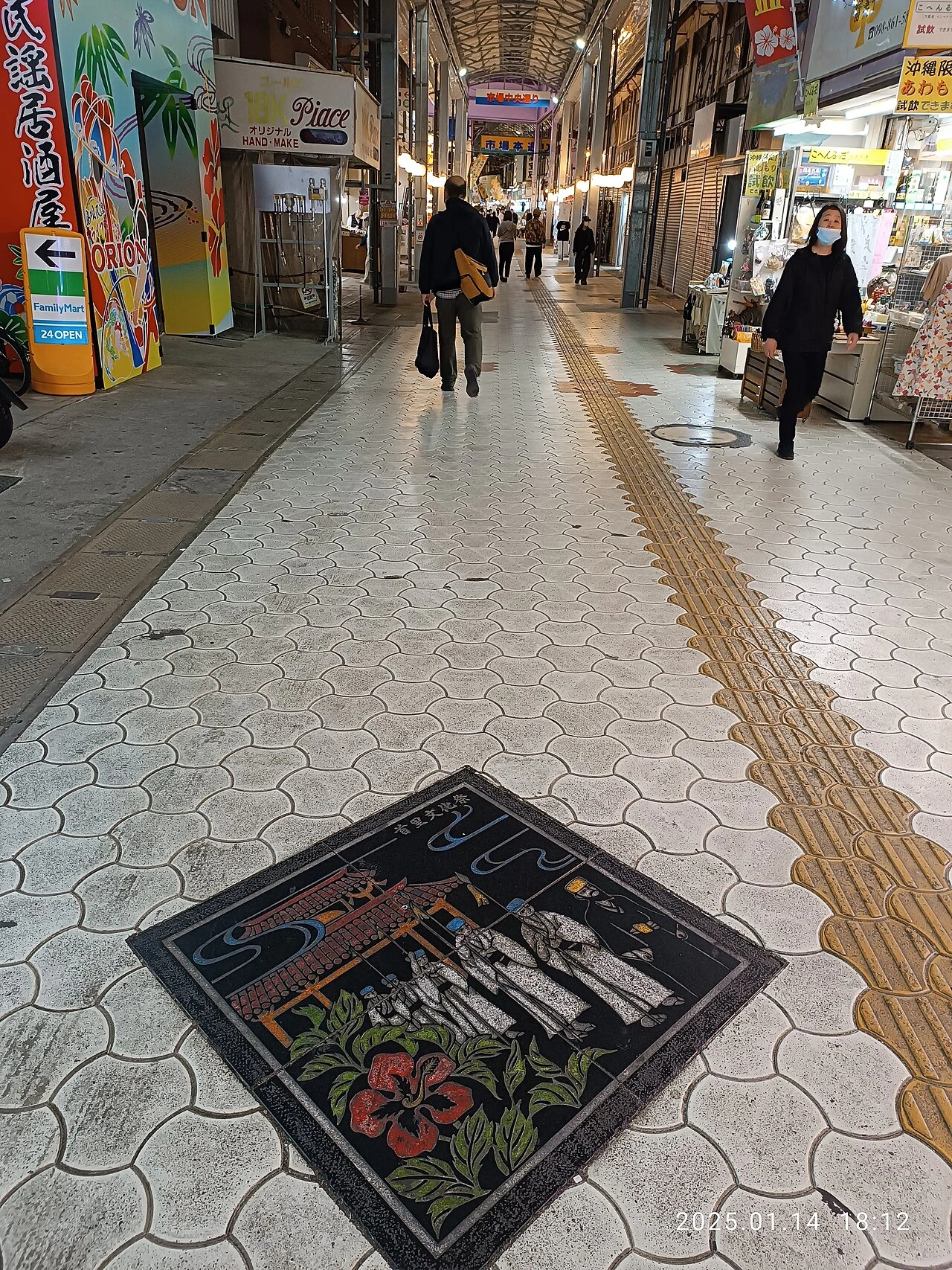
    Covered shopping arcade beside Makishi Public Market with shops and tactile paving
    Covered shopping lanes beside Makishi Public Market

    From Kokusai Street, enter the shopping streets towards the market rather than expecting the main entrance to stand directly on the main road. The covered arcades and the market building are connected parts of a walk, but are not one business with one set of hours.

    From Naha Airport or a hotel

    Yui Rail connects the airport with central Naha, followed by the walk from a suitable station. If you have substantial luggage, consider going to your accommodation first and returning for a relaxed meal. Our Naha Airport transfer guide compares arrival options; the Okinawa without a car guide helps with a wider Naha stay.

    Parking, taxis and meeting a driver

    The facility guide lists no market car park. Its access page notes nearby paid parking, one-way traffic on Ukishima Street and time-dependent road restrictions on Kokusai Street. Select a lawful parking or meeting location before arriving; a restaurant booking does not reserve road access or parking.

    If this is one stop in a wider private sightseeing day, agree a specific nearby meeting point and time with your driver, then explore the market lanes on foot. Readers arranging that wider journey can ask OkinawaVia about a suitable Naha route and pick-up. For the market alone, walking from a central Naha base is often the simpler plan.

    A flexible Naha walking plan: market, Kokusai Street and Tsuboya

    The official Naha introduction places the market among the covered shopping streets off Kokusai Street and describes nearby Tsuboya’s pottery heritage. That makes a compact food-and-shopping walk possible without adding a cross-island drive.

    Time availableSuggested shapeKeep flexible
    About 45–60 minutesA downstairs browse and one small purchase or snackSkip a complex carry-up order if time is fixed.
    About 1½–2 hoursBrowse, decide on a normal menu or carry-up lunch, then a short arcade walkMeal preparation and queues may need longer.
    A relaxed half dayMarket lunch, shopping lanes, then Tsuboya or Kokusai StreetChoose one extra area rather than rushing through every lane.

    A lunch-centred visit

    Walk in with enough appetite for lunch, browse first and make the meal your fixed stop. Leave the shopping afterwards open-ended. If one restaurant is closed, another normal menu can keep the visit enjoyable without making a specific carry-up selection the only successful outcome.

    Adding pottery or an evening stroll

    After eating, choose the Tsuboya area if pottery shops interest you, or return to Kokusai Street for a broader shopping walk. Check the actual shop hours if there is a particular studio you want to see. Keep the market meal earlier than the building’s closing time suggests.
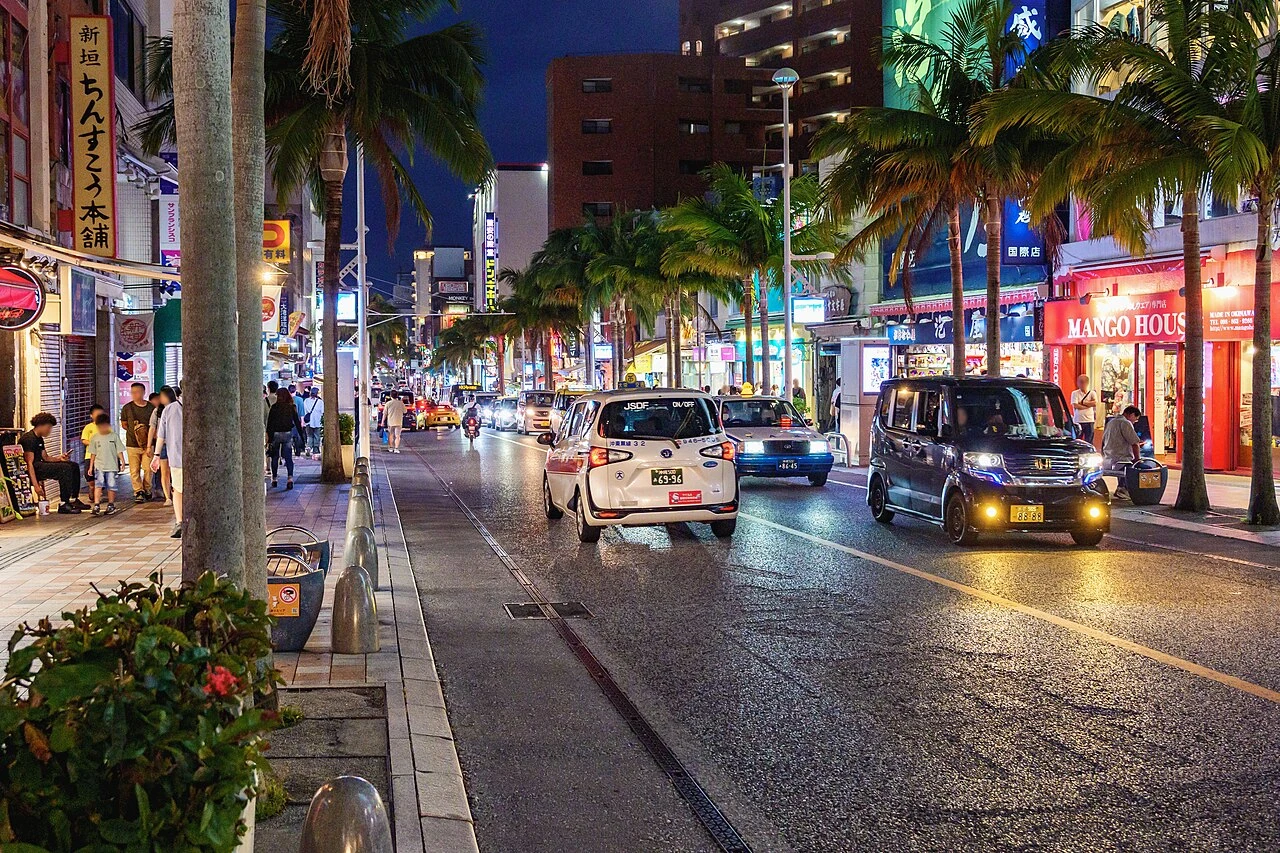
    People walking along illuminated Kokusai Street in Naha at dusk
    Kokusai Street in Naha at dusk

    Fitting the market into a longer Okinawa trip

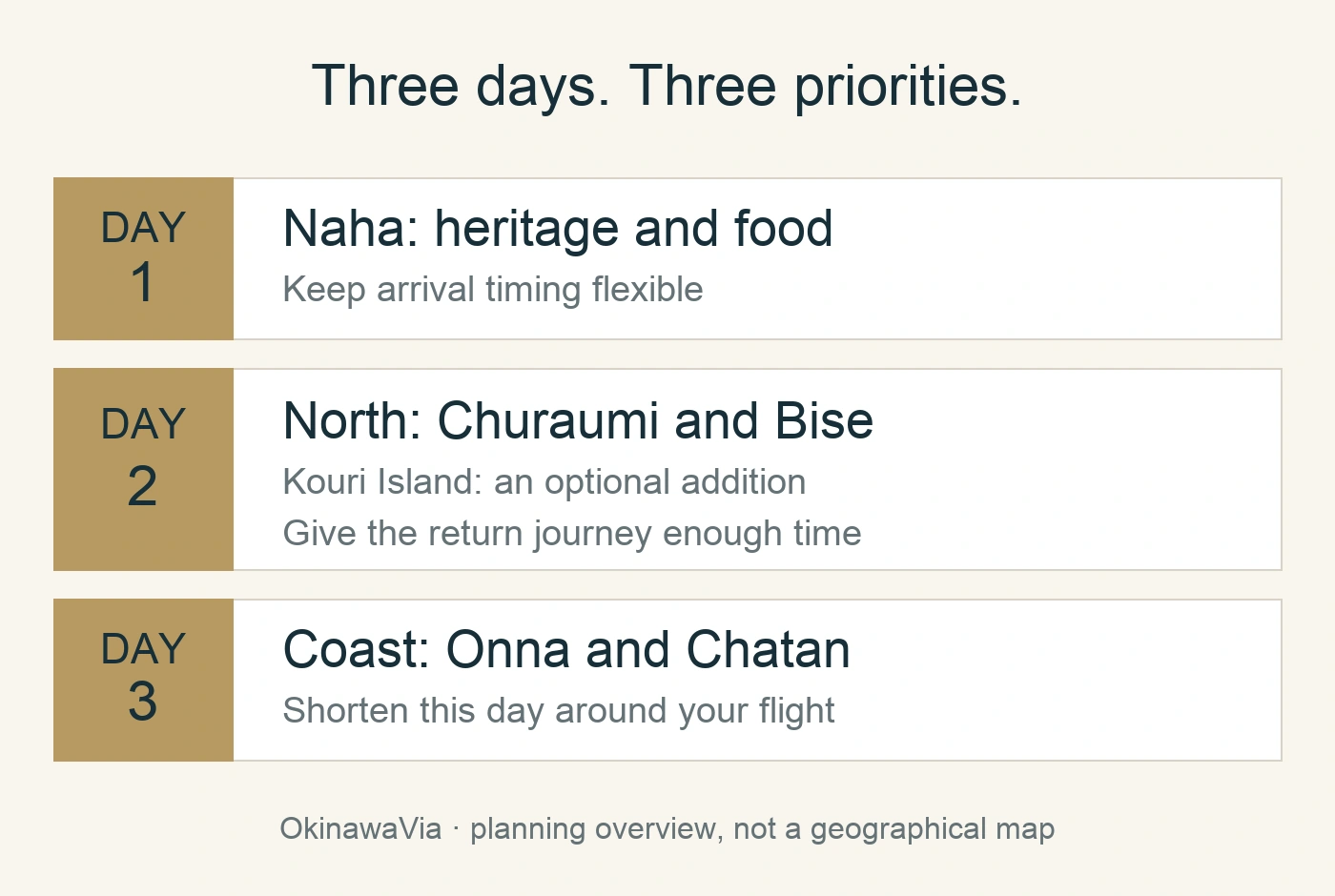
    Give Naha’s food streets their own time instead of treating them as a rushed lunch between distant attractions. Our three-day Okinawa itinerary separates a Naha day from coastal and northern sightseeing. That leaves room to stop when a menu or shop catches your interest.

    Visiting with children, mobility needs or dietary preferences

    Facilities and access

    The facility guide lists accessible toilets, wheelchair lending and a nursing room, and says stroller rental is unavailable. The shop directory’s map marks elevators and escalators. If a particular facility or step-free route is essential, contact the market management office on 098-867-6560 before visiting and confirm how to reach the chosen restaurant.

    Choose the meal around the people eating it

    For children, ask about portions, bones and the preparation they will be comfortable eating. For dietary restrictions, include stock, sauces and cooking ingredients in the conversation. Have a written explanation available if useful, and choose a business that can answer your questions. An English menu or a familiar photograph does not establish the ingredients of the final dish.

    A short checklist before setting out

    • Check the market closure notice and the chosen shop’s weekly day off.
    • Save the current Matsuo address and plan the walk or lawful vehicle meeting point.
    • Choose a normal menu meal or agree carry-up eligibility before buying ingredients.
    • Confirm the full ingredient and preparation costs, plus any extras.
    • Allow time for cooking and keep a fixed flight or tour deadline separate from an open-ended lunch.
    • Ask before close-up photographs of stalls or people, and leave working aisles clear.

    Makishi Public Market FAQ

    Is Makishi Public Market worth visiting if I do not eat seafood?

    It can be: the directory includes meat, grocery, peanut-tofu and seaweed specialists, as well as restaurants and sweets. Browse first, then choose a suitable item or normal menu meal. Check ingredients with the business rather than assuming a dish is seafood-free.

    Do I have to buy fish downstairs to eat upstairs?

    No. Restaurants such as Tsubame and Honen list their own cooking alongside carry-up services. Compare the regular menu if you want a simpler lunch.

    Is the cooking fee always ¥500 or ¥550?

    The operator says cooking charges vary with the preparation. Confirm the charge for your selected ingredients and group before buying. A fee quoted in an older guide should not be treated as a current fixed rule.

    Is the market open every Sunday?

    No. Its regular closure is the fourth Sunday, except December, and special or shop-specific holidays also matter. Check the operator’s notices for your exact date.

    Can I eat dinner at 21:00 because the building closes at 22:00?

    Do not plan on that. General guidance lists carry-up cooking last orders at 19:45 and second-floor dining at 20:00; individual restaurant cut-offs may differ. Confirm service with the restaurant and arrive earlier.

    How long should I allow?

    Our suggestion is about 1½–2 hours for browsing and a meal, with more time for queues, a leisurely carry-up order or nearby shopping. A short snack visit can be quicker. These are planning allowances, not measured waiting times.

    Is the market still in its temporary building?

    The rebuilt market reopened in March 2023 at 2-10-1 Matsuo. Use the current official map; do not rely on temporary-market directions from an older article.
  • Traditional Okinawan Dishes: A Local Food and Market Guide

    Traditional Okinawan Dishes: A Local Food and Market Guide

    A bowl of Okinawa soba, a plate of goya champuru and a few unfamiliar small dishes can tell you as much about the islands as a day of sightseeing. Use this Okinawa food guide to choose what to eat, understand the menu and put good meals into a route that makes sense.

    Explore Okinawa traditional food through the dishes below, from noodles and tofu to local vegetables and sweets, and leave time for food stops in your travel plan.

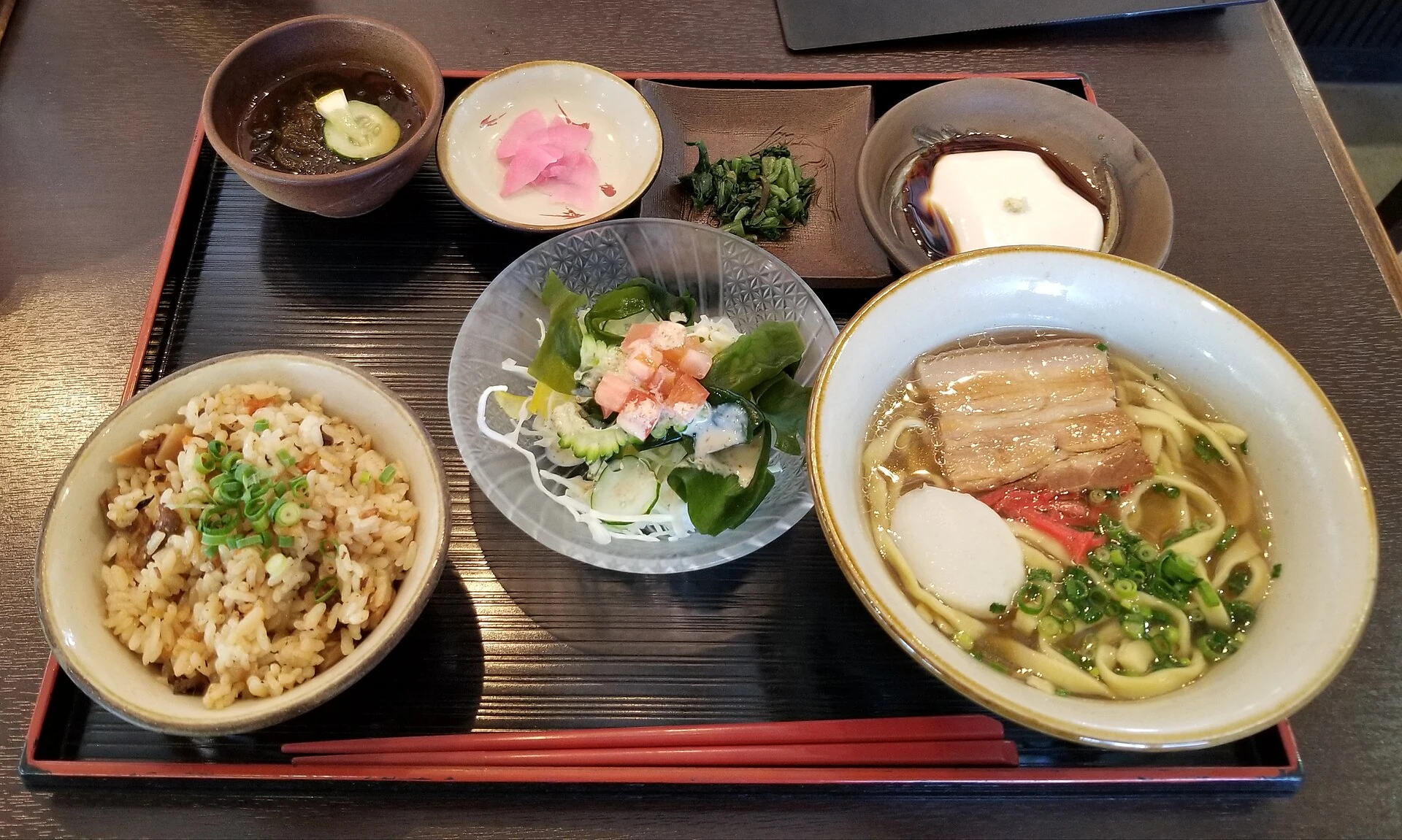
    An Okinawan set meal with seasoned rice, noodle soup, peanut tofu and small side dishes on a tray
    An Okinawan set meal with local dishes

    A FIRST TASTE OF THE ISLANDS

    Start with one noodle or rice lunch, one dinner of shared local dishes and one sweet stop. You do not need to cross the island for every speciality. Choose the dishes first, then find them near the places you already plan to visit.

    Practical information checked October 17, 2026. Meal combinations and visit allowances below are editorial suggestions. Photo captions identify the dates and distinguish dish illustrations from specific dining locations.

    Okinawa food at a glance: what should you try first?

    If you have only a few meals, begin with Okinawa soba or taco rice for lunch. At dinner, choose a local restaurant with small plates so that your group can try different textures: bitter melon, soft braised pork, peanut tofu and sea grapes. Leave a little room for sata andagi or a purple sweet-potato dessert.

    The table is a starting point for choosing, rather than a fixed tasting menu. Ingredients, portions and accompaniments change between kitchens; ask what comes with the particular dish you order.

    What you feel likeLook forWhat to expectCheck before ordering
    A noodle lunchOkinawa soba / soki sobaWheat noodles, savoury broth and a choice of toppings.Pork, fish broth, topping and bowl size.
    A familiar rice dishTaco riceTaco-style toppings over rice.Exactly which toppings are included; sauce and spice.
    Vegetables with a distinctive flavourGoya champuruA bitter-melon stir-fry, often with tofu and egg.Meat, fish seasoning and available variations.
    A rich shared plateRafuteSoft, slowly simmered pork.Whether it is a small plate or a full set meal.
    Something smooth or crunchyJimami tofu / umibudoPeanut tofu / sea grapes.Peanuts in jimami tofu; ingredients in the sauce.
    A sweet breakSata andagi / beni-imo sweetsFried doughnuts / purple sweet-potato treats.Flavour, ingredients and storage instructions.

    What makes Okinawan food different?

    Okinawa’s cooking reflects its history as the Ryukyu Kingdom and a place of exchange with China, mainland Japan and other parts of Asia. Court cooking, everyday home dishes and ceremonial meals all contribute to the cuisine. The official Okinawan food-culture introduction is a useful background to that variety.

    For a visitor, the most useful distinction is between a speciality’s name and the way a restaurant serves it. A dish might appear as an individual plate, a rice-and-soup set, a noodle topping or part of a course. Two menus with the same dish name can give you quite different meals.

    You will also meet firm island tofu, seaweed, pork and vegetables such as goya. Modern comfort foods belong in the picture too: the official main-island itinerary includes taco rice and pork-and-egg rice snacks alongside traditional cuisine. A first trip can make room for both a shokudo, or casual diner, and a more deliberate Ryukyuan dinner.

    Okinawan dishes to try: noodles, rice and main plates

    Okinawa soba and soki soba

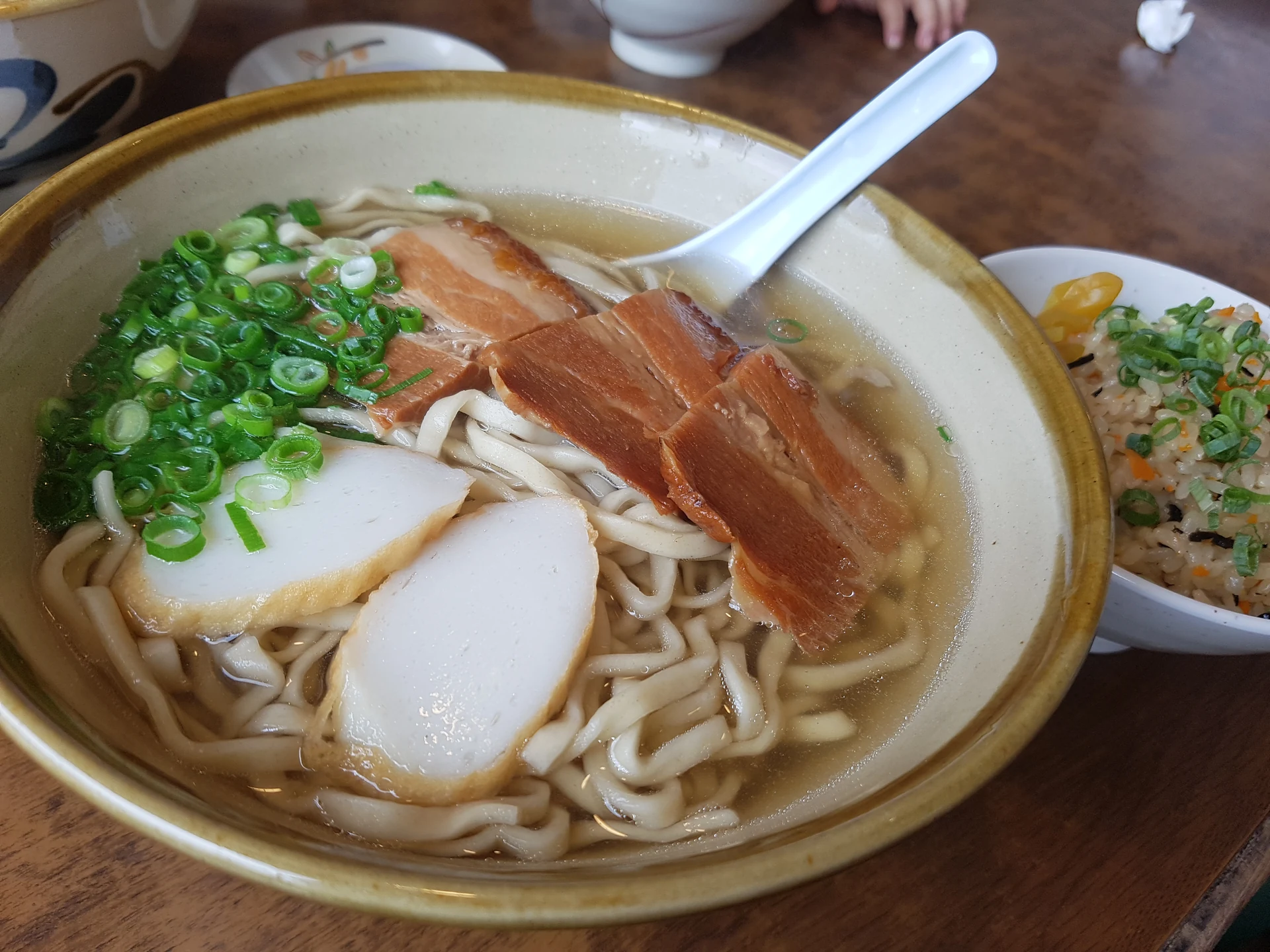
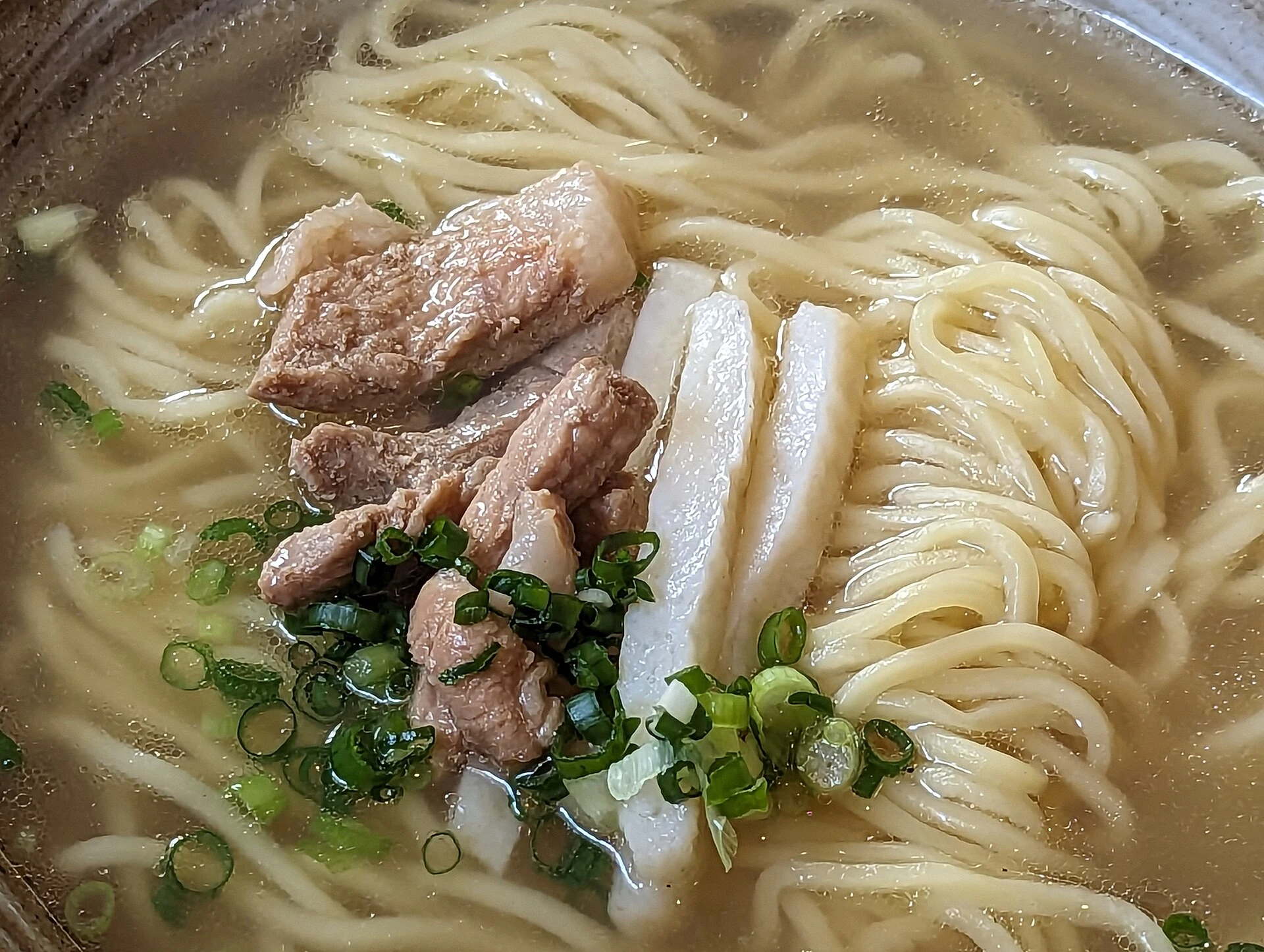
    Despite the name, Okinawa soba is made with wheat rather than buckwheat. The Ministry of Agriculture’s dish guide describes pork-and-bonito broth and toppings including pork belly, fish cake and spring onion. Soki refers to the pork-rib topping; it is not simply another name for every bowl of Okinawa soba.

    A bowl of Okinawa soba in Yamabare with wheat noodles, pork, fish cake and chopped spring onion
    Okinawa soba with pork and spring onions

    Choose the topping before adding sides. A bowl with a rice accompaniment may already be enough for lunch, especially if you want an afternoon snack. Ask whether a smaller bowl is available for a child or a lighter appetite. Add condiments after tasting: koregusu is chilli steeped in awamori, so check it if you avoid alcohol or strong seasoning.

    Goya champuru and other stir-fries

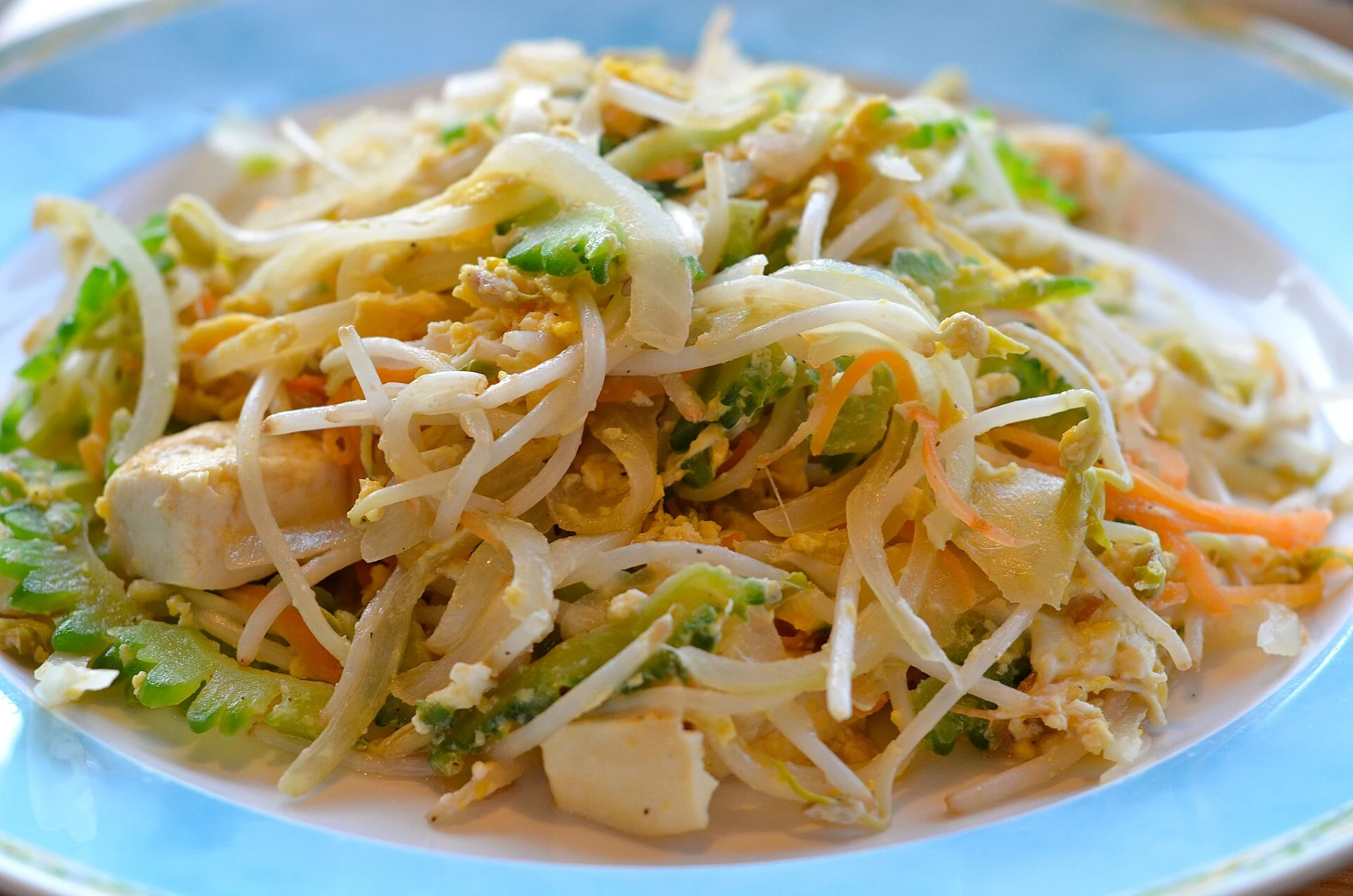
    Goya is bitter melon, with a flavour that deserves its name. In champuru, it is stir-fried with other ingredients rather than served as a plain vegetable side. The official island-vegetable guide introduces goya and other ingredients you may see on menus.

    Goya champuru with sliced bitter melon, tofu, egg and bean sprouts at Yumenoya in Ishigaki
    Goya champuru with tofu and egg

    If your group is curious about the bitterness, share a plate before making it everyone’s main meal. Ask about a tofu or other vegetable variation if you prefer a different centrepiece. A vegetable name does not establish a vegetarian recipe: ask about the meat, stock and seasoning in the actual stir-fry.

    Rafute and Agu pork: a dish versus an ingredient

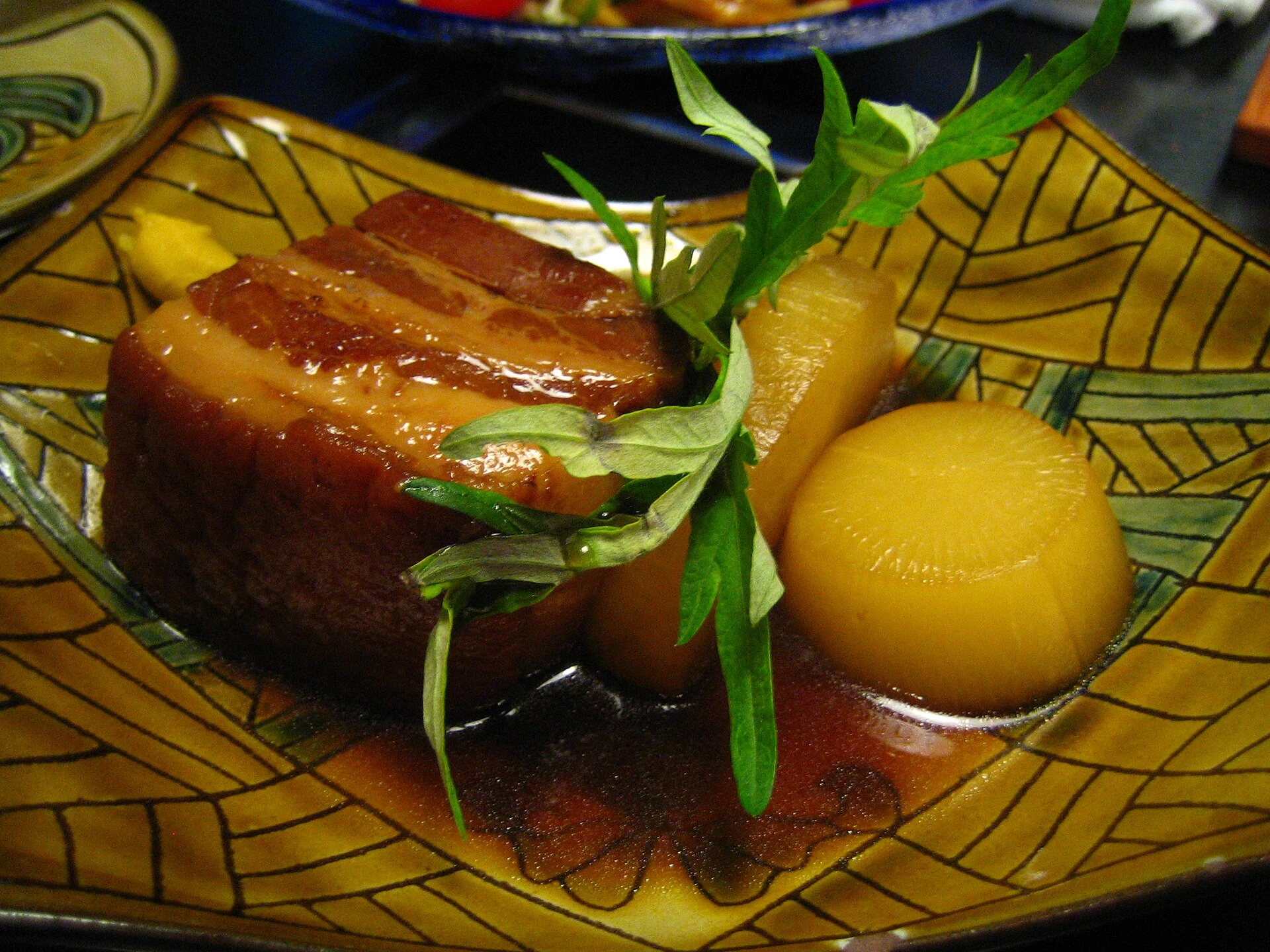
    Rafute is slowly simmered pork, traditionally cooked with ingredients such as soy sauce, sugar and awamori. MAFF’s rafute guide explains the preparation. It is a useful shared choice when your table wants something soft and rich alongside vegetables or seaweed.

    Glossy pieces of rafute braised pork belly with vegetables in a patterned ceramic bowl
    Rafute braised pork belly

    Agu identifies a pork speciality, rather than one particular recipe. The official premium-meat guide describes it in preparations including shabu-shabu. Do not assume every plate of rafute uses Agu. If the breed matters to you, look for it explicitly on the menu and confirm which course or cut you are buying.

    Okinawa taco rice

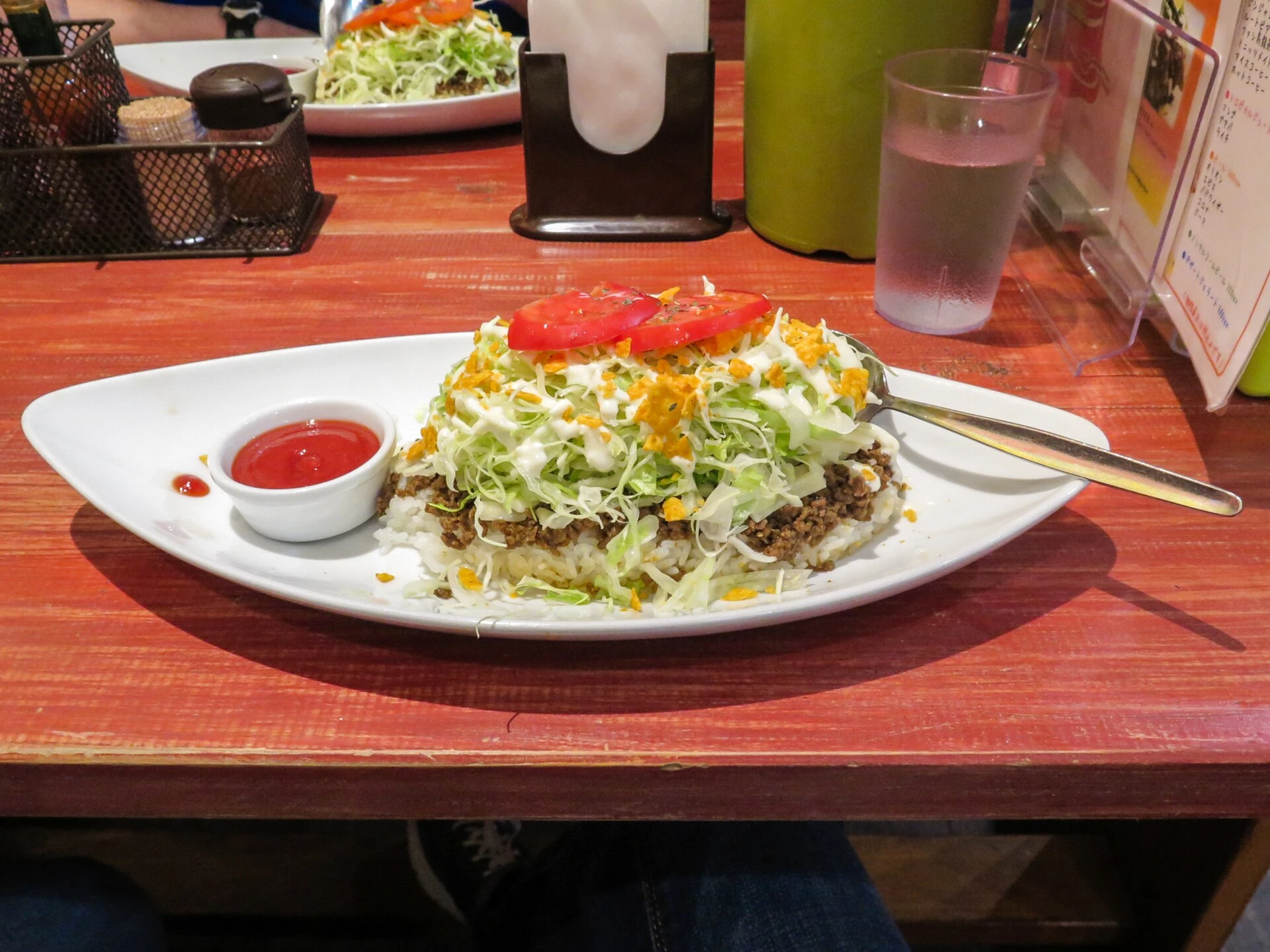
    Taco rice puts taco-style meat and other toppings over rice. The official tourism itinerary introduces it as an example of Okinawa’s blended food culture. It suits a straightforward lunch when you want a different flavour from noodle soup.

    Taco rice with minced meat, shredded lettuce, cheese and tomato, with sauce on the side in Chatan
    Taco rice with lettuce, cheese and tomato

    Read the option names carefully. Meat, cheese, vegetables, egg and sauces may form separate combinations, so the lowest listed price may not buy the fully topped plate in a photograph. Ask for spicy sauce separately if that suits your group, and check the portion before ordering extra sides. This guide helps you choose the dish; a restaurant’s current menu determines the exact version.

    Jushi: the rice accompaniment worth noticing

    Jushi, also written juushii, can refer to more than one rice preparation. MAFF distinguishes mixed-rice and porridge styles. That is useful when a menu translation simply says “Okinawan rice.”

    Ask whether the serving is a small side, a set accompaniment or a bowl in its own right. Check the stock and added ingredients if you avoid meat or fish. Ordering one rice-and-noodle combination thoughtfully can be more satisfying than treating every component as a separate full meal.

    Pork-and-egg onigiri for a simpler stop

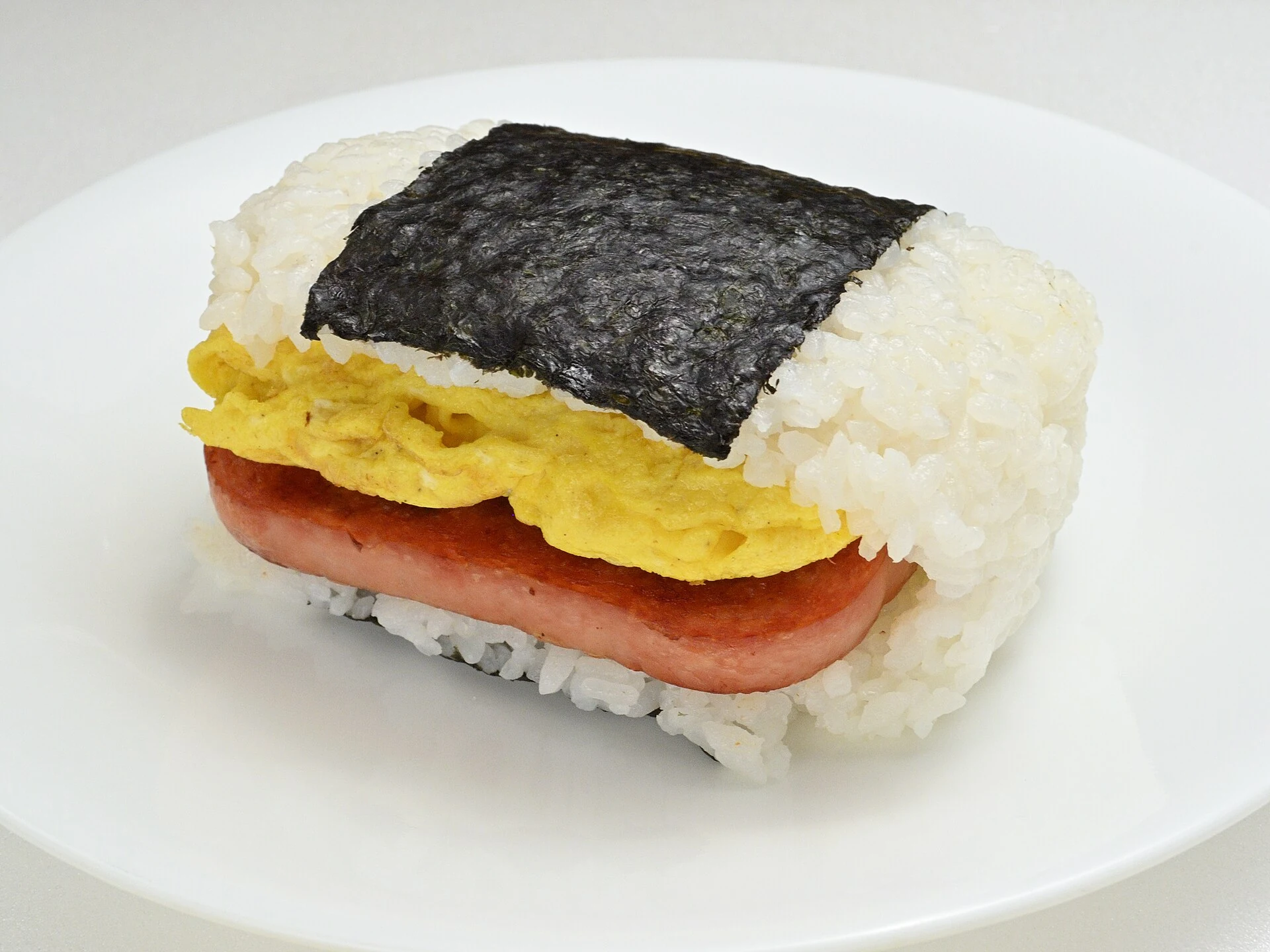
    Pork-and-egg onigiri combines luncheon meat and egg with rice and nori. Potama’s own introduction describes the rice-sandwich format; different shops and branches offer different fillings.

    A pork-and-egg onigiri sandwich with luncheon meat and egg between rice and a strip of nori
    A pork-and-egg onigiri sandwich

    It is a practical breakfast or takeaway choice when you want to keep the morning flexible. Select the branch as well as the filling: the operator’s menu separates shared items from branch-specific versions. A photograph of a sandwich elsewhere is not a promise of a particular brand’s ingredients or portion.

    Tofu, sea grapes and small plates to share

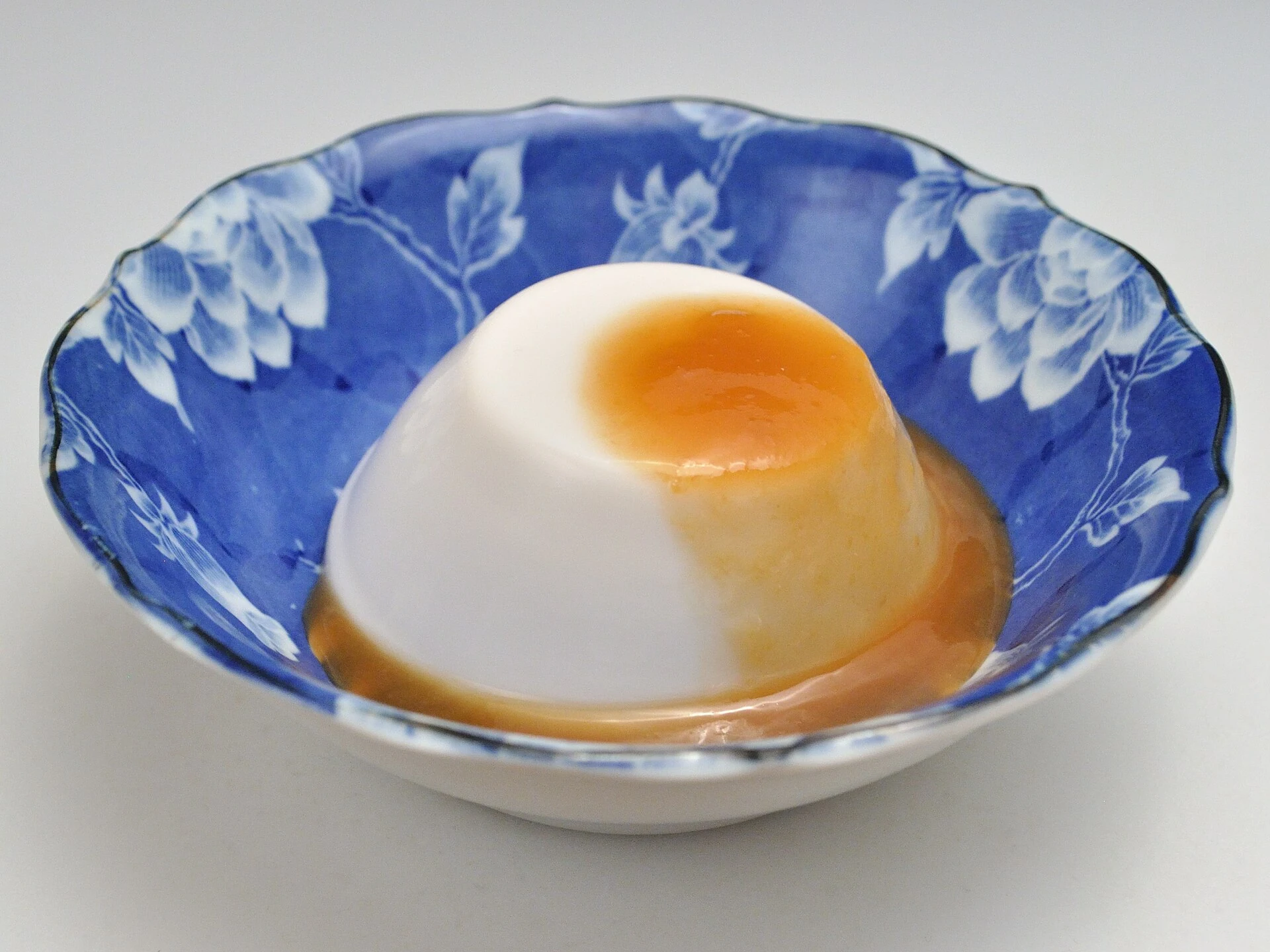
    Jimami tofu: peanut tofu with a smooth texture

    Jimami tofu is made from peanuts and starch. Its name can be misleading if you expect ordinary soy tofu. MAFF’s jimami tofu page describes its ingredients and the sauce served with it.

    A pale mound of jimami peanut tofu topped with amber-coloured sauce in a blue ceramic dish
    Jimami peanut tofu with sauce

    Try it as a small plate if you like smooth textures. It may come with a savoury-sweet sauce, rather than being offered only as dessert. It contains peanuts; explain any ingredient restrictions before ordering and include the sauce in that conversation.

    Umibudo and mozuku: two different seaweed experiences

    Umibudo, or sea grapes, have tiny beads that pop as you eat them. The official seafood guide describes them as an edible seaweed found in markets and restaurants, including salads and rice dishes.

    Mozuku offers a different, softer seaweed texture. For a simple introduction, look for a small side or soup and ask how it is seasoned. Our opening set-meal photograph includes mozuku; it illustrates how a small portion can sit alongside a main dish. If you are choosing plant-based food, ask about dressings and stock rather than relying on the seaweed itself.

    Island tofu and a wider Ryukyuan meal

    Shima dofu is firm island tofu, while yushi dofu is a softer preparation. MAFF’s Okinawa introduction explains the distinction. These names are worth recognising when comparing a tofu-centred meal with a dish that merely contains some tofu.

    For dinner, a useful starting combination is one tofu dish, one vegetable plate and a main such as rafute or cooked fish, with rice if wanted. Confirm serving sizes with the restaurant. A course can be another way to explore the cuisine, provided you check the menu, number of diners, substitutions and price before reserving.

    Okinawan sweets and drinks for the gaps between meals

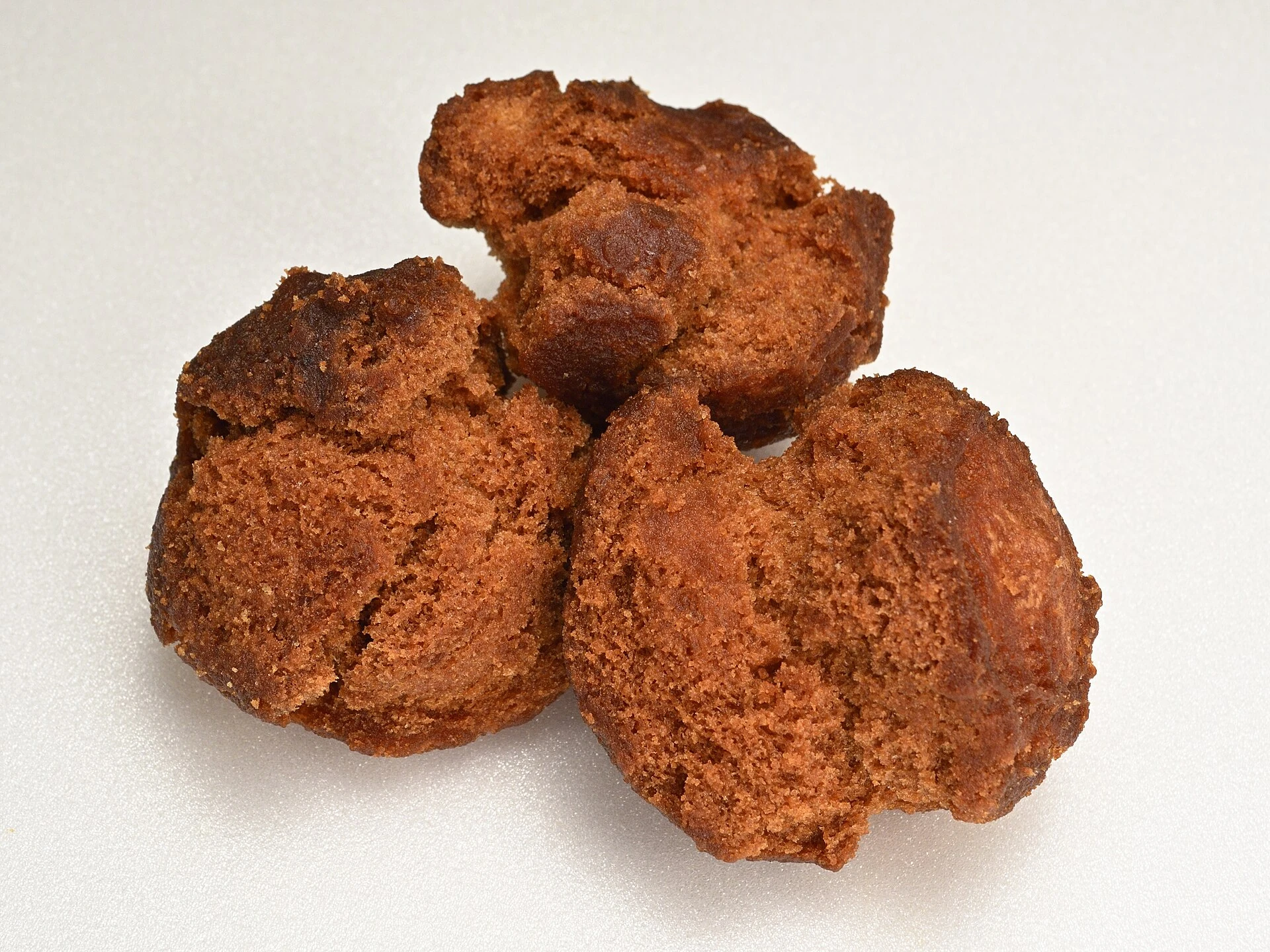
    Sata andagi

    These round fried doughnuts have a characteristic split surface. MAFF’s sata andagi introduction describes a flour, egg and sugar dough, with variations in flavour. Buying a small amount lets you try one without displacing the next meal.

    Three brown-sugar sata andagi doughnuts with their characteristic cracked surface
    Brown-sugar sata andagi doughnuts

    Ask what has just been prepared and which flavours are available. If you are buying a bag to take away, check the maker’s storage and best-before guidance; a fresh snack and a packaged souvenir are different purchases.

    Beni-imo sweets and island fruit

    Beni-imo is purple sweet potato, used in sweets such as tarts. Okashigoten’s tart story gives a producer’s view of the speciality. Read the product label when comparing baked tarts, chilled desserts and frozen versions; they need different handling.

    Fruit is another good way to vary a sweet stop. The official island-fruit guide introduces shikuwasa, pineapple and mango. It lists mango season as June–August. A mango-flavoured dessert available in another month does not necessarily mean fresh local mango is being harvested then.

    Tea, citrus drinks and awamori

    Ask for the drinks list rather than assuming every local speciality is alcoholic. Potama’s menu, for example, lists sanpin tea alongside other drinks. Shikuwasa gives a tangy citrus option in juices and other preparations; ask whether a drink is sweetened if that matters to you.

    Awamori is a distilled rice spirit, rather than brewed sake; the official awamori introduction explains its production. If you choose an alcoholic drink, arrange your onward travel without driving. Alcohol can also appear in cooking and condiments, so mention avoidance when discussing a meal.

    Where to find local food around Naha and the coast

    Choose an area that fits your day before choosing a restaurant. A meal within walking distance of your Naha accommodation serves a different purpose from a destination lunch during a northern drive. The following are planning areas, not a ranking of restaurants or a claim that every venue serves every dish.

    AreaA useful food planWhat to check
    Naha: Kokusai Street and MakishiA market visit, noodle lunch, sweets or a dinner of shared dishes.The actual shop, kitchen hours and market closure date.
    Chatan / American VillageA meal alongside a coastal visit; compare taco rice, rice snacks and other menus.Branch address, seating and queues for your chosen time.
    Onna and the west coastKeep lunch close to the coast stop or accommodation you already use.The last order and return transport; avoid a long detour for a short snack.
    Nago / Motobu / the northern routeChoose one lunch area around your main attraction, leaving optional snacks flexible.Map the restaurant separately from the attraction and allow parking time.

    A walkable Naha starting point

    Makishi Public Market and the nearby shopping streets let you build several food choices into a compact visit. Save the market location rather than a general pin for Kokusai Street. A specific example nearby is Potama’s Makishi Market branch, which publishes its own address and hours; it is a separate business from the market itself.

    If you are exploring without a vehicle, our Okinawa without a car guide helps with the wider transport plan. You can leave a northern restaurant for another day rather than interrupting a good walking route.

    Chatan, Onna and northern stops

    The official main-island itinerary includes food options in American Village, such as taco rice and pork-and-egg rice snacks. For a northern sightseeing day, select lunch near the attraction that gets most of your time. A meal around Motobu suits an aquarium day more naturally than a return to Naha solely for lunch.

    Our Churaumi Aquarium guide and Kouri Island guide help you judge how much room remains for a meal. A cafe photograph with an ocean view should not dictate the route until you have checked the actual address, opening day and kitchen service.

    How to eat at Makishi Public Market

    The rebuilt Naha City First Makishi Public Market under a blue sky in July2023
    Makishi Public Market beneath a blue sky

    The market’s mochiage, or carry-up, system lets you buy suitable ingredients on the first floor and have them cooked at a second-floor restaurant. Use the market’s own explanation rather than assuming a single all-inclusive price.

    1. Ask before purchasing. Confirm that the ingredient can be carried upstairs, how it will be prepared and which restaurant will cook it.
    2. Agree the food cost. Clarify the quantity, any weight-based price and the full ingredient total with the vendor.
    3. Agree the cooking cost separately. The market says preparation charges vary with the cooking method. Ask about rice, soup, drinks and any other extras too.
    4. Pay in the appropriate places. Ingredients are paid for at the shop; cooking is paid for at the restaurant.

    You can also choose a restaurant’s normal menu if you would prefer a simpler order. A market visit does not require buying a large seafood selection. Ask before taking close photographs of stalls or people, and keep the working aisles clear.

    Hours, last orders and closure days

    The official market website lists building hours of 08:00–22:00, varying by shop. It gives 19:45 as the last order for cooking eligible first-floor carry-up ingredients, and 20:00 for second-floor restaurants. Those last orders matter more to a dinner plan than the building’s closing time.

    The regular closure is the fourth Sunday of each month, except December; New Year, Lunar New Year and Obon arrangements can vary by shop. Check current notices for your date. The address is 2-10-1 Matsuo, Naha; the operator gives approximately nine minutes on foot from Makishi Station. Our suggestion is to leave 60–90 minutes for browsing and a straightforward meal, with more time for queues or a leisurely carry-up lunch.

    How to budget and order without surprises

    Compare the whole order, not the first number

    For a diner meal, check whether the listed item includes rice, soup and sides. For a course, check the price per person, the required number of diners and drinks. For an izakaya, ask about any seating, cover or small appetiser charge before settling in. A headline booking price needs its exact branch, date and course to be useful.

    As one menu reference, Potama’s current standard sandwich page listed ¥450 including tax when checked on October 17, 2026. Delivery prices differ. Compare the actual branch and filling; an older downloadable menu can show a different price from the live product page.

    A concrete souvenir example: Okashigoten’s official shop listed its standard room-temperature beni-imo tarts at ¥648 for three and ¥1,296 for six, including tax, when checked on October 17, 2026. These are product prices, not a typical restaurant bill; delivery charges and other products differ. Check the current label and price when buying.

    For everyday meals, build your budget from the actual menu instead of treating an old blog’s price as a quote. Keep a small cash option and confirm accepted payments with the particular business. A reservation, a table request and a prepaid course can have different cancellation conditions.

    Ask about ingredients in the dish, broth and sauce

    Useful questions are specific: “What is the soup stock made from?”, “Does this contain pork, fish or peanuts?” and “Can the sauce be served separately?” Give the restaurant your restrictions in writing if that makes the conversation clearer.

    Menu wordingUseful follow-up
    Okinawa sobaAsk about wheat noodles, stock, fish cake and the chosen pork topping.
    Tofu or vegetable dishAsk about meat, bonito seasoning, broth and sauce.
    Jimami tofuIdentify peanuts explicitly and discuss the accompanying sauce.
    Taco riceConfirm meat, cheese, egg, dressings and sauce rather than relying on a photograph.
    SweetsRead the actual product’s ingredients and storage instructions.

    For vegetarian, vegan, halal or other dietary requirements, look for a venue that can confirm the complete preparation. Removing a visible topping does not change the stock already used. For food allergies, ask the restaurant about ingredients and preparation before ordering; a menu name or online photograph cannot answer those questions.

    How to build food stops into your sightseeing day

    Choose one meal that matters most, then keep the other stops flexible. Our suggested combinations below spread the different dishes across a trip, without asking you to eat a full lunch at every stop.

    Your dayA balanced starting planKeep flexible
    Naha on footA simple breakfast → market browse and lunch → small sweet stop → shared Okinawan dinner.Choose either a substantial market lunch or a separate full noodle meal.
    Chatan or the west coastBreakfast near your hotel → taco rice or a local diner lunch → a coastal drink break.Skip the extra cafe if it adds a long detour.
    Aquarium / northern dayBreakfast before departure → one planned lunch area near the main visit → an optional sweet stop → dinner near your overnight base.Allow the attraction its time; keep a second lunch choice in the same area.

    Our three-day Okinawa itinerary puts these areas in a wider trip. Before leaving the hotel, check opening days and last orders, save the exact address and decide which stop you would drop if the morning runs late.

    If your group is already planning a private sightseeing journey and wants a particular lunch stop, send OkinawaVia the restaurant name, hotel and preferred time. Allow for parking, queues and meal time within the agreed service hours. Restaurant reservations, dietary suitability and meal costs should be confirmed separately; the private driver guide explains the transport arrangements.

    Okinawa food FAQ

    What food is Okinawa famous for?

    A useful first selection is Okinawa soba, goya champuru, rafute, taco rice, jimami tofu and umibudo. Add sata andagi or a beni-imo sweet if you want dessert. Choose a few across your meals rather than trying to fit every dish into one sitting.

    Is Okinawa soba made from buckwheat?

    The traditional noodles described by MAFF use wheat instead of buckwheat. Confirm the ingredients of the actual bowl if you have a dietary restriction, including the broth and toppings.

    Is Okinawan food vegetarian?

    There are vegetables, tofu and seaweed to explore, but a vegetable or tofu dish can include meat, fish stock or animal-based seasoning. Choose a venue that can confirm your requirements and ask about the complete preparation.

    What is the difference between jimami tofu and ordinary tofu?

    Jimami tofu is made with peanuts and starch. Shima dofu and yushi dofu are soy-based tofu preparations. Check the serving and its sauce separately, especially when explaining an allergy or other restriction.

    Can you eat at Makishi Public Market in the evening?

    Check the particular restaurant and current market notices. The market lists second-floor last orders at 20:00 and eligible carry-up cooking last orders at 19:45, even though its general building hours extend later. The fourth Sunday is normally a closure day except in December.

    How much does the market’s carry-up cooking cost?

    The official guide says ingredients and cooking are paid for separately, and the cooking charge varies with the preparation. Ask for the ingredient total, cooking total and extras before purchasing. A single price quoted in an older travel article is not a complete bill.

    Do you need a car to try Okinawa food?

    You can plan a varied first introduction around Naha on foot, with transport to your chosen neighbourhood. For coastal or northern meals, fit the food stop into an existing route and plan the return. You do not need a separate island-wide restaurant trip to start enjoying the cuisine.

    ABOUT THIS GUIDE

    Prepared by OkinawaVia for English-speaking visitors. Official practical sources checked October 17, 2026. This is an editorial planning guide, without a claim of personal dining visits. Restaurant menus, prices and operations can change. Sources are linked beside the relevant information; photograph captions identify authors, licences, dates and adaptations. No restaurant ranking, review score or guaranteed reservation is implied.

  • Kouri Island Things to Do: Bridge, Beaches and Ocean Tower

    Kouri Island Things to Do: Bridge, Beaches and Ocean Tower

    Cross Kouri Bridge with blue water on either side, then leave time for the island beyond the bridge. This guide helps you choose a beach, find the viewpoint you actually want and fit Kouri into a comfortable northern Okinawa day.

    For Kouri Island things to do, start with the bridge, beach views and a realistic route through northern Okinawa. Choose stops to suit your group rather than filling every hour.

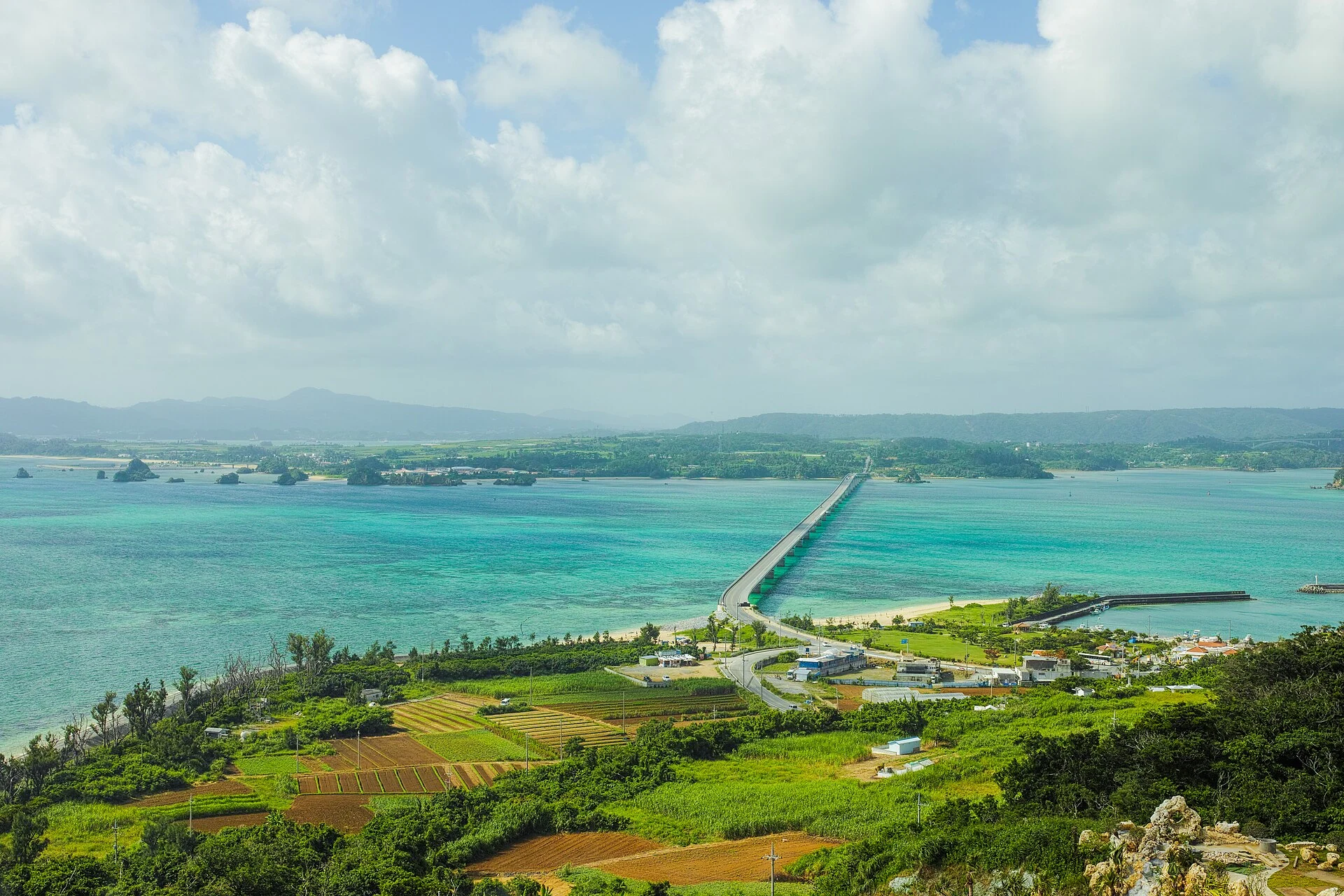
    Kouri Bridge stretching across turquoise water toward Yagaji Island, viewed from the Kouri Ocean Tower area
    Kouri Bridge above turquoise water

    A BRIDGE, THREE AREAS TO EXPLORE

    For a first visit, our suggestion is 3–4 hours on Kouri Island for a beach walk, Ocean Tower, a north-coast stop and a meal. For a brief introduction, allow 60–90 minutes around the bridge and Kouri Beach. These are editorial visit allowances; add the journey from your hotel separately.

    Practical sources checked on October 16, 2026. Photographs are licensed documentary images from the dates given in their captions. This is a planning guide, rather than an account of our own visit.

    Where is Kouri Island, and how long should you stay?

    Kouri Island, also written Kourijima, belongs to Nakijin Village in northern Okinawa. You reach it by road through Yagaji Island, so a visit does not require a ferry booking. Its compact size makes a short sightseeing stop possible, while a longer visit lets you explore the shore, viewpoints and places to eat at an easier pace.

    The official Okinawa destination guide describes a drive around the island of about 15 minutes. Treat that as a description of the loop, rather than a complete sightseeing itinerary. Parking, walking down to a beach, visiting the tower and having lunch take additional time.

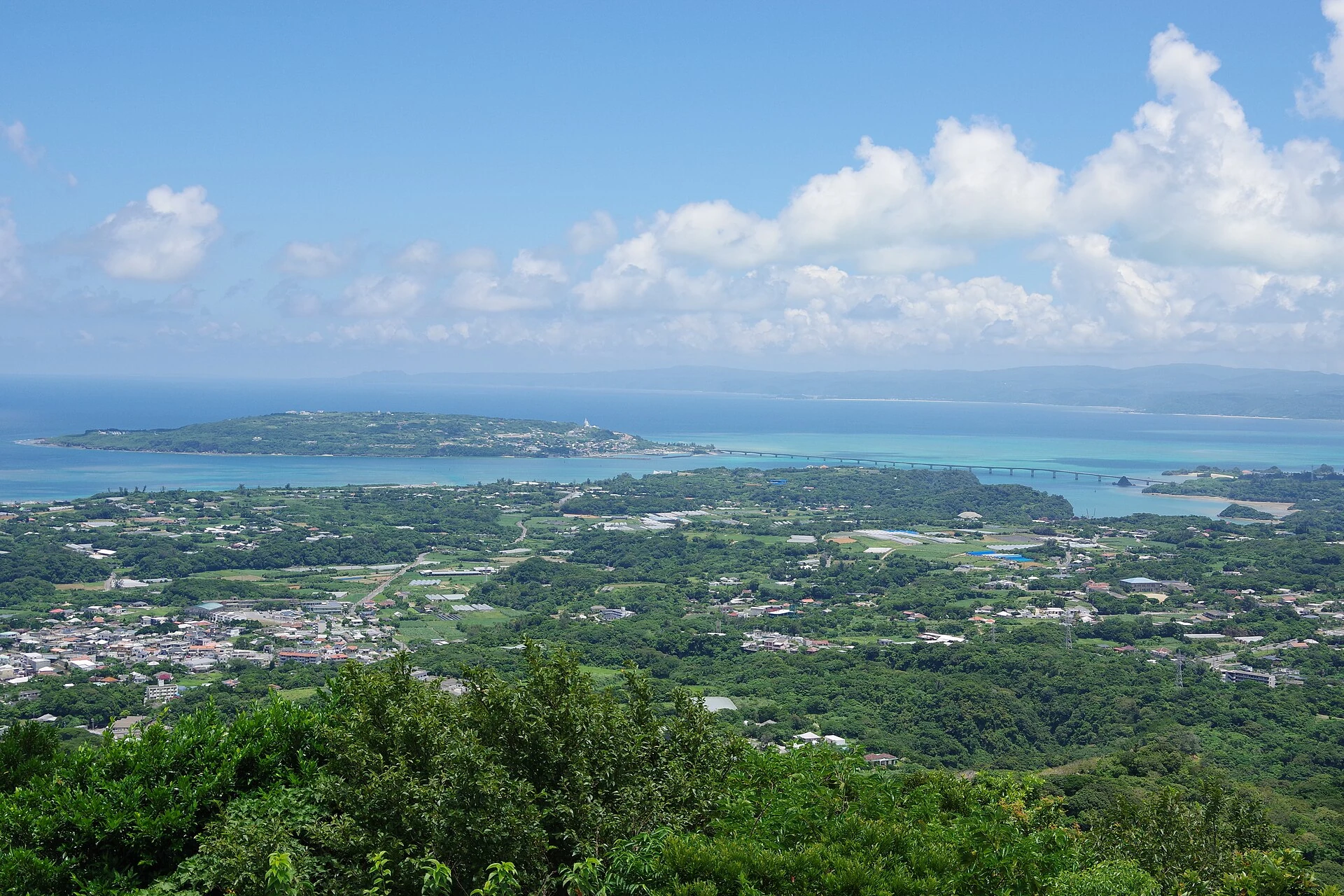
    Kouri Island and the long Kouri Bridge in the distance, seen across northern Okinawa from Mount Oppa in August 2024
    Kouri Island and its bridge from Mount Oppa
    Time available on and around the islandA reasonable focusWhat to leave for another visit
    60–90 minutesBridge scenery, Kouri Beach and a short refreshment stop.The tower and north-coast beaches.
    About 3–4 hoursA beach walk, the tower, Heart Rock and a meal, adjusting the order to your transport.A long swim or several additional attractions.
    Most of a day from a northern baseA slower island visit, a booked marine activity or an extended meal, with a flexible return.An ambitious circuit of distant Okinawa sights.

    These are our planning suggestions. A party with a stroller, limited mobility or a long lunch will need a different pace. If you are starting in Naha, the driving or bus journey belongs outside these visit blocks.

    Save the south, southeast and north as separate places

    A map pin for “Kouri Island” is too broad for meeting a driver or choosing a bus stop. Save the places you want to visit individually. The following orientation table links to map searches; confirm the specific entrance or parking area when you arrive.

    AreaPlaces to saveWhy it matters
    South: the bridge entranceKouri Beach and Sorahashi.A practical starting area for the beach, food and the named Sorahashi bus stop.
    Southeast: the elevated viewpointKouri Ocean Tower.A separate paid attraction with its own entry route.
    North: rock formations and natural shoreHeart Rock at Tinu Beach and Tokei Beach.Different beach access points, rather than an extension of the bridge-side beach.

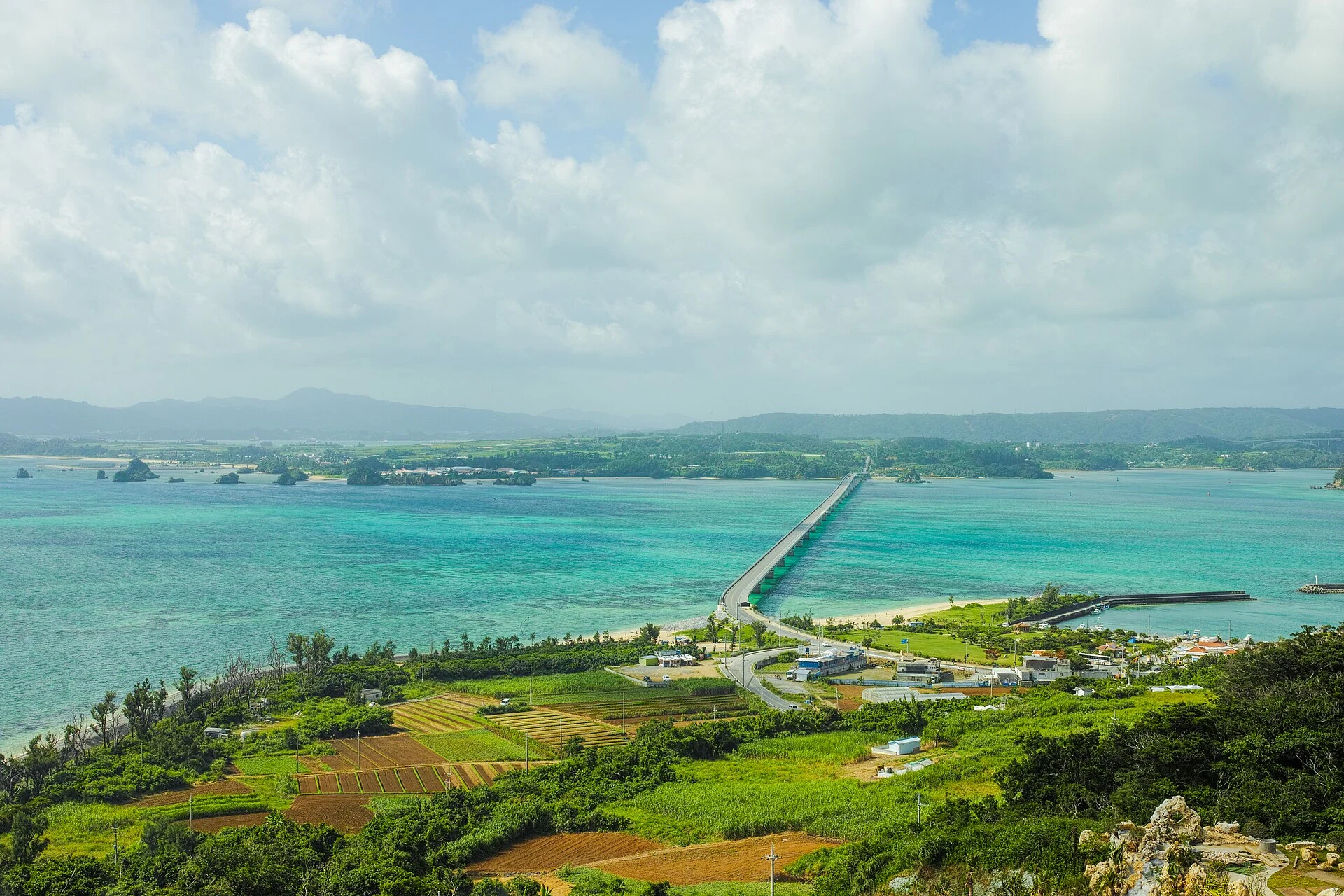
    Kouri Bridge: crossing the water and choosing a viewpoint

    The bridge links Yagaji Island with Kouri Island. Sorahashi’s visitor information gives its length as 1,960 metres and dates its opening to 2005. You can enjoy the changing colour of the water during the crossing, then look back at the bridge from the island shore.

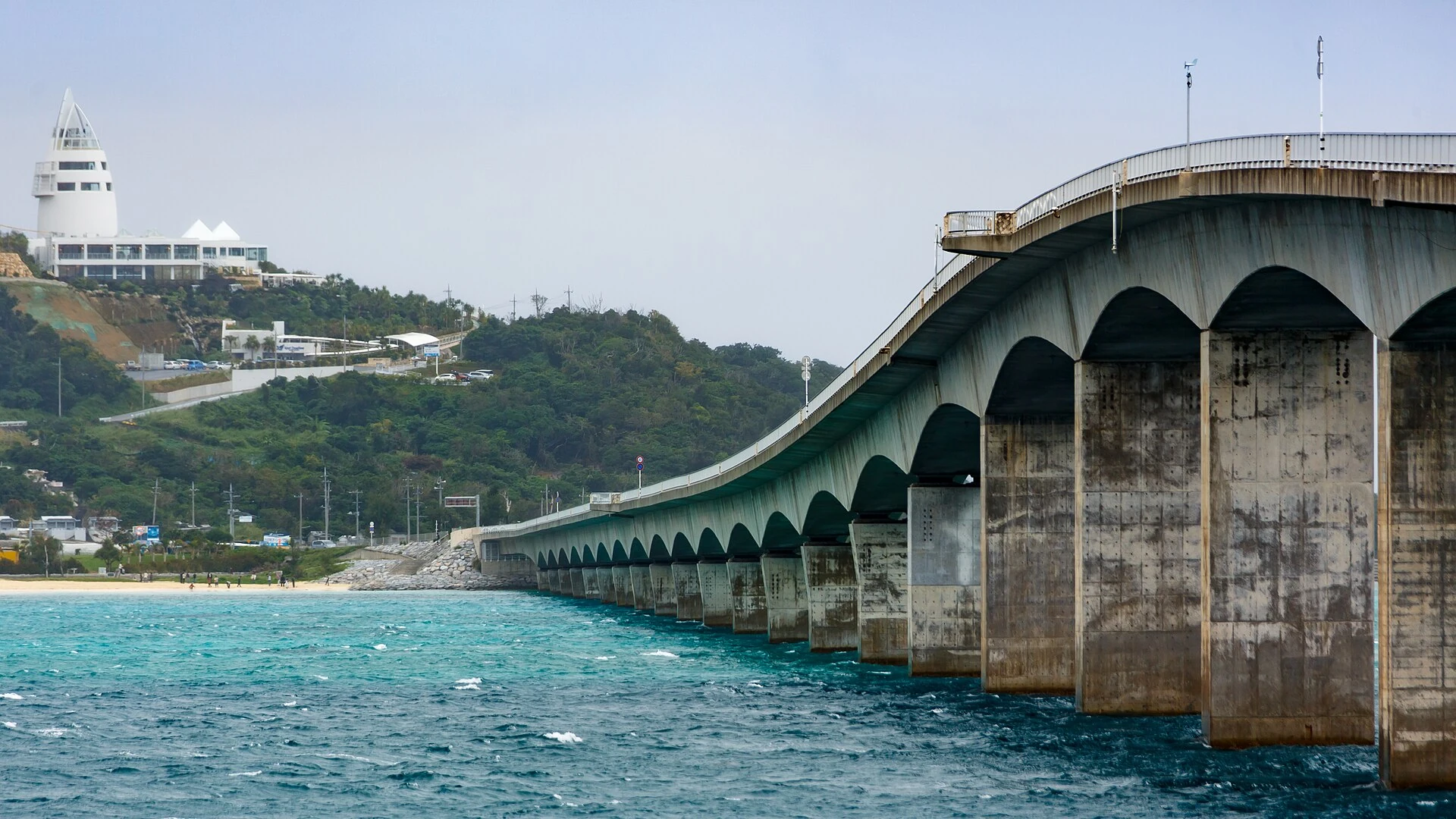
    The concrete arches of Kouri Bridge above clear turquoise sea, with Kouri Ocean Tower visible on the island hillside
    Kouri Bridge seen from the shore

    Decide whether you want a beach view or an elevated panorama

    From the beach area, the bridge is close and the water fills much of the scene. From Ocean Tower, you look down across a much larger sweep of coast. A tour photograph taken from the tower should not lead you to assume that an ordinary beach stop includes admission to that viewpoint.

    Tell a driver which angle interests you. For a bus tour, read the stop list rather than relying on the destination name. A short stop described simply as “Kouri Island” may give you time only near the bridge.

    Build photographs around a proper stopping place

    Arrange to park and continue on foot to an appropriate public viewpoint. Keep the crossing for travelling and use a passenger to take any photographs from inside the vehicle. Do not plan a roadside pause in a traffic lane to recreate a photograph.
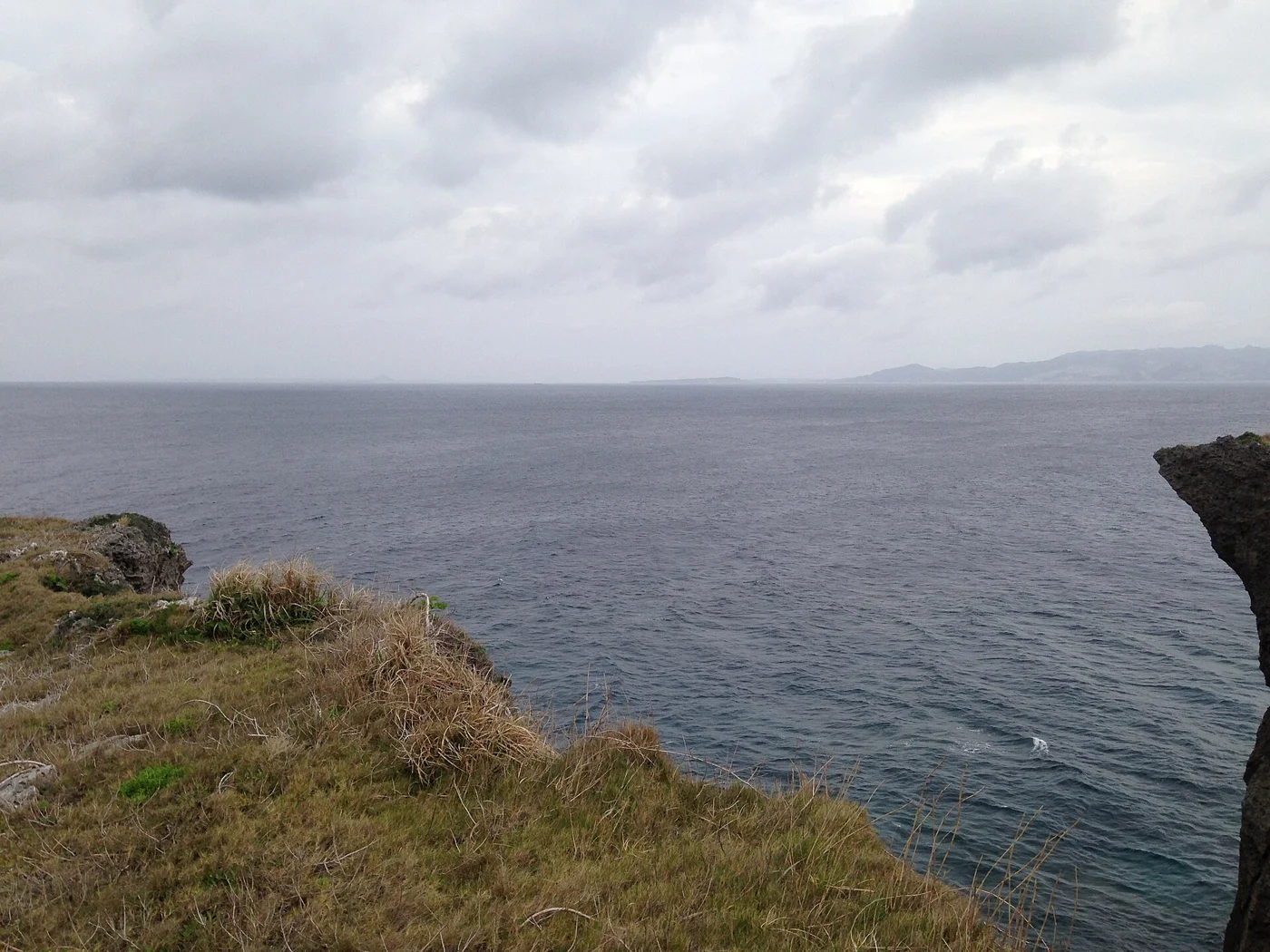
    For the beach photograph, allow time to walk, look at the light and return to the vehicle. Weather and water conditions change the colours; a photograph of bright blue water is a record of one day, rather than a forecast for your own trip. A cloudy day can still be worthwhile for the landscape, without promising the same result.
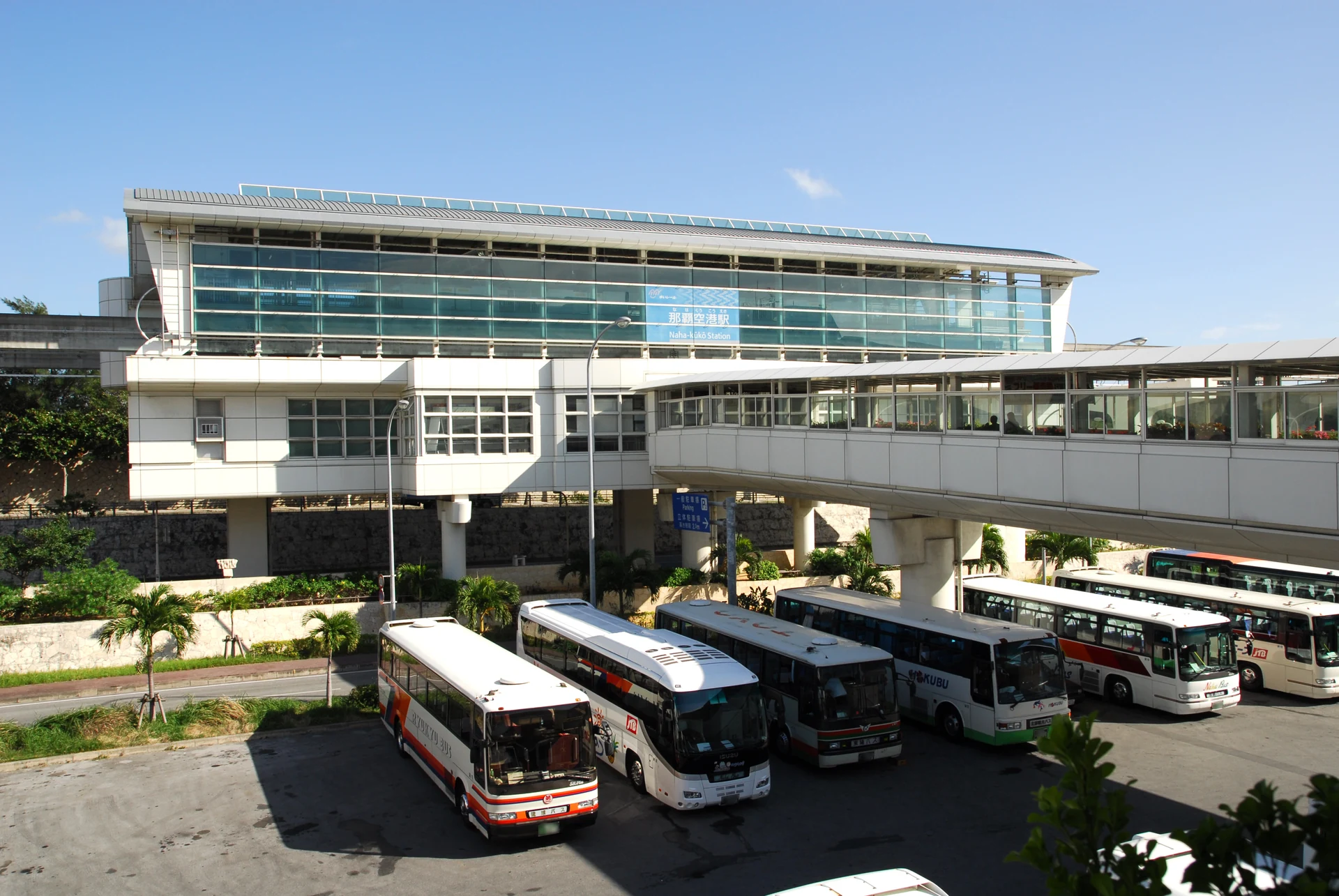
    Kouri Island beaches: choose the shore that suits your visit

    Kouri Beach: the straightforward first stop

    Kouri Beach is at the island end of the bridge. It works well when you want a beach walk, a view of the crossing and a break near the visitor facilities. Save a more remote cove for a visit with enough time and a clear plan for getting back.

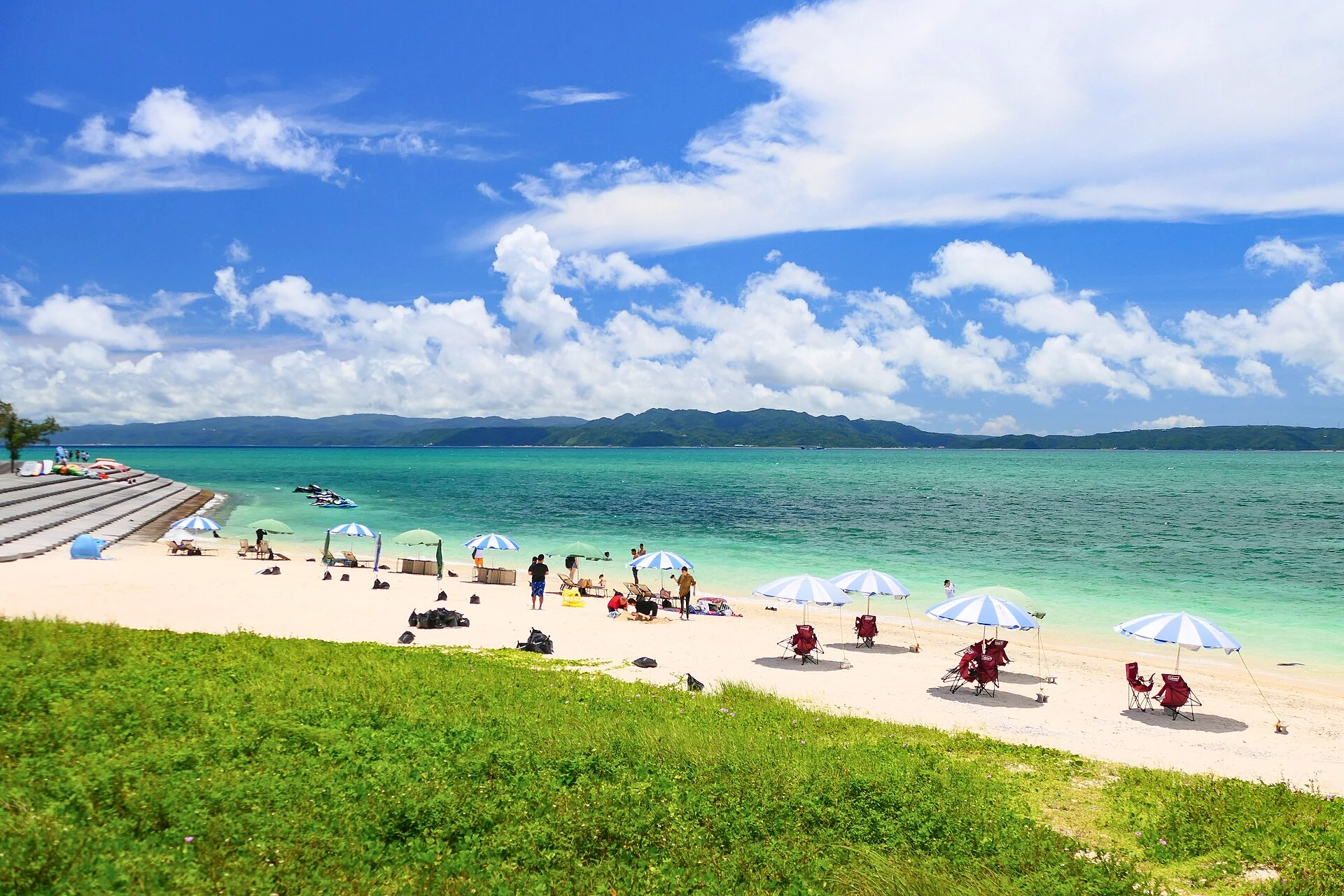
    Kouri Beach on the east side of the bridge, with white sand, beach umbrellas and turquoise water in June 2024
    White sand and clear water at Kouri Beach

    For facilities, the Nakijin Tourism Association’s village guide points Kouri Beach visitors to Sorahashi for toilets and showers. Ask about current availability, charges and operating times before planning to change clothes there. A beach walk and a swim require different preparation.

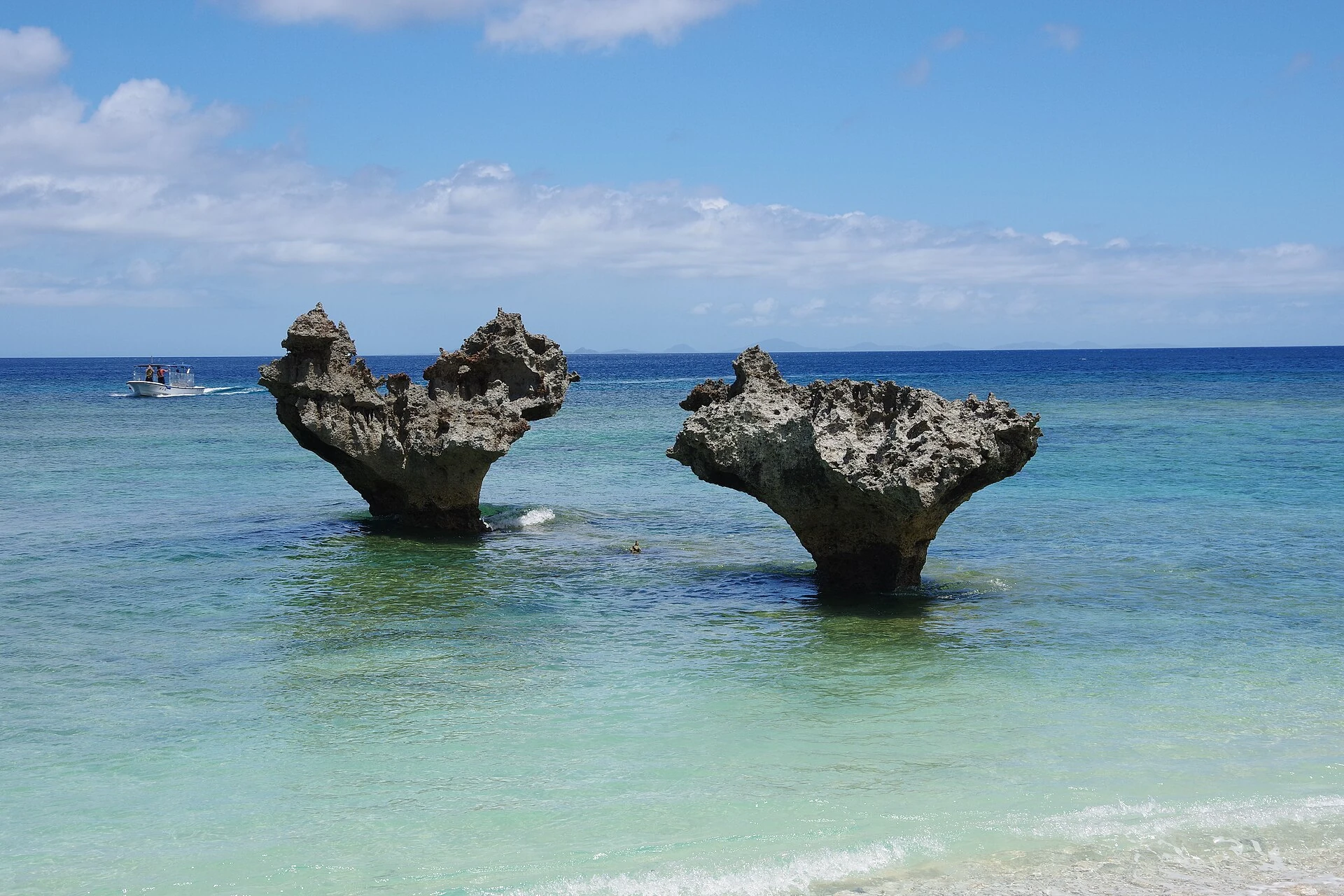
    Tinu Beach and Heart Rock: a separate north-coast visit

    Tinu Beach, sometimes spelled Teenu Beach, is where you find the two formations known as Heart Rock. The shape you see changes with your position and the water around the rocks. Give yourself time to look from the shore rather than treating one precise photograph as the purpose of the whole visit.

    Two heart-shaped rock formations standing in the shallow turquoise sea at Tinu Beach on Kouri Island in June 2020
    Heart Rock at Tinu Beach

    The northern beach access involves a separate walk from the road or parking area. Wear shoes suitable for the approach and keep the meeting location saved. For someone who needs a level route, ask about current access before committing to the walk; the bridge-side area may be a more comfortable alternative.

    Tokei Beach: rock formations and a natural coastline

    Tokei Beach is another north-coast choice. The official destination guide identifies the unusual rock formations around Tokei and Tinu, including circular holes in the rocks. Choose Tokei if observing the coastline interests you, and allow for the approach as well as the time on the shore.

    Keep a flexible itinerary here. Looking at the shore from an accessible point can be enough; there is no need to climb onto rocks or approach breaking waves for a better angle. Private land, ropes and local access signs take precedence over an old route description.
    Peace Beach and quieter coves: decide what you need first

    The official Okinawa guide groups Peace Beach with the northern beaches that lack facilities and lifeguards. A quieter shore can suit a short landscape stop, while a family needing toilets, changing facilities or a supervised swim has different requirements. “Quiet” should not be used as a substitute for checking those needs.

    Swimming and beach facilities: check the actual beach

    The northern beaches are places to appreciate the scenery. Okinawa’s official sea-safety guide advises visitors to swim at beaches with lifeguards and use designated swimming areas. Follow local restrictions and current conditions, and choose a supervised beach or a suitable professional activity provider if swimming is the main goal.

    Check the return bus or meeting time before walking down to a cove. Carry water, take rubbish back with you and leave shells and wildlife where you find them. If the coast is closed or rough, change the plan.
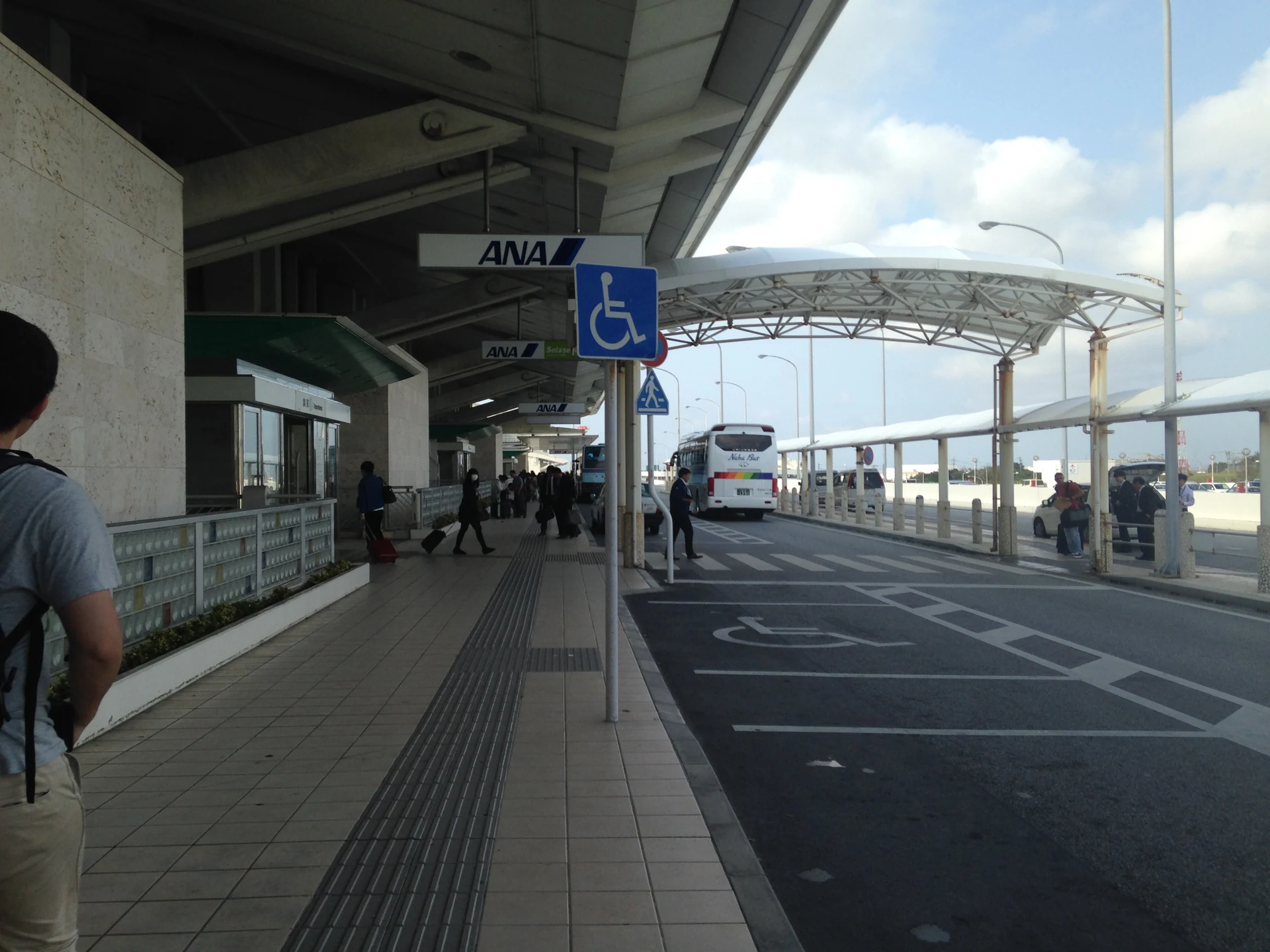
    Kouri Ocean Tower: opening hours, admission and the visitor route

    Ocean Tower provides the elevated view many visitors associate with Kouri. The operator’s tower guide describes indoor viewing floors, an outdoor ocean deck and a cart ride through the grounds. The quoted 82 metres refers to elevation above sea level, rather than the building’s height.

    Current standard prices and hours

    The Japanese facility page lists the following standard information, checked on October 16, 2026. Use current notices alongside it; parts of the English page still display older seasonal schedules.

    ItemPublished standard information
    Opening hours10:00–18:00; last admission 17:30.
    Adult admission, age 16 and over¥1,000.
    Child admission, ages 6–15¥500.
    Children under sixFree under the operator’s published rules.
    Address538 Kouri, Nakijin Village.
    ClosuresNormally open daily; severe weather can change operations.

    For two adults and a child aged 6–15, standard admission totals ¥2,500. Food, transport and optional purchases are separate. Online packages may include a drink or sweets, so compare the inclusions before comparing the price.

    Allow time for the museum and the viewpoint

    Our suggested tower block is 60–90 minutes, with more time for a meal. That is an editorial allowance, rather than a promised queue or visit duration. Arriving close to last entry gives you less flexibility for the full route.

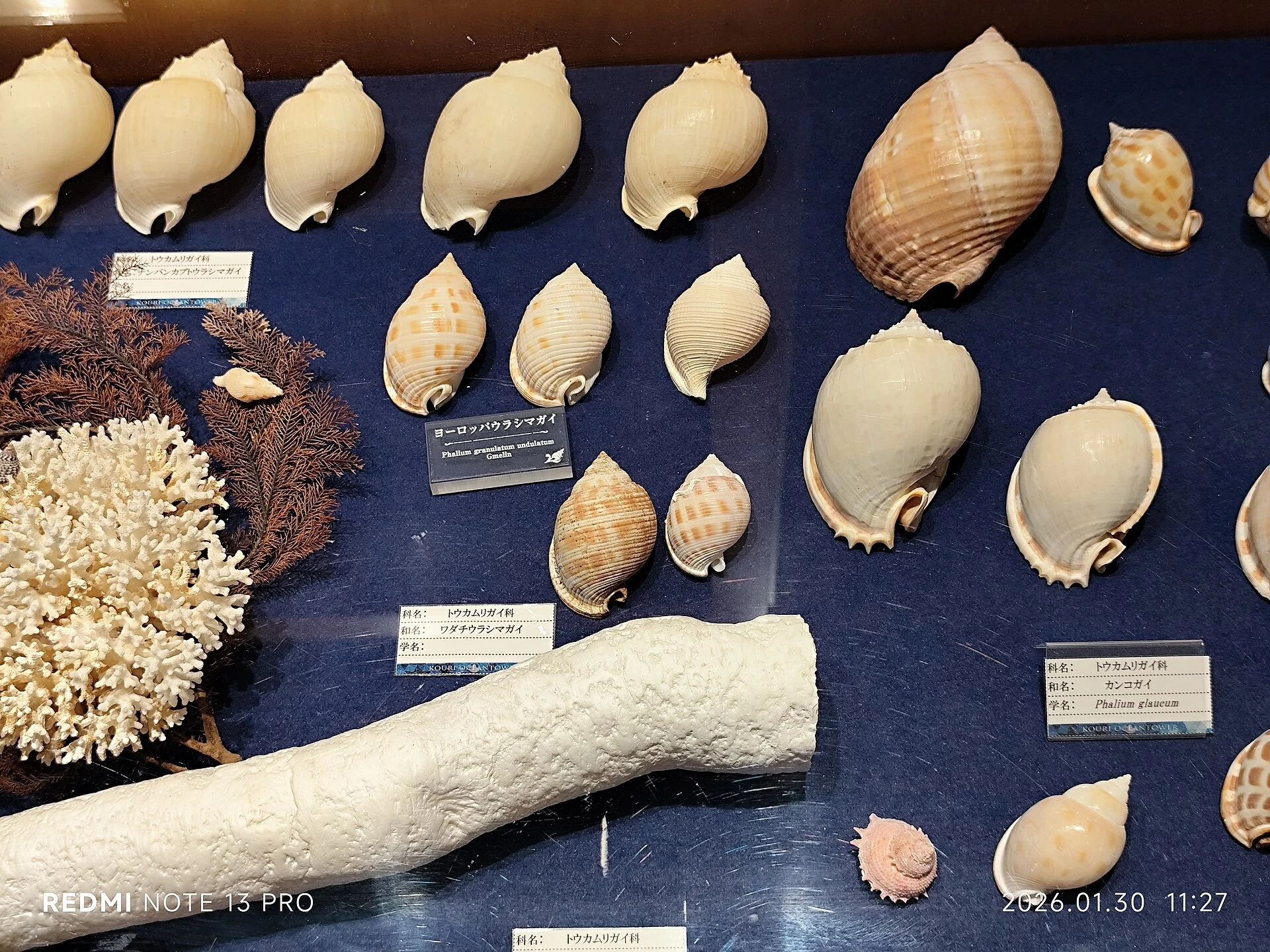
    Labelled seashell specimens displayed in the Shell Museum at Kouri Ocean Tower in January 2026
    Seashell displays at Kouri Ocean Tower

    The operator’s museum page introduces its seashell collection. This gives the visit an indoor element, but the quality of the outdoor panorama still depends on the weather. Check whether the rooftop is operating if that is your priority.

    Steps, transfers and the rooftop

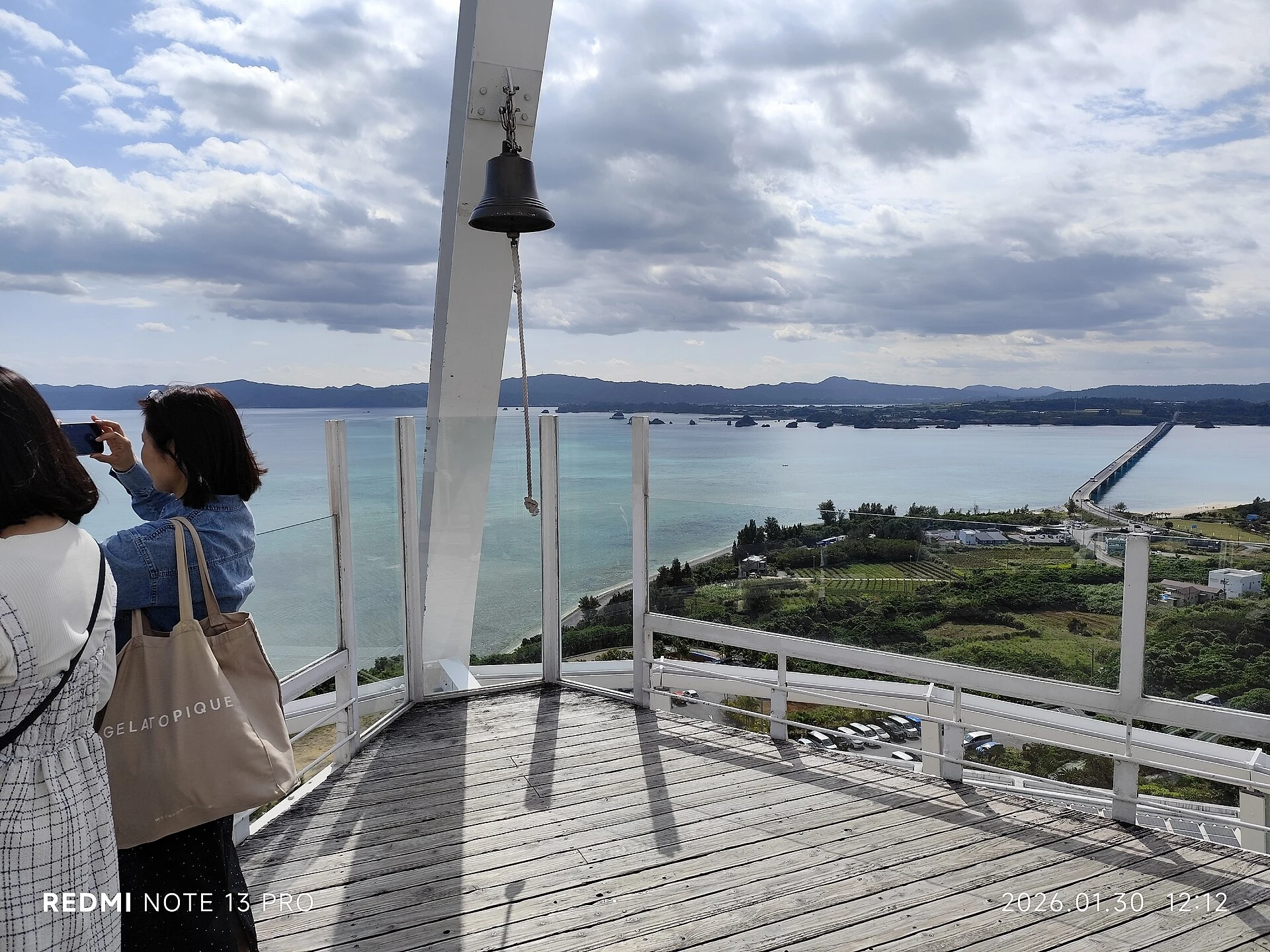
    The rooftop viewing deck and bell at Kouri Ocean Tower, with the sea and bridge beyond, photographed in January 2026
    The rooftop deck at Kouri Ocean Tower

    The facility FAQ identifies a transfer when boarding the cart and stairs to the rooftop; it describes the other areas as barrier-free. Contact the operator about your own mobility requirements, rather than treating the whole attraction as one step-free route.

    The attraction’s carts run within its grounds. They are not vehicles you can rent for travelling to Heart Rock or around the island.

    Getting to Kouri Island from Naha: car, private driver, bus or tour

    Driving and a private driver

    Ocean Tower’s official access page gives approximately 1½–2 hours from Naha using the expressways. This is a reference journey to the attraction. Your hotel location, traffic, breaks and chosen route can change it substantially.

    A rental car suits travellers who want to set their own pace and are comfortable driving. A private driver can make sense when your group prefers to travel together, needs specific pick-ups or wants to agree a route with several distinct stops. For either option, allow a full day from Naha when adding a proper island visit and lunch.

    If you are staying in Onna, supply the exact hotel rather than using a Naha estimate. An island visit from a northern hotel can also be planned differently from one that requires a long journey back to Naha that evening.

    The current local bus route reaches Kouri

    Yanbaru Express operates the Three Islands Line, connecting with its Airport Line at Nakijin Village Office. The operator’s timetable revised November 1, 2025 includes Kourijima-no-Eki Sorahashi, Tokeihama / Heart Rock and Kouri Ocean Tower. Some older visitor pages describe only a bus to Yagaji followed by a long walk; use the bus operator’s current information for this decision.

    1. Plan the northbound connection. Find the Airport Line service from your actual Naha stop and its connection at Nakijin Village Office.
    2. Choose the island stops. Read the Three Islands Line table in the correct direction and distinguish daily services from weekday-only services.
    3. Plan the return before adding stops. Check the island departure, onward connection and final stop near your hotel. Keep time for walking back to the stop.

    Check what the Kouri Pass covers

    The same operator timetable lists a one-day Kouri Pass at ¥1,000. It covers the Three Islands Line and the Airport Line section between Nakijin Castle Ruins and Nakijin Village Office. The journey from Naha is outside that local coverage. Compare the pass with individual fares for the trips you will actually make, and check current purchase and use conditions with the operator.

    For a wider comparison of buses, hotel bases and tours, see our Okinawa without a car guide. Bus timetables can change, and a convenient outward journey does not establish a convenient return.

    When a sightseeing tour is the simpler choice

    A group tour can solve the long-distance transport, but compare the exact Kouri stop, time there, departure point and guide language. An English booking page does not establish that the guide speaks English. Ask whether the option includes the tower, Heart Rock or only the bridge-side area, and whether admission and lunch are included.

    For a tailored route, send OkinawaVia your hotel, date, group size and priority Kouri stops. Ask for a vehicle suitable for your passengers and luggage, the service hours, total quote and language arrangements. Our private driver guide explains what to confirm before booking.

    Where to pause for lunch or a drink on Kouri Island

    Sorahashi near the bridge

    Kourijima-no-Eki Sorahashi brings together food outlets, local produce, refreshments and visitor information near the bridge-side area. It is a useful place to plan a practical break rather than continuing around the island hungry and hoping to find an open kitchen.

    The operator advertises 09:00–19:00 for the facility. Individual outlets and meal service have their own schedules, so check those separately. Its website introduces Okinawan soba and several snack and drink businesses; use the current menus to decide what suits your party.

    The Okinawa tourism listing describes visitor information, a food court, parking and family facilities. When using parking, follow the signs and any current conditions for the particular area you enter.

    A longer break at Ocean Tower

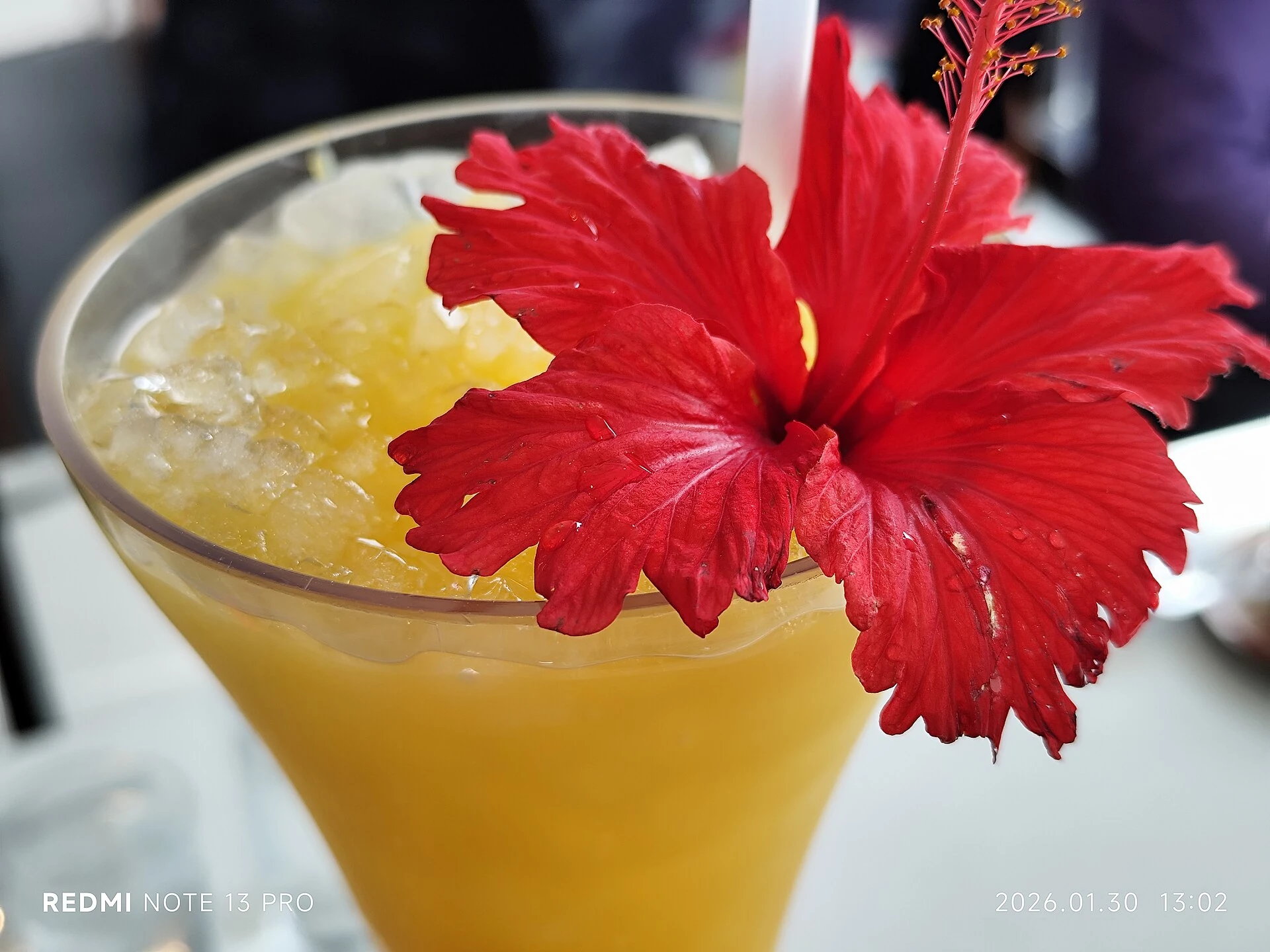
    A mango drink decorated with a red hibiscus at the Kouri Ocean Tower restaurant in January 2026
    A mango drink with a hibiscus flower

    If you prefer to sit down during the tower visit, consult the operator’s restaurant information before arranging your afternoon. Leave meal time outside your sightseeing allowance, especially when your return depends on a specific bus.

    For dietary requirements or allergies, ask the restaurant directly before choosing a dish. Confirm the ingredients, preparation and available alternatives; photographs and an English dish name are not enough to establish suitability. Carry drinking water and allow a simple backup meal if your first choice is busy or closed.

    Kouri Island day-trip routes: a short stop or a northern Okinawa day

    Choose one of these starting plans, then adjust it to your hotel, transport and interests. They are editorial route suggestions, without guaranteed drive times or attraction availability.

    Route ideaSuggested sequenceBest fit
    Bridge and beach introductionCross the bridge → Kouri Beach walk → refreshments → continue your northern route.A 60–90-minute stop when you have a different main attraction.
    Kouri as the main destinationBeach area → tower and museum → lunch → Heart Rock → return.About 3–4 hours on the island, with connections and driving added separately.
    Aquarium with a short Kouri stopChuraumi Aquarium as the main visit → bridge and beach → hotel.A full day with a shorter island visit and a flexible meal stop.
    Northern base, slower paceStart from your northern accommodation → selected Kouri stops → optional Warumi viewpoint → return.Travellers who want to avoid spending most of the day travelling from and back to Naha.

    Combining Kouri with Churaumi Aquarium

    The two destinations can fit into one northern day, but decide which deserves most of your time. The tower operator gives roughly 25–30 minutes between the aquarium and its attraction across its access and FAQ pages. Treat that as a driving reference; parking, traffic and walking still need their own allowance.

    If the aquarium is the priority, keep Kouri to the beach and bridge area. If Heart Rock and the tower are essential, consider a separate island visit instead of adding every stop to an already full aquarium day. Our Churaumi Aquarium guide covers admission, programmes and time inside, while the three-day Okinawa itinerary helps place the north within a longer trip.

    Warumi as an optional approach or return stop

    Warumi Bridge and the wooded shores of the strait, seen from Rikarika Warumi in March 2019
    Warumi Bridge between wooded shores

    Warumi offers a different landscape around the approach through northern Okinawa. It is useful to recognise the name when reading a route or bus timetable. Add a viewpoint only if its current access, opening conditions and location fit the way you are travelling; it is an optional part of the day.

    A hotel transfer, an airport transfer and a sightseeing charter are different arrangements. If luggage or a flight is involved, tell the operator before agreeing a route. See our Naha Airport transfer guide for the details needed when arranging an airport journey.

    Weather, children and the checks that make the day easier

    Choose the day for the activity you care about

    For landscape photography, look at the forecast and keep some flexibility in your northern days. For swimming or a marine activity, the operator’s conditions and beach restrictions matter more than the appearance of the sky. During severe weather, follow closure notices and change the route rather than going to an exposed shore.

    A coastal stop can still be enjoyable outside the main swimming season. Plan for wind on the viewpoints and suitable footwear for the shore. Keep a meal or indoor visit available as a practical alternative, while recognising that the tower can also close or restrict its outdoor areas.

    Plan around the least comfortable part of the route

    For children, older travellers or anyone who needs regular breaks, check the walking approach, toilets and steps at each stop. A comfortable vehicle does not establish accessible beach access. Ask for specific information about transfers and surfaces, and agree where your group will meet again.

    • Save the hotel address, each attraction and the actual meeting or bus-stop location.
    • Pick the essential stop first, then mark optional stops that can be dropped.
    • Check current tower notices, restaurant hours and return transport.
    • Bring water, sun protection, suitable footwear and a way to keep belongings dry.
    • Keep useful tickets, route information and contact details available offline.
    • For a private journey, confirm passenger and luggage capacity, child-seat needs, service hours and the full quote.

    If your group would benefit from a planned route, request a Kouri Island itinerary and quote with your travel date and hotel. English-speaking drivers and particular vehicle requirements should be requested and confirmed in advance. An enquiry begins the discussion; it does not confirm a reservation.

    Kouri Island FAQ

    Is Kouri Island worth visiting?

    It is a good fit if you enjoy coastal scenery, beach walks and viewpoints. From Naha, consider the journey alongside the visit. A brief bridge stop may be enough within a larger northern itinerary; give the island longer if the tower and Heart Rock are priorities.

    How long do you need on Kouri Island?

    Our starting allowance is 60–90 minutes for the bridge-side beach area, or 3–4 hours for a fuller visit with the tower, a north-coast stop and a meal. Add your hotel journey, traffic and bus connections separately.

    Can you visit Kouri Island without a car?

    Yes. The current Yanbaru Express Three Islands Line serves Sorahashi, Tokeihama / Heart Rock and Ocean Tower, with an Airport Line connection at Nakijin Village Office. Plan the return timetable as carefully as the outward journey. A group tour or private driver is another option.

    Is Kouri Bridge the same place as Heart Rock?

    No. The bridge enters the island from the south; Heart Rock is at Tinu Beach on the north coast. Save separate map pins and include travel and walking time between them.

    Does the Kouri Pass include the bus from Naha Airport?

    The published local pass covers the Three Islands Line and only a short Airport Line section between Nakijin Castle Ruins and Nakijin Village Office. The Naha Airport journey is outside that coverage. Verify current fares and conditions with Yanbaru Express.

    Can you swim at every Kouri Island beach?

    Choose a designated, supervised swimming area and follow current restrictions. The official Okinawa guide identifies northern beaches without lifeguards or facilities; appreciate those shores as scenery rather than assuming they are suitable swimming spots.

    Can Kouri Island and Churaumi Aquarium fit into one day?

    A focused combination is possible by choosing one main visit and keeping the other shorter. A full aquarium visit, tower, multiple beaches and a long lunch need more time. Agree the route against your start point and return requirements.

    ABOUT THIS GUIDE

    Prepared by OkinawaVia for English-speaking travellers planning a visit to Kouri Island. Practical sources checked October 16, 2026. Visit allowances and route suggestions are editorial estimates, without a claim of personal participation. Transport, opening information and access can change; confirm with the relevant operator before travel.

    Sources are linked beside the relevant information. For general orientation, see JNTO’s Kouri Island introduction, Nakijin Tourism Association and the current operator pages linked above. The cart belongs to Ocean Tower; photographs of the attraction do not depict OkinawaVia vehicles or staff. Photo sources, authors, licences and adaptations appear in the captions.

  • Churaumi Aquarium Ticket Price and Visit Planning Guide

    Churaumi Aquarium Ticket Price and Visit Planning Guide

    Whale sharks may bring you to Churaumi Aquarium. Make room for the coral gardens, smaller creatures and the sea beyond its windows, and the visit becomes much more than one photograph of a giant tank.

    Looking up the Churaumi Aquarium ticket price? Check the official ticket information linked below when planning your visit, together with travel time from your hotel.

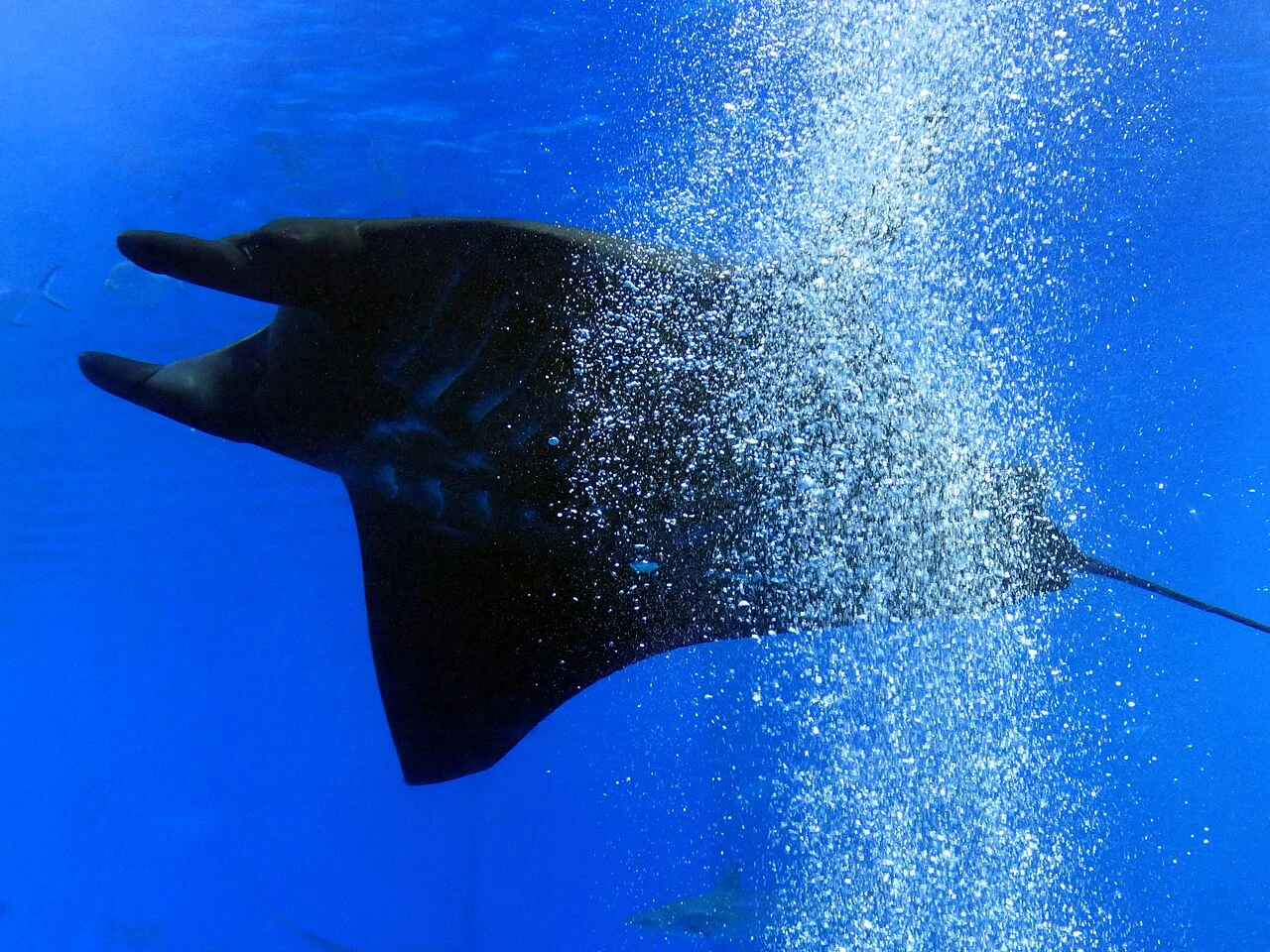
    A manta ray swimming in blue water at Okinawa Churaumi Aquarium, photographed in 2024
    A manta ray at Churaumi Aquarium

    PLAN THE VISIT, THEN THE JOURNEY

    Our starting suggestion: allow 2–3 hours inside the aquarium, and longer for a meal, the outdoor marine facilities and the walks between them. Choose one programme you particularly want to see before arranging your return. Churaumi is in Motobu, in northern Okinawa Main Island, rather than in Naha.

    Official visitor information checked on October 15, 2026. Visit-time suggestions below are our planning allowances, not timed entry slots or promises about crowds.

    Churaumi Aquarium at a glance

    Okinawa Churaumi Aquarium sits within Ocean Expo Park in Motobu. Its setting matters: arriving at the park, reaching the paid aquarium, watching an outdoor programme and returning to your bus are separate parts of the visit. A bus stop or parking space is not the entrance to the Kuroshio Sea gallery.

    Planning questionA useful starting point
    Where is it?424 Ishikawa, Motobu, Okinawa Main Island, within Ocean Expo Park.
    What is the main attraction?The Kuroshio Sea tank, with whale sharks and manta rays, alongside coral-reef, shark and deep-sea exhibits.
    How much time?Our suggestion is 2–3 hours indoors; add walking, food and selected outdoor visits separately.
    What should I decide first?Your priority programme, the time you need at the aquarium and your actual return connection.

    The official location and access guide is the starting point for reaching the park. If you searched for an “Okinawa aquarium,” check the name carefully: DMM Kariyushi Aquarium is a different attraction. Tickets and transport for one are not interchangeable with the other.

    Churaumi Aquarium tickets: prices and what to book

    Official general admission prices

    The aquarium’s official fee page lists the following general admission prices. School categories follow the Japanese school system; check the appropriate category when purchasing for a visiting student.

    Visitor categoryGeneral admission
    Adult¥2,180
    High school student¥1,440
    Elementary / junior high school student¥710
    Preschool child under sixFree

    Two adult tickets and one elementary-school ticket total ¥5,070, calculated from those prices. Transport, meals and optional purchases are additional. The operator may request identification. Check its certificate rules directly if applying for disability admission concessions.

    Admission, a bus ticket and a day tour are different purchases

    Before paying, identify what the product actually includes. An aquarium admission ticket gets you into the paid building. A round-trip bus product deals with transport. A sightseeing tour may combine transport and admission, or list tickets as a separate cost. Similar attraction photographs do not make those products equivalent.

    For any online ticket, read the validity period, date selection, cancellation terms and entry instructions for the chosen option. Is it a QR code for the entrance, or a voucher requiring exchange? Do not assume a bus voucher follows the same process as aquarium entry. Save the usable ticket and its instructions before leaving your hotel.

    The official fee page links to its web-ticket seller. Use that route or review your chosen seller’s current terms; a displayed reseller discount can vary with date, currency and product. We do not quote a universal discounted price.

    Same-day re-entry

    The operator permits re-entry on the same day when you present your admission ticket. Keep it if you leave for a meal or an outdoor programme. Re-entry does not extend opening hours or include a missed departure.

    Opening hours, closures and when to arrive

    As checked on October 15, the official hours page gives the regular aquarium hours below. It lists separate, date-specific extended periods, so avoid applying an old “March to September” rule to every future visit.

    ItemCurrent official informationPlanning implication
    Regular aquarium day08:30–18:30; last admission 17:30.Last admission is the entry deadline, rather than the time to begin a leisurely full visit.
    Scheduled aquarium closuresNo scheduled closing days through March 31, 2027; temporary closures remain possible.Check current notices, especially around severe weather.
    Surrounding marine facilitiesRegular hours listed as 08:30–17:30.The indoor building and outdoor facilities do not share every closing time.

    For an early visit, allow for getting from your drop-off or parking area to admission before choosing the first exhibit or programme. For an afternoon visit, work backwards from your return journey, not only the building’s closing time. A quieter-looking hour is useful only if your bus, meal and preferred programme fit it.

    We recommend checking the official homepage notices again near your travel date. A notice about one programme being suspended is different from closure of the whole aquarium.

    What to see inside Churaumi Aquarium

    Coral and tropical fish: begin with the smaller details

    Give the first galleries some attention before heading for the famous tank. The official coral-reef area guide introduces shallow-water life, the sunlit Coral Sea, tropical fish and the smaller Coral Reef Gallery tanks. The living coral exhibition uses sunlight and a supply of seawater from the nearby sea.

    Choose a few tanks to observe slowly. Look for differences between sandy bottoms, rocky shelter and branching coral; then notice how the animals use those spaces. This is also a good way to involve children: let each person choose a small creature to watch, instead of treating every tank as a stop for another photograph.

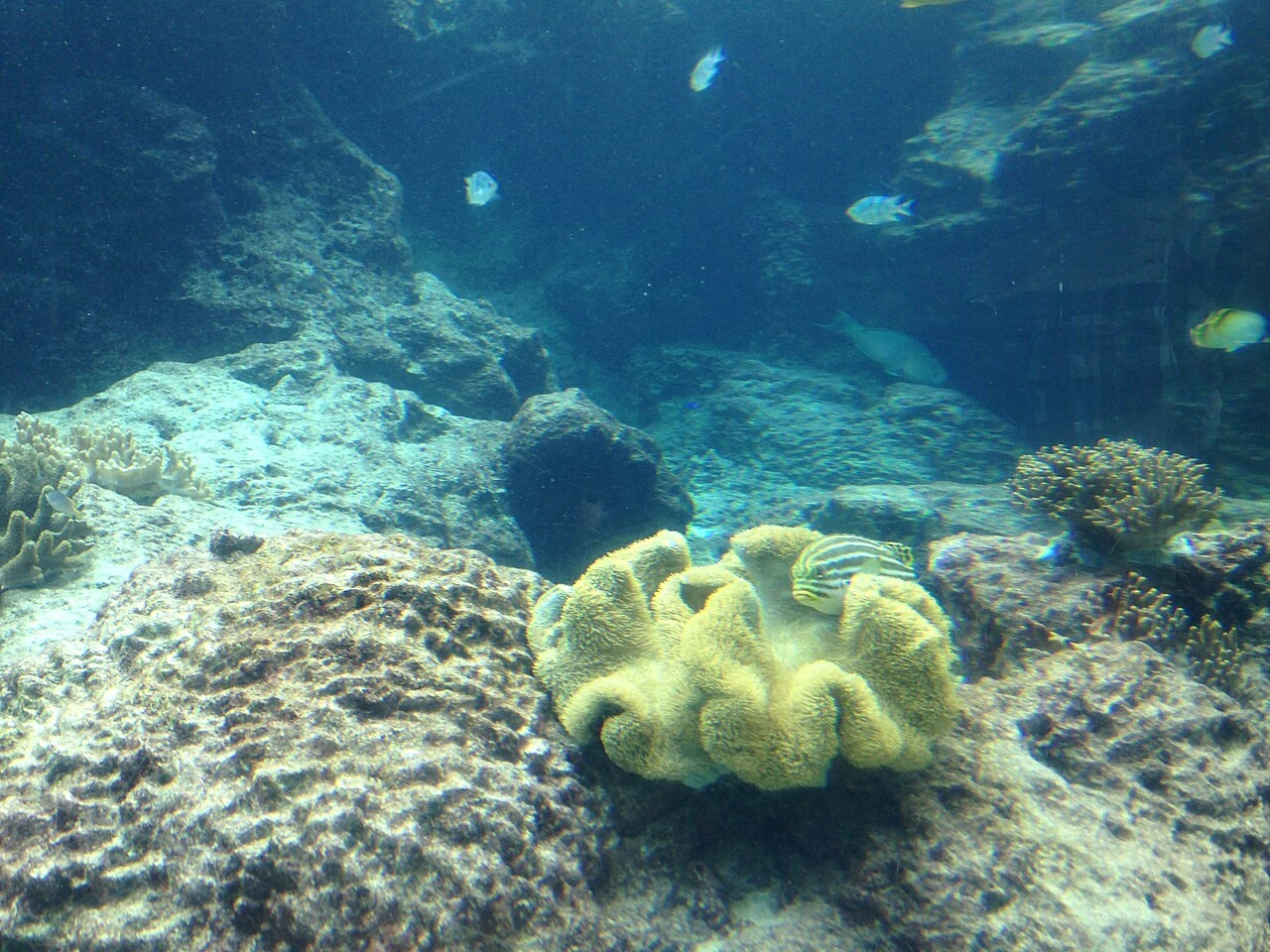
    Coral formations and reef fish at Churaumi Aquarium, photographed in 2015
    Coral and reef fish at Churaumi Aquarium

    The Kuroshio Sea: leave time to stand and watch

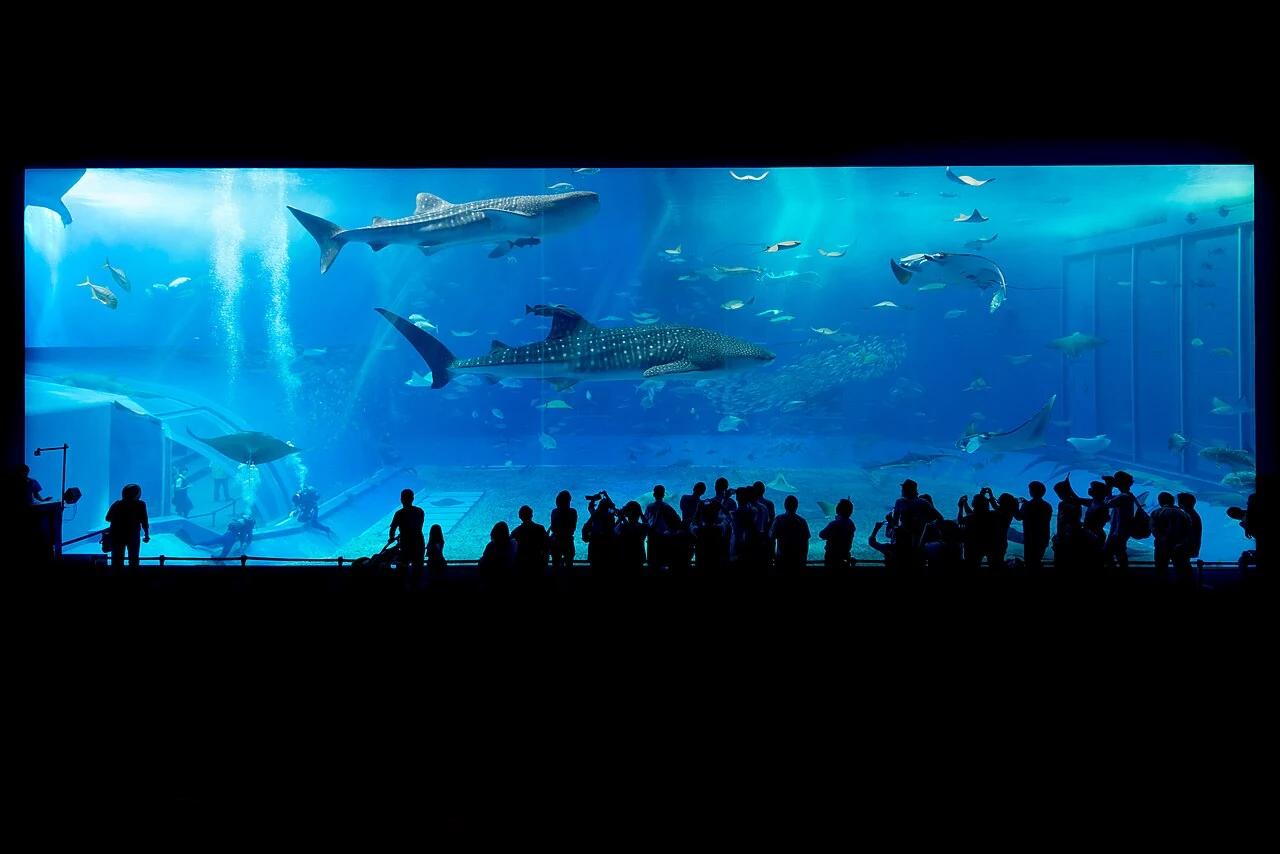
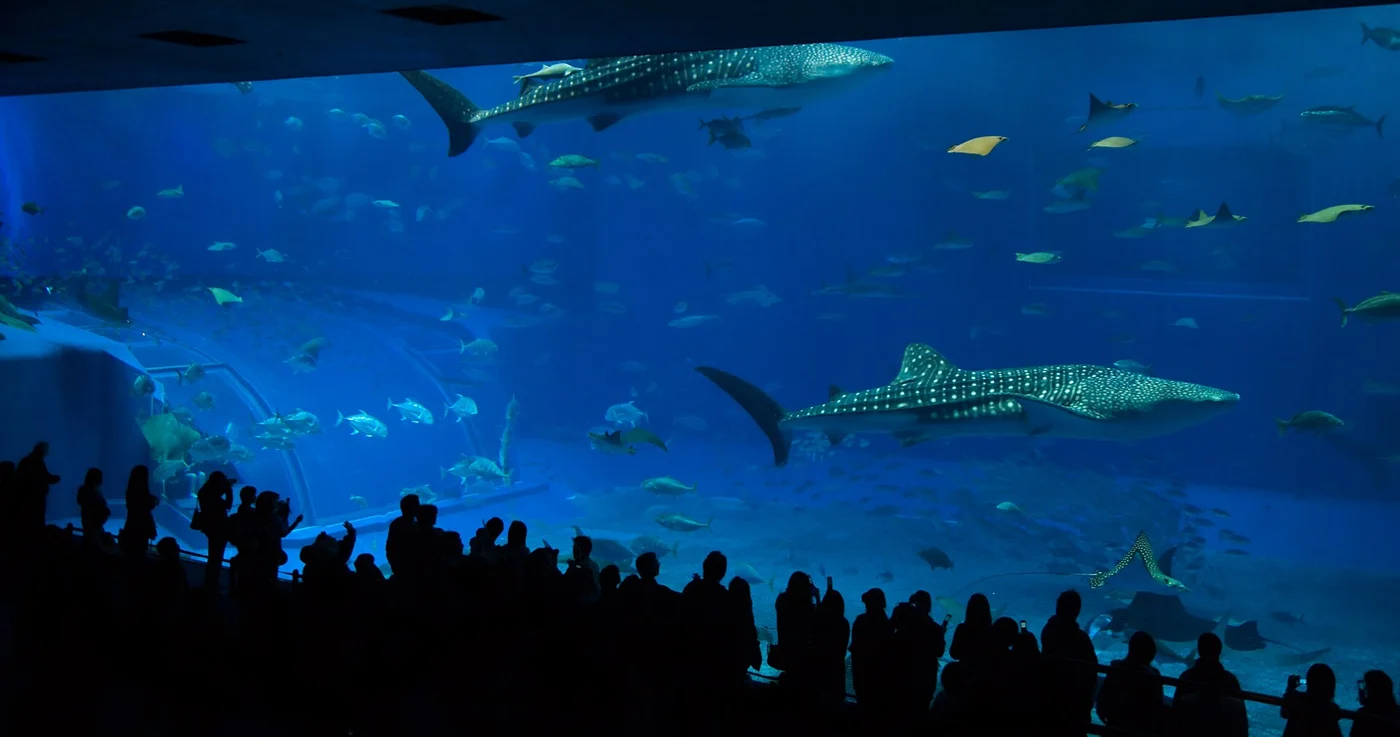
    The Kuroshio Sea is a 7,500-cubic-metre tank. Its large viewing panel lets you take in whale sharks, rays and other fish together. Animals displayed can change, so the operator’s current information is more useful than a promised count based on an older photograph.

    First take in the full scene, then concentrate on a single animal’s movement. If the nearest viewing space is busy, give other visitors room and try a different position rather than expecting everyone to move for your camera. The Aqua Room provides another perspective through an acrylic ceiling, described in the Kuroshio area guide.

    Wide view of the Kuroshio Sea tank and visitors at Churaumi Aquarium, photographed in 2012
    Visitors beside the Kuroshio Sea tank

    Shark Research Lab: an exhibit to read, not just pass

    The Shark Research Lab combines living sharks with specimens and research information. It offers a different kind of stop from the broad Kuroshio view: read a panel, study a specimen and use it to answer one question about how sharks live.

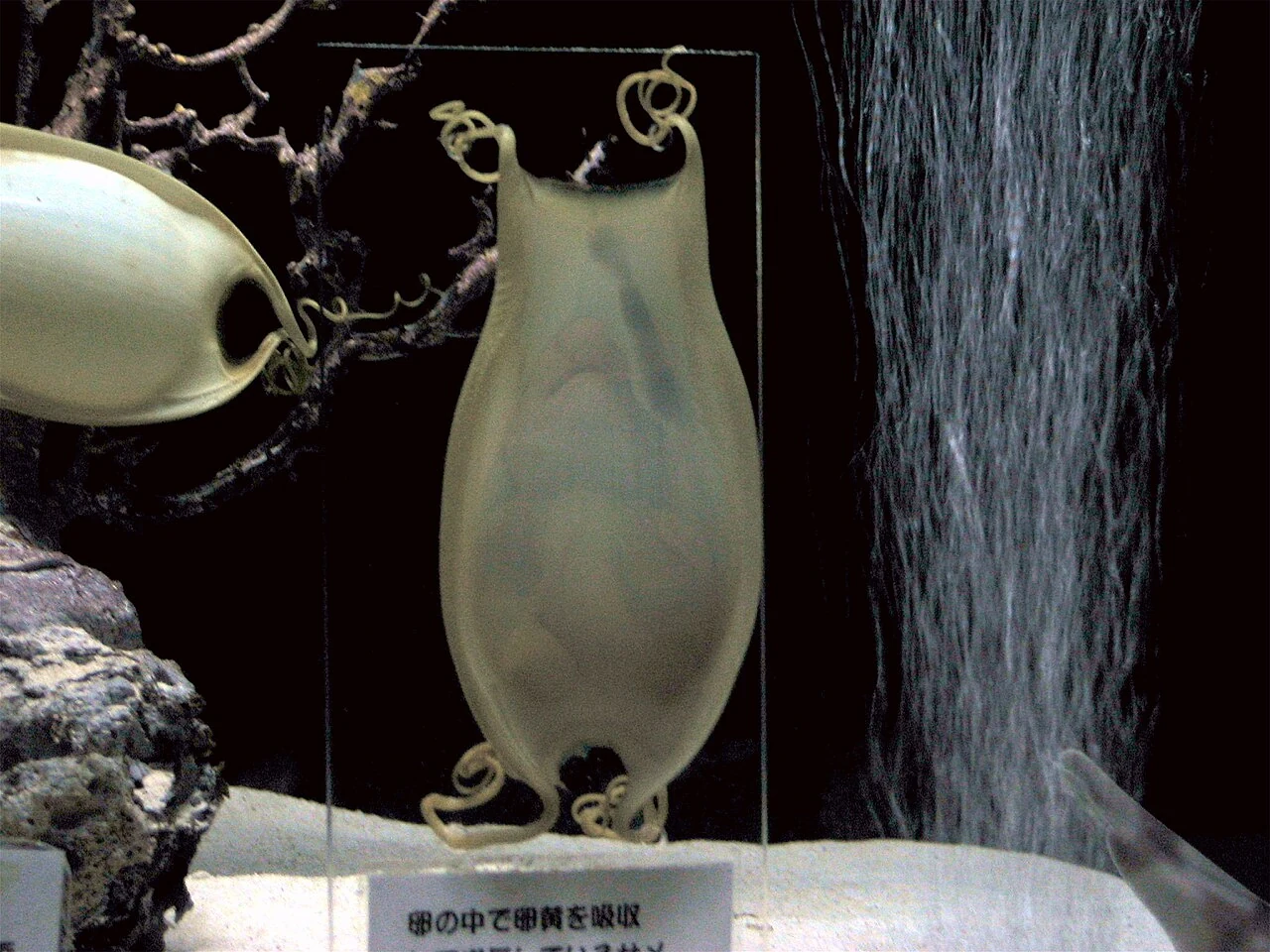
    If your party enjoys learning, keep a little time here even when the big tank is your main reason for coming. The archival egg-case photograph below illustrates the aquarium’s smaller-scale educational displays; it is not a promise that the same specimen is on view today.

    A developing shark inside an egg case at Churaumi Aquarium, photographed in 2005
    A developing shark inside an egg case

    Deep-sea galleries: keep some curiosity for the final area

    The deep-sea area introduces animals from Okinawan waters at depths of 200 metres and more, with research displays and smaller marine life as well as the better-known large exhibits. The contrast with the sunlit coral galleries is part of the appeal.

    Do not spend your entire available visit waiting for a single photograph and then rush this area. With a fixed return, decide earlier which optional stops to shorten. A little attention at the final galleries can be more rewarding than adding another hurried outdoor attraction.

    Small tanks: give one creature a proper look

    A good aquarium visit alternates broad scenes with close observation. You might spend several minutes looking across the Kuroshio tank, then slow down at a small display. Let a child choose an animal to sketch later, or compare the different ways animals stay near the sand or shelter.

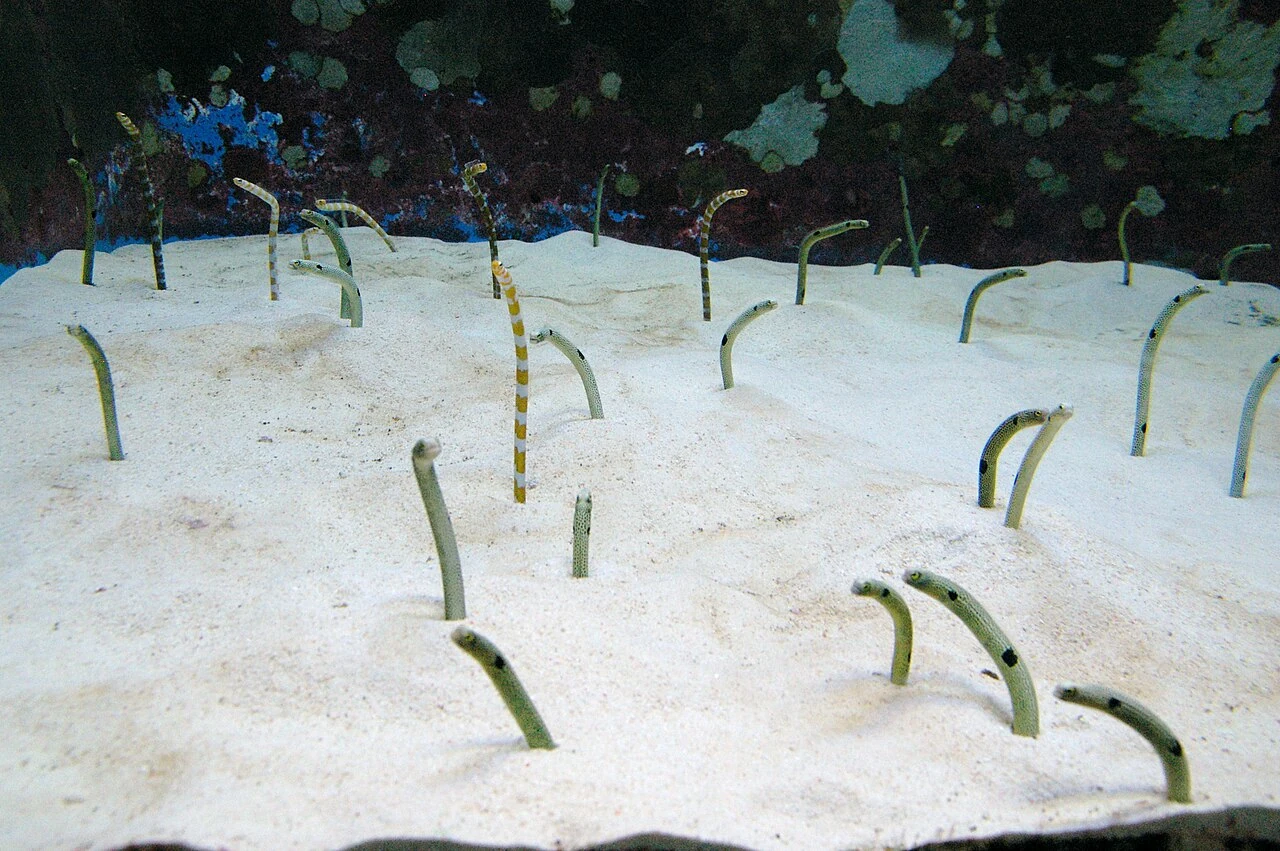
    Garden eels rising from sand in a Churaumi Aquarium display, photographed in 2007
    Garden eels rising from the sand

    The visitor guidance asks visitors to avoid selfie sticks and not disturb other guests when taking personal photographs. Our practical suggestion is to switch off flash to reduce reflections, hold the camera steadily and enjoy some moments without a screen. That is a photography suggestion, rather than a claim that the operator prohibits all flash.

    Feeding times and dolphin shows: choose your anchor

    A programme you care about can shape the visit. Start with its location and time, then fit the galleries, lunch and walking around it. The current Kuroshio feeding page and Okichan programme page list:

    ProgrammeListed start timesWhere to plan for it
    Manta-ray feeding09:30Kuroshio Sea, inside the paid aquarium.
    Whale-shark feeding15:00 / 17:00Kuroshio Sea, inside the paid aquarium.
    Dolphin show10:30 / 11:30 / 13:00 / 15:00 / 17:00Okichan Theater, outside the paid building; the programme is free.

    The important clash: the 15:00 feeding and 15:00 dolphin show are in different places. Choose one, or use a different dolphin-show time. A programme list is not an itinerary that allows you to watch everything simultaneously. Keep the walk, finding a place and any queue in the plan.

    The operator announces that Okichan dolphin shows will be suspended January 4–9, 2027 for maintenance. Programmes can also change with animal condition or weather; verify the day’s information. The same notice should not be read as closure of the main aquarium.

    For another perspective, the official above-water observation course currently lists entry periods of 09:00–10:45 and 17:30–18:15, using a dedicated lift from the first-floor Whale Shark & Manta Ray Corner. No reservation is listed, but hours can change. It is not available throughout the day, and its evening period does not override the aquarium’s last-admission deadline.

    How long to spend and a route that feels unhurried

    For a first visit, our starting allowance is 2–3 hours inside. This gives you more space than a quick circuit: time to read, pause at the main tank and change pace. Walking from transport, lunch and the surrounding marine facilities need their own allowance.

    Visit styleOur planning allowanceWhat to prioritise
    Aquarium-focused2–3 hours inside; approach and transport separate.Coral, Kuroshio, shark and deep-sea galleries.
    Aquarium and parkRoughly 4–5 hours on site, including a meal and walking.The indoor visit plus a chosen programme or marine facility.
    Slower family visitAllow 5–6 hours if your party wants breaks, food and several park stops.Fewer fixed appointments and enough flexibility to shorten the route.

    These are editorial suggestions, not minimum admission periods. A focused visitor may want less, while someone reading every display may want longer. Check the actual visit duration in a bus-tour itinerary: “Churaumi Aquarium day tour” does not mean a full day in the aquarium.

    If 15:00 feeding is your priority: eat beforehand or decide when to break for lunch, enter with a comfortable gallery window, and reach the Kuroshio viewing area before the programme. Afterwards, keep time for the deep-sea galleries and the walk to your agreed departure. Do not add the 15:00 dolphin show to that same slot.

    If a morning park visit is your priority: choose an early indoor visit and a compatible later outdoor programme. The above-water course’s morning window is another choice, rather than an instruction to rush through every gallery before 10:45. Choose what matters most to your party.

    Getting from Naha to Churaumi Aquarium

    Plan the northern journey as part of the day. The aquarium’s access page gives about two hours by car from Naha Airport using the expressway, and approximately three hours by express bus. Those are broad operator estimates; actual journeys depend on the service, starting point and traffic.

    For a scheduled bus, use the selected operator’s current timetable, not a single universal journey time. The official aquarium page links to the Okinawa Airport Shuttle and other operators. Match the actual stop and direction to your hotel. Choose a usable return before deciding that you have time for another village or island.

    OptionUseful whenCheck before paying
    Scheduled direct busThe aquarium is the day’s main destination.Date, boarding place, return, ticket exchange, seating and luggage rules.
    Fixed sightseeing bus tourThe published stops and pace match your interests.Time at the aquarium, admission, meals, language and meeting point.
    Self-driveYou want to set the route and can arrange a suitable rental.Parking, road time, tolls and the driver’s commitments.
    Private vehicle with driverYour group needs an agreed hotel pick-up, pace and return.Whole-route quote, service hours, bags, child seats and included costs.
    Churaumi Aquarium building and green lawn in Ocean Expo Park, photographed in 2022
    Churaumi Aquarium in Ocean Expo Park

    Ocean Expo Park parking is free; the operator identifies the North Gate multilevel car park, P7, as closest to the aquarium. Follow current parking signs and staff directions. Even with a car, include the walk and the time needed to get everyone back to the vehicle.

    Our Okinawa without a car guide contains a dated northern bus example and hotel-base advice. For an arrival-day or resort connection, use the Naha Airport transfer guide. Keep a longer northern outing separate from a tight airport deadline.

    For booking questions, see our private driver guide, vehicle guidance and quote information.

    Food, children and accessibility

    Choose the kind of meal you want

    The official restaurant guide distinguishes Ocean Blue, the cafe inside the aquarium by the Kuroshio tank, from Inoh on the fourth floor, which can be accessed without entering the paid aquarium. A tank-side snack and a full lunch are different breaks. Check the selected outlet’s current service hours, last orders and seating arrangements; some Ocean Blue seats involve an additional charge.

    If the cafe is your main interest, leave flexibility for availability. If getting everyone fed efficiently matters more, choose the meal before fixing a programme immediately afterwards. Do not base the rest of the day on an assumed table beside the glass.

    With young children

    The infant facilities guide lists nursing rooms on the third floor near the entrance and on the second floor by Churaumi Theater, as well as changing facilities. Strollers are available at designated park locations, including P7, in limited numbers without reservations. Confirm the current collection point and availability; the aquarium admission queue is not a stroller reservation.

    Pack the things your child normally needs and keep the route adjustable. A meal, toilet stop or rest may matter more than reaching another show. If you split the group between an outdoor programme and an indoor gallery, agree a precise reunion point and time.

    With a wheelchair or limited walking stamina

    The official accessibility page describes lift access, accessible toilets and wheelchair services. Rental availability is limited and first come, first served; check the designated park counter before relying on a rental. Confirm the complete path from your arrival point, including the return.

    Ask about the boarding arrangements for the actual bus or vehicle and any walking your party needs to avoid. “Hotel pick-up” alone does not answer whether a wheelchair can stay occupied during transport or whether the luggage area suits your equipment. Set out those requirements when contacting a provider.

    Nearby stops: Bise, Motobu and Kouri Island

    Bise: choose a village walk you have time to enjoy

    Bise’s shaded fukugi lanes can make a good contrast with the aquarium. Treat the walk as a visit with its own purpose: choose an entrance, a route, a place to stop and how you will get back to your transport. “Near the aquarium” does not make the complete outing effortless for every party.

    A shaded lane between fukugi trees in Bise village near Motobu
    A shaded lane in Bise village

    If the aquarium and lunch have taken longer than expected, shorten the village plan or leave it for another day. With a scheduled bus, the walk back to boarding is part of the time available; with a driver, agree the pick-up location before separating.

    Stay within Ocean Expo Park for a lighter day

    You do not need to leave the park to add variety. The official surrounding-area guide describes the Sea Turtle Pool, Manatee Pool, waterfront walkway and Emerald Beach, alongside the dolphin facilities. Choose one or two rather than treating every name as compulsory.

    Follow the facility signs, current operating information and weather conditions. A sea view and a swim are different plans; a photograph of a beach does not establish its swimming hours or sea conditions on your date. Keep sun, rain, walking and the party’s energy in mind.

    Kouri Island: a separate road excursion

    Kouri Island can be discussed as part of a northern road day, but it is not an extra section of the aquarium park. Add the complete road journey, the time you want on the island and the onward return. Avoid assuming a scheduled aquarium bus also provides a convenient island connection.

    Kouri Bridge stretching across turquoise water towards Kouri Island
    Kouri Bridge above turquoise water

    For a broader trip, our three-day Okinawa itinerary shows how to group Naha, coast and northern visits. For this day, keep Churaumi as the anchor if the aquarium is the reason you are travelling north.

    Your pre-visit checklist

    • Confirm the facility: Okinawa Churaumi Aquarium in Motobu, within Ocean Expo Park.
    • Check the date: opening hours, last admission, weather and any programme-specific notice.
    • Read the ticket: admission versus transport, category, validity and entry or exchange process.
    • Pick a priority: decide which feeding, show or gallery matters most, and resolve conflicting start times.
    • Keep time indoors: leave room for coral, sharks, the main tank and the deep-sea area.
    • Plan food and breaks: check the relevant outlet rather than assuming a tank-side table.
    • Arrange access needs: walking, steps, equipment, rentals and transport boarding.
    • Write down the return: exact boarding or pick-up place, departure and the walk to it.
    • Choose the optional extra: add a park stop, Bise or another road destination only if the complete day fits.

    A satisfying northern day is one you can actually enjoy. The best route may contain fewer stops and more time in front of the tank that brought you here.

    Churaumi Aquarium: frequently asked questions

    How much are Churaumi Aquarium tickets?

    The official general admission categories and prices are in the ticket table above. Check the operator’s fee page and the selected seller’s conditions before buying; an admission ticket and a transport package cover different things.

    How long should I spend at Churaumi Aquarium?

    Our starting suggestion is 2–3 hours inside, with additional time for the approach, meals and outdoor facilities. Your interests and walking pace may call for longer. Check the actual visit window when booking a fixed tour.

    Are the dolphin show and whale-shark feeding in the same place?

    No. Feeding is at the Kuroshio Sea inside the paid building; the dolphin programme is at Okichan Theater outside. Several start times overlap. Choose compatible sessions and allow time to move between them.

    Can I visit Churaumi Aquarium without a car?

    Yes. Compare a scheduled direct bus, a fixed sightseeing tour or a private vehicle with a driver. Plan both directions and the walk from the stop. See the linked car-free guide for a dated northern bus example.

    Is Churaumi Aquarium good for a rainy day?

    The indoor galleries can form the main visit. Prepare for the approach and any outdoor movement, and check notices during severe weather. Do not assume an outdoor programme will run simply because the main building is open.

    Can I go out for lunch and come back?

    Same-day re-entry is permitted on presentation of your admission ticket. Keep it, check the remaining hours and allow time to return. A meal outside still needs to fit your final transport.

    Is this the same aquarium as DMM Kariyushi?

    No. They are separate attractions. Use the full name, location and product description when booking admission or transport so that your ticket and destination match.

    ABOUT THIS GUIDE

    Prepared by OkinawaVia for English-speaking visitors. Official prices, operating notices and programme information checked October 15, 2026; confirm the information applying to your travel date. Route choices and visit-time allowances are editorial suggestions, not a report of a personal visit. Photographs retain their credited licences, and historical images are dated.

  • Okinawa Without a Car: Where to Stay and Transport Choices

    Okinawa Without a Car: Where to Stay and Transport Choices

    You can enjoy Okinawa without renting a car. Choose a hotel with useful connections, make Naha your easy exploring day, and arrange the longer journeys around the places you most want to see.

    Building an Okinawa itinerary without a car starts with choosing a base and checking which journeys work by rail, bus, taxi or a reserved private driver.

    A Yui Rail monorail train travelling above the streets of Naha
    Yui Rail travelling through Naha

    THE QUICK ANSWER

    For city sightseeing: stay near a useful Naha station and combine rail with walking. For the aquarium and the north: compare a scheduled bus, a fixed day tour and a private charter. For a resort stay: check both the airport connection and how you will reach dinner or activities after arriving.

    This guide covers Okinawa Main Island without driving yourself. Buses, taxis and a hired vehicle with a driver are among the options. A trip relying entirely on public transport needs more attention to stops and return departures than one with a pre-arranged road journey.

    Is Okinawa without a car right for your trip?

    Start with the holiday you want, rather than the transport you think you must book. Naha food, city streets and a selected northern outing can work well without a rental car. Several distant beaches, a late dinner away from your hotel and spontaneous stops on the same day need a different arrangement.

    The official Okinawa transport overview distinguishes monorail, buses, taxis and island transport. Use those options selectively: you do not have to hire a driver for every city journey, and a bus reaching one attraction does not automatically connect the rest of your wish list.

    • A good fit: a station-area Naha hotel, city walking, time for a seated lunch, and one main destination on a longer day.
    • Needs closer planning: a hotel away from shops, children and several bags, a late flight, or a northern outing with multiple separate stops.
    • Worth arranging in advance: transport after your selected return service, a vehicle with suitable luggage space, child seats, or specific access and language requirements.

    Choose how independent you want to be. You might use rail on arrival, walk around Naha, take a scheduled bus to the aquarium and arrange a direct return airport transfer. Another party might prefer a fixed sightseeing tour for its northern day. Both are valid ways to travel without driving.

    Where to stay in Okinawa without a car

    Your hotel’s actual entrance matters more than the district name. Check the walk from the station or bus stop, the road crossings, luggage storage and the places you can reach for dinner. A low room price can lose its appeal if every meal requires another paid journey.

    Naha: choose the station for the journeys you will make

    Naha is our practical starting recommendation for visitors combining city days with trips elsewhere. Asahibashi is useful when your chosen buses use Naha Bus Terminal. Kencho-mae—labelled Prefectural Office on the English rail map—suits plans using the western end of Kokusai Street or a confirmed nearby boarding point. Makishi and Miebashi give other central-city options.

    Before booking, map the hotel against your selected departure point. A tour’s meeting place, a local bus platform and the northern shuttle’s stop can be different even when all are described as “Naha.” Do the final walking check with the hotel, especially if you are carrying large suitcases.

    Red-tiled traditional-style storefront on Naha’s Kokusai Street
    Colourful shops on Kokusai Street

    Chatan: useful when waterfront evenings are a priority

    Chatan can suit a slower stay around American Village and the waterfront. Check that your hotel and preferred restaurants form a comfortable walking area. Then plan the journeys outside that area separately: airport access, a Naha day and any northern excursion. Yui Rail does not run to Chatan.

    Onna and Motobu: choose the hotel and the connection together

    A resort stay without a rental car can work when you want time at the hotel and arrange selected outings. It becomes less convenient if you expect to visit a different distant restaurant or beach every day. For Onna, check the particular bus and final hotel connection. For a Motobu stay focused on the aquarium and Bise, check the exact entrance and walking route before assuming everything is nearby.

    BaseUseful forCheck before booking
    Naha station areaCity food, rail journeys and selected day-trip departures.Hotel entrance, station exit and actual bus or tour meeting point.
    Chatan waterfront areaWalkable evenings and time around American Village.Road connections for every trip outside Chatan.
    Onna resortHotel time with a few planned outings.Served stop, hotel connection, meals and return airport journey.
    Motobu / Bise areaA northern stay centred on the aquarium and village.Walking distances, luggage and the connection back south.

    How to use Yui Rail for a Naha-based holiday

    The operator’s English guide lists the stations from Naha Airport to Tedako-Uranishi. Useful city stops include Asahibashi, Prefectural Office, Miebashi, Makishi, Omoromachi and Shuri. Select the station for the entrance you want to reach; being near the line does not mean an attraction is beside its platform.

    StationPlanning useFinal connection
    Naha AirportArriving at or leaving the city by monorail.Terminal walking, luggage and airport procedures.
    AsahibashiPlans involving Naha Bus Terminal.Your bus platform or separate roadside stop.
    Prefectural Office / Kencho-mae, Miebashi or MakishiCentral Naha and a Kokusai Street walking plan.The end of the street, market or hotel you actually need.
    ShuriA heritage outing in Shuri.The approach to the park and time to reach any reserved entry.

    Yui Rail accepts Suica and the interoperable cards listed on its official IC-card page, including PASMO and ICOCA. QR tickets and rail passes are alternatives. A card used on the monorail should not be treated as proof that the same payment method works on your next bus.

    Naha Airport monorail station and terminal walkway in an archival 2009 photograph
    Naha Airport Station and its connecting walkway

    For the airport journey, see our Naha Airport transfer guide. It compares rail, hotel buses and road transfers, including the final connection to Naha, Chatan and Onna accommodation.

    Okinawa buses: choose the service before choosing the payment

    A local bus, airport bus and day tour do different jobs

    A route bus takes you to a listed stop. A hotel limousine bus connects designated locations. A sightseeing tour follows its own itinerary and meeting instructions. The official bus overview explains these categories. Check the selected operator’s service rather than applying one bus’s reservation or luggage rules to every bus on the island.

    For a local journey, record the route number, direction and stop name in both English and Japanese if available. Check the walking connection at each end and the return departure. Use the operator’s timetable alongside the route planner; a map estimate is a starting point, not confirmation of a seat or an unchanged service.

    OKICA, cash and bank-card tap payments

    The official local-bus guide describes OKICA and cash payments. On distance-based services, a cash passenger takes a numbered boarding ticket, matches its number to the fare display, and pays when leaving. Some flat-fare city services use payment on boarding. Follow the signs for the bus you are taking.

    Prepare small yen notes and coins before the journey. The guide notes that machines on some buses may not handle new banknotes or newer ¥500 coins. Confirm the payment method for the specific service; a bank card’s tap function, an OKICA reader and a Suica-compatible rail gate are different systems.

    Booking rules can also change. Okinawa Bus’s April 2026 limousine-bus tap-payment trial notice allows onboard tap payment subject to seats and equipment, with advance-ticket customers given priority. Its general English guide still instructs travellers to buy tickets beforehand. For a planned hotel journey, check the current reservation instructions and availability instead of relying on a last-minute tap payment.

    Places you can explore from Naha without driving

    Kokusai Street, Makishi and the pottery lanes

    Build a central Naha walking area around one meal and a few places you want to browse. Kokusai Street, the Makishi area and Tsuboya’s pottery lanes can be combined without repeatedly returning to the station. Leave time for sitting down, choosing lunch and browsing small shops. Carry purchases lightly or check whether you can leave them at the hotel before a longer outing.

    The Makishi market’s facility guide lists 8:00–22:00, with shop-specific hours, and a regular fourth-Sunday closure except December. Check additional holiday closures and the individual food stall. The building’s opening time does not mean every restaurant serves throughout those hours.

    A current museum check: Naha City lists the Tsuboya Pottery Museum as temporarily closed from September 1, 2026 to March 31, 2027, with reopening planned for April 1, 2027. A pottery-street stroll and a museum visit are separate plans; confirm current shop openings for browsing during the closure.

    A bowl of Okinawa soba with pork and fish cake beside mixed rice
    Okinawa soba and seasoned rice

    Shuri: allow for the approach, not just the train ride

    Take Yui Rail to Shuri and plan the walk or a suitable final connection to the park. For visitors reserving the restored main hall, the park’s current booking guide recommends a viewing time 40–50 minutes after estimated arrival at Shuri Station. That allowance includes more than the approach to the grounds.

    The same guide announces public opening of the restored Seiden on November 23, 2026, with designated date-and-time reservations for interior viewing. Before that date, plan around the areas actually available. Afterwards, check the ticket and entry slot for your visit. The gate in the photograph below is Shureimon, not the restored main hall.

    Shureimon gate at Shurijo Castle Park in a photograph taken in 2015
    Shureimon Gate at Shurijo Castle Park

    A Naha itinerary with a lighter pace

    Our city-day suggestion is to choose either Shuri or a longer central-city walk as the main activity, then add lunch and one nearby area. You can combine more if your walking pace and available hours allow. For a rainy-day alternative, check the Okinawa Prefectural Museum & Art Museum near Omoromachi; its closure calendar matters when changing plans.

    For a full multi-day route, use our three-day Okinawa itinerary. Here, the focus is how to choose the hotel, transport and connections that make your selected visits workable.

    How to visit Churaumi Aquarium and the north without a car

    Independent bus travel: decide the return first

    For an aquarium-focused day, compare a scheduled northern bus before arranging a multi-stop tour. Check the named stop, the service date, your outward journey and the return. Allow time to walk from the stop into the park, visit, eat and return to the boarding point.

    The following is a dated planning example from Okinawa Airport Shuttle’s official timetable for October 15, 2026–January 31, 2027. It illustrates a Naha-city outing; the outward departure is not at the airport.

    DirectionSelected scheduled serviceWhat it means for your plan
    Outward · rapid #3Kencho Kitaguchi 08:15 → Churaumi Aquarium / Kinenkoen Mae 09:56.Get from your hotel to Kencho Kitaguchi before departure.
    Return · rapid #16Churaumi Aquarium / Kinenkoen Mae 15:30 → Asahibashi / Naha Bus Terminal Mae 17:18.Return boarding and the final hotel journey are part of the day.

    The scheduled rides are 1 hour 41 minutes outward and 1 hour 48 minutes back, calculated from those times. They exclude hotel connections, walking and waiting, and are not guarantees about traffic. The two Naha stops differ. Recheck the operator’s dated table, fare and booking conditions before travel; the operator suspends services #17 and #22 from October 15 in this timetable.

    Visitors watching whale sharks in Churaumi Aquarium’s Kuroshio Sea tank
    The Kuroshio Sea tank at Churaumi Aquarium

    Bise is another walking plan, not an automatic extra

    If Bise interests you, choose the village route and where you will board afterwards before setting off. The shuttle also lists Bise Fukugi Namiki Iriguchi, with direction-specific boarding and alighting restrictions. Do not assume you can use the same long-distance service as a short local ride between every northern stop.

    Think about everyone’s walking pace, heat, a meal and the return. If you want an extended aquarium visit, it is reasonable to keep the day there. If the village is the main interest, give it the time it deserves rather than squeezing it between a long visit and the last departure.

    A shaded lane lined with fukugi trees in Bise village
    A shaded lane in Bise village

    For several northern stops, compare a tour or agreed charter

    An independent aquarium bus journey is different from visiting Churaumi, Kouri, Bise and other northern places in one day. List the stops you care about, then compare a fixed day tour with a private route. Look at the actual time allowed at each attraction, the return point and what happens if your party needs longer.

    Do not treat every tour as a door-to-door service. Confirm the selected boarding place, spoken language or audio-guide provision, admission tickets, meals and child conditions. A headline listing several attractions tells you less than the detailed itinerary.

    Chatan and Onna without a rental car

    Keep a coastal outing centred on one area. A Chatan afternoon can be about the waterfront, browsing and a meal. An Onna stay can be about the hotel, beach facilities and selected outings. Connecting several widely spaced coast stops by separate buses is a different undertaking.

    Sunset Beach and waterfront hotels in Chatan
    Sunset Beach and the Chatan waterfront

    For Onna, check the shuttle operator’s hotel-connection guide. Some listed hotels involve a walk, others require a taxi or hotel pick-up arranged beforehand. Rapid services skip the coastal Onna stops. A bus passing the district is not enough: match the chosen service to the actual stop and the final connection.

    If sunset and dinner are the purpose of the outing, find the usable return journey first. Plan the meal’s finish and the walk to boarding. If the timetable does not fit, choose an earlier return, a nearby overnight stay or a pre-arranged road journey. Avoid adding another coast stop simply because it appears along the same broad route.

    When an Okinawa taxi, day tour or private driver helps

    A short taxi ride can connect a hotel, station or attraction when walking would use too much energy. A longer point-to-point journey or a day of sightseeing needs a clearer arrangement. The official taxi guide distinguishes standard taxis, pre-booked shuttle taxis and sightseeing services, and lists GO and DiDi for advance taxi requests.

    Check availability, payment and the fare basis for your actual journey. Save the destination’s address to show the driver. When booking a vehicle for a longer period, confirm the stops, hours, return point, luggage and total quote. English correspondence and a driver’s spoken language should be checked separately.

    OptionChoose it whenMain trade-off
    Scheduled busOne main destination fits the outward and return services.You plan the stops, walking and timetable connections.
    Fixed Okinawa day tourYou like the published route and visit durations.The meeting point, timetable and stops are set by the product.
    Short taxi journeyYou need a useful final connection or relief from walking.Confirm availability, capacity and payment for that ride.
    Private charter with driverYour party needs an agreed route, pace and return point.Obtain a suitable vehicle and total quote for the full plan.

    Read our private driver guide for booking questions, and use the vehicle guidance and sample routes when deciding what to discuss.

    The cost of Okinawa without a car: tickets and passes

    Compare fares for the journeys you will actually make. A pass can simplify a busy transport day, but it does not create extra services or make every bus eligible. The following adult prices were checked against the operators on October 14, 2026.

    PassAdult priceKey condition
    Yui Rail QR 1-day ticket¥1,000.24 hours from purchase; monorail travel.
    Yui Rail QR 2-day ticket¥1,800.48 hours from purchase; monorail travel.
    Okinawa route-bus 1-day pass¥2,900.Designated participating local routes.
    Okinawa route-bus 3-day pass¥5,800.Check the selected product’s period and eligible routes.
    3-day bus pass with Yui Rail addition¥6,400.The included monorail ticket is a 1-day ticket, not three days of rail travel.

    Sources: Yui Rail ticket guide and the official bus-pass prices and conditions. The bus pass excludes routes 111 and 117, airport limousine buses and regular sightseeing buses. Check coverage for each chosen service before buying. Other specialised products have their own rules.

    Two adults each buying a ¥1,000 rail ticket spend ¥2,000 on that rail product. This is not a complete day budget. Add any buses outside the pass, taxis, admission, meals and hotel costs. If your city plan involves mostly walking and only a few rail journeys, compare individual fares before buying a pass.

    When comparing a day tour with a private vehicle, use the whole party’s transport cost and check included admissions. A per-person bus price and a whole-vehicle quote use different units. Our pricing guidance explains the details to send for an OkinawaVia quote; the public-transport prices here are operator fares.

    Build a car-free Okinawa plan that works from door to door

    For each outing, write a single chain: hotel entrance → boarding point → main visit → return boarding point → hotel. Put the departure names into your notes, not just the attraction names. That makes missing connections easier to spot before you pay for accommodation or tickets.

    • Hotel: check the entrance, walking route, luggage storage and places to eat nearby.
    • Outward journey: note the date, operator, service, boarding point and reservation conditions.
    • Visit: allow for the approach, tickets, meals and the walking pace of your party.
    • Return: identify the correct direction, boarding point and departure before choosing extra stops.
    • Payment: prepare the relevant ticket or supported card, plus useful small cash where appropriate.
    • Bags and assistance: confirm space, boarding needs, child seats and any access requirements.
    • Alternative: know how you will shorten or change the outing if a connection is unavailable.
    • Flight day: work backwards from your airline’s airport deadline, including luggage collection and the final terminal journey.

    For a family, a slower walker or someone with access requirements, assess the complete connection rather than whether a vehicle is labelled “large.” Ask the hotel and operator about steps, walking and boarding arrangements. A station close on a map does not answer those questions.

    If you add an island excursion, make a separate boat-and-island transport plan. Confirm current sailings and the journey from the island port to your chosen place; the official transport guide notes that weather can affect ferry services. Keep enough flexibility for changes rather than treating an island outing as a guaranteed connection to your flight home.

    Okinawa without a car: frequently asked questions

    Is Okinawa worth visiting without renting a car?

    Yes, when you choose a useful base and plan the longer journeys. Naha city days can use rail and walking. A northern outing can use a suitable scheduled bus, fixed tour or private charter. The best choice depends on your stops and the return you need.

    Where should I stay without a car?

    For a city-and-day-trip holiday, start by comparing Naha hotels near the station and departure points you will use. Chatan or a resort can suit a slower stay, with the journeys outside the area arranged separately. Check the actual hotel entrance and dinner options.

    Can I use Suica or PASMO in Okinawa?

    Yui Rail accepts the interoperable IC cards listed by the operator, including Suica and PASMO. For a bus, check that service’s payment rules. Do not assume its reader accepts the same card; prepare the correct ticket, OKICA or another supported payment method.

    Can I get to Churaumi Aquarium by public transport?

    Yes. Compare the northern bus service for your date and plan the return as well. The worked example above uses different Naha stops for the outward and return journeys. Walking into the park and back to boarding remains part of your visit window.

    Can I stay in Onna without a rental car?

    Yes, particularly when hotel time is a priority. Confirm the airport journey, final hotel connection, meals and chosen outings before booking. A rapid northern bus may skip the coastal stop you need.

    Is a private driver the same as a tour guide?

    They are different arrangements. A driver provides the agreed transport; detailed guiding, interpretation and specific spoken languages need separate confirmation. State what you need when comparing a tour or requesting a quote.

    Does an OkinawaVia enquiry reserve my trip?

    The acknowledgement confirms receipt of the enquiry. The itinerary, vehicle, service hours, availability, price and booking are agreed separately. Include your hotel, dates, party, bags and priorities so we can review a suitable plan.

    Plan the last ride before choosing the last stop

    A route is not complete when you know how to reach the beach. Check the return bus, the walk to its stop, and any connection after that. If dinner or sunset ends after the useful service, arrange a return ride in advance rather than relying on city-style taxi availability in a remote location.

    Changing transport from day to day is sensible: monorail and walking in Naha, a reserved vehicle or suitable bus for the north, and a separately planned airport journey. Include every traveller, luggage and waiting time when comparing the full cost.

    ABOUT THIS GUIDE

    Prepared by OkinawaVia for English-speaking visitors planning Okinawa Main Island without driving. Official transport fares, dated bus examples and visitor notices were checked on October 14, 2026. Hotel-base choices and planning suggestions are editorial advice, not accounts of a personal trip. Use the operator information applying to your travel date. Photographs retain their credited licences; archival images are identified in their captions.

  • Okinawa Itinerary for 3 Days: Naha, Coast and a Northern Day Trip

    Okinawa Itinerary for 3 Days: Naha, Coast and a Northern Day Trip

    Three days in Okinawa can bring together Naha’s food and heritage, the aquarium and villages of the north, and an unhurried stretch of the west coast. The useful question is how much of each you can enjoy with the flights, hotel and transport you actually have.

    Planning an Okinawa 3 day itinerary? Use the route below to balance Naha, coastal stops and a northern day trip around your arrival and departure times.

    Kouri Bridge crossing turquoise sea to Kouri Island in northern Okinawa
    Kouri Bridge above turquoise water

    THE THREE-DAY PLAN

    Day 1: Shuri, Makishi and the streets of Naha. Day 2: Churaumi Aquarium and Bise, with Kouri Island if your timing permits. Day 3: Onna coast views, a lunch break and Chatan—or a shorter finish near Naha if you are flying home.

    This guide covers Okinawa Main Island. It assumes three usable sightseeing days and a Naha starting point. If you arrive late on Day 1 or leave early on Day 3, use the shorter version below. The stop durations are our planning suggestions, not booked tour times or promises about traffic.

    An Okinawa itinerary for 3 days, at a glance

    Keep the northern outing together on one full day. Use Naha as the lighter city day and leave the coast day adjustable. That gives you room to change the order around a reservation, a market closure or the forecast without trying to rebuild the whole trip.

    DayCore planIf you have more timeFirst thing to shorten
    1 · NahaShuri heritage, Makishi lunch, central streets.Tsuboya pottery browsing and a longer dinner.The extra shopping loop if arrival is late.
    2 · NorthChuraumi Aquarium, lunch and a Bise walk.Kouri Island, with a revised return plan.Kouri when the aquarium or traffic uses more time.
    3 · West coastCape Manzamo, a relaxed lunch and Chatan.A longer waterfront stop or resort time.Onna if the airport deadline leaves little margin.

    Before fixing the route, write down your airport arrival, hotel check-in arrangements and the time your airline requires you to be at the airport for departure. A “three-day trip” with two flight days needs a different plan from three full days already on the island.

    Three-day plan grouped into Naha on Day 1, Churaumi and Bise on Day 2 with optional Kouri, and Onna and Chatan on Day 3
    Three days of sightseeing in Okinawa

    Day 1: Naha, local food and Ryukyu heritage

    Begin with a day that does not depend on a long drive. Leave your luggage at the hotel if its arrangements allow, and choose the city stops around the time you can genuinely start exploring. Naha is also a useful place to settle into the trip before an early northern departure.

    Morning: Shuri, with the right expectations for your date

    Plan Shuri as your main heritage visit, with time for the approach, the grounds and whatever areas are open on your date. Shureimon is the gate shown in the photograph below; it is not the Seiden main hall.

    A current booking check: the park’s official notice schedules the restored Seiden’s public opening for November 23, 2026. Interior viewing requires a designated date-and-time reservation. Before that date, do not plan the visit as if the restored interior were already open. See Shurijo Castle Park’s official ticket and reservation guide.

    If your visit includes a timed entry, place that reservation first and fit lunch around it. Give yourself time between arriving near the park and reaching the ticket gate; the vehicle drop-off or station is not the interior entrance. For a shorter arrival day, keep Shuri for a later city morning rather than rushing from the airport.

    Shureimon gate at Shurijo Castle Park, photographed in 2015
    Shureimon Gate at Shurijo Castle Park

    Lunch and afternoon: Makishi, Kokusai Street and pottery lanes

    Head back towards central Naha for lunch and browsing around Makishi. Keep lunch as part of the day, with a proper seat and a break, rather than treating every meal as something to eat between attractions. Browse the market, choose a menu that suits your party, then continue along Kokusai Street or into Tsuboya’s pottery area.

    Makishi Public Market’s official facility guide lists opening hours of 8:00–22:00, varying by shop. Its regular closure is the fourth Sunday of each month except December, with additional holiday closures. That building-wide time does not mean every food stall is serving throughout it. Check your date and the individual shop before building lunch around it.

    For a meal to look for, Okinawa soba is a useful starting point. Japan’s agriculture ministry’s regional food guide describes wheat noodles with pork- or bonito-based broth and pork or fish-cake toppings. Ask about the actual ingredients and preparation if you have dietary requirements; the dish name alone does not answer that question.

    Okinawa soba with pork, fish cake and spring onions beside a bowl of mixed rice
    Okinawa soba and seasoned rice

    Choose one walking loop you enjoy. You do not need to see every arcade and shop on the same afternoon. Naha’s official sightseeing access guide places Tsuboya Yachimun Street within walking reach of the Kokusai Street area. Leave space to browse and return to the hotel.

    A traditional-style red-tiled storefront along Naha’s Kokusai Street
    Colourful shops on Kokusai Street

    Evening: dinner near the hotel

    Keep dinner close to where you are sleeping, particularly before the northern day. A late cross-island dinner creates another journey at the point when your group may most want to stop. Check a restaurant’s last order, not just its closing time, and book ahead if a particular meal matters to you.

    Day 2: Churaumi Aquarium, Bise and an optional Kouri Island stop

    This is the day to give the north enough time. Naha’s tourism association lists about two hours by car from Naha Airport to Churaumi Aquarium in its access guidance. A city hotel has a different starting point, and traffic can change the journey. Check the complete route from your hotel; the aquarium visit itself is only one part of the day.

    Make the aquarium your anchor

    If the aquarium is a priority, reserve a substantial part of the morning for it. We suggest allowing roughly 2½–3 hours for your chosen exhibits and pauses, then adding the walk from parking and a lunch break. You can shorten that if your interests are specific, or spend longer; it is not an official required visit duration.

    The published regular hours are 8:30–18:30, with last admission at 17:30. Special dates and temporary closures can change those hours. Check the official hours page and any current notices before leaving. Do not build the day around an old leaflet’s seasonal or evening-ticket details.

    Visitors watching whale sharks in Churaumi Aquarium’s Kuroshio Sea tank
    The Kuroshio Sea tank at Churaumi Aquarium

    After lunch: choose a manageable Bise walk

    Bise’s tree-lined lanes make a contrasting outdoor stop after the aquarium. The official Okinawa tourism itinerary places Bise about five minutes by car from the aquarium. Parking, finding your walking start and the walk itself still need time.

    Our suggestion is a selected 45–60-minute walk, rather than a commitment to explore every lane or add cycling as well. Treat the area as a residential village: keep your voices low, do not enter private yards, and park where permitted. In heat or rain, shorten the walk and take a break instead of turning it into an endurance test.

    A shaded lane lined by fukugi trees in Bise village
    A shaded lane in Bise village

    Kouri Island: add it deliberately

    The bridge and island views in the opening photograph are a good reason to consider Kouri. Put it on your route before you travel, with a chosen stop and a revised return time. Do not assume a bridge drive, lunch, beach visit and separate attractions are all one quick stop.

    If the aquarium takes longer than expected, protect your return margin and omit Kouri. If Kouri is your main interest, reverse the priorities: spend more time there and shorten the aquarium, or choose a different northern outing. The best northern day is the one built around what your party values.

    Your priorityKeepMake optional
    Aquarium and a gentler paceChuraumi, lunch, a short Bise walk.Kouri and extra park attractions.
    Island sceneryKouri and one other northern highlight.A full-length aquarium visit.
    Young children or slower walkingOne main attraction and a comfortable meal.Long walks and several separate stops.

    Decide your latest departure from the north with the driver or your own live route estimate. If you book a charter, confirm the service hours and return point before adding stops. An airport transfer and a sightseeing day are different arrangements, as explained in our Okinawa private driver guide.

    Day 3: west coast views and a relaxed finish

    After the longest day, choose a coastal day that can stretch or shrink. For a Naha-based route, visit the Onna area first and work south through Chatan before returning to Naha. If you are staying at an Onna resort, adapt the start to your hotel instead of travelling to Naha just to start the route again.

    Onna: Cape Manzamo and a real lunch break

    Use Cape Manzamo as a scenery stop, with time to walk and look out to sea. The facility operator publishes a viewing fee of ¥100, with children below elementary-school age free, and notes that sightseeing is until sunset. Shops and food outlets have their own arrangements; do not confuse the enquiry desk’s hours with the last possible time for the viewpoint.

    Sea and peninsula views from Cape Manzamo in Onna
    Coastal views from Cape Manzamo

    Then give lunch its own place in the schedule. Select an Onna-area café or restaurant based on current opening times, your group’s needs and the direction of travel. A good meal and time to sit can be more valuable than another attraction squeezed into the middle of the day.

    Chatan: waterfront time at your own pace

    Spend the later part of the day around American Village and the waterfront if it fits your plans. Choose browsing, a drink or a walk, rather than expecting to do every shop, beach and restaurant. If you want to be here for sunset, keep dinner and the journey back afterwards in your schedule.

    Sunset Beach and waterfront hotels in Chatan
    Sunset Beach and the Chatan waterfront

    If Day 3 is your departure day

    Work backwards from the airline’s required airport arrival time. Include the journey, collecting luggage, loading, rental-car return if applicable and the transfer to the terminal. An airport arrival deadline should determine the last stop, rather than a sightseeing wish list determining when you leave.

    For an early or mid-afternoon departure, keep the morning near Naha and omit the Onna outing. For a later flight, select only the coast stops that leave a comfortable margin. Do not rely on a sunset visit unless the flight schedule genuinely permits it. Our Naha Airport transfer guide explains how hotel stops, luggage and return arrangements affect the last journey.

    Where to stay and how to get around for three days

    Choose one base unless changing hotels has a clear benefit

    For a short trip, one hotel avoids another packing and check-in cycle. Pick the base for the trip you want: a walkable city evening and simpler airport connection, or more time at a coastal hotel. Changing hotels may make sense if you are extending the trip, but it is not necessary to make this three-day plan work.

    BaseUseful whenTrade-off to consider
    NahaCity food and streets matter, and you want a city day with walking and rail.The northern day needs a substantial outward and return journey.
    ChatanYou prefer waterfront evenings and want a central-west base.Check road transport for both the Naha day and the airport.
    OnnaTime at your resort is part of the purpose of the trip.Exact hotel location and connections shape every outing.

    An Okinawa itinerary without a car you drive yourself

    You can use walking and Yui Rail for parts of the Naha day, then choose a separate road-based arrangement for the north. The official Yui Rail route does not take you to Churaumi, Kouri or Onna. Compare the transport plan before deciding your final stops.

    ChoiceWhat it gives youWhat to confirm
    Rental carYou set the route and stops.Driving documents, vehicle and bags, parking, return arrangements and the person doing the driving.
    Private charter with driverAn agreed route for your own party.Service hours, total quote, pick-up, return point, luggage and language requirements.
    Group Okinawa day tourA published route and timetable.Actual boarding point, languages, included tickets, meal arrangements and time at each stop.
    Scheduled busesA transport connection to a listed stop.Your travel date, outward and return services, walking connections and how any additional stop will work.

    For an Okinawa day tour, compare the selected product rather than its headline alone. Fixed tours may include attractions you would otherwise spread across Days 2 and 3. Avoid paying for the same admission twice; if a group tour already covers Manzamo, use Day 3 for a slower coast or city day. Check whether Bise is actually included before assuming it is.

    The airport leg also deserves its own plan. Use the airport guide for your Naha, Chatan or Onna hotel. See our sample charter routes and vehicle guidance when deciding what to discuss.

    Admission fees and the parts of the budget to keep separate

    A useful budget separates attraction admission from transport, meals and the hotel. The following are published standard fees checked on October 13, 2026. They are not a package price or an OkinawaVia quotation.

    VisitPublished feeImportant condition
    Churaumi AquariumAdult ¥2,180; high-school ¥1,440; elementary / junior-high ¥710; preschool children under six free.Standard general admission; school categories follow the operator’s rules.
    Cape Manzamo¥100 per person; below elementary-school age free.Viewing fee; food and other purchases separate.
    Shurijo paid area from November 23, 2026Adult individual admission ¥1,000.Interior Seiden viewing requires the appropriate reserved date/time ticket; this is the announced future fee.

    Sources: Churaumi admission, Manzamo operator, and Shurijo reservations and new fees. Use the ticket information applying to your actual travel date, especially for Shuri.

    For two adults, the aquarium and Manzamo fees alone total ¥4,560. Add Shuri admission if selected, as well as transport, meals, parking and other costs. With a charter, ask what is included in the total and which admissions are paid separately; our pricing guidance explains the information to send for a personalised quote.

    Adapt the itinerary to flights, children and weather

    Only three calendar days, including arrival and departure

    If you land in the afternoon and leave on the third morning, you have one full sightseeing day. Choose your priority for that day: the northern outing or a city-and-coast plan. Use the arrival evening for settling in and a nearby meal. Do not copy the full three-day schedule into that smaller window.

    If you have an early arrival and a late departure, you may retain more of the route. Still allow for airport procedures, bags and check-in. Move Shuri around its availability and shorten Day 3 according to the airport deadline.

    Families and people who prefer a slower pace

    Keep one main visit per day, a seated lunch and room for pauses. On Day 2, let Churaumi and the meal be the essentials; Bise and Kouri can be optional. Discuss strollers, child-seat requirements, walking limits and luggage before arranging the vehicle. A larger vehicle does not by itself confirm accessible boarding.

    Rain, strong wind or tired legs

    Change the sequence where it helps, while checking opening dates and booking conditions. Churaumi can still be a main visit when the village walk is unattractive, but it remains a substantial road journey. Do not replace a nearby indoor stop with a drive north simply because the aquarium is indoors.

    For a Naha-based alternative, consider the Okinawa Prefectural Museum & Art Museum. Its official guide lists Monday closure, with the next business day closed when a public-holiday Monday is open. Exhibition fees and hours should be checked for your date. Keep a covered food or shopping option nearby, too.

    For outdoor viewpoints or any separately booked sea activity, follow current operator and local notices. A beach photograph is not a statement that swimming is available or suitable on your travel date. If relaxing at the hotel is your priority, replace the coastal outing with that time rather than adding both.

    A short checklist before you book

    • Usable days: write down actual arrival and departure times.
    • Hotel: use its full name and address, and check luggage arrangements.
    • Priorities: choose one main visit per day and identify what can be omitted.
    • Reservations: check Shuri’s date-specific access, attraction notices and any timed booking.
    • Transport: confirm each day’s starting point, return point and service hours.
    • Party: share adults, children’s ages, bags and any access requirements.
    • Budget: separate total vehicle charges from admission, meals and optional purchases.
    • Departure: leave enough time for the whole process, including any vehicle return or luggage collection.

    For a route enquiry, a useful starting message is: “We have three sightseeing days, are staying at [hotel], and want [two or three priorities]. Our arrival is [flight/time], departure is [flight/time], and we are [party and luggage]. Please suggest what fits comfortably.”

    Okinawa itinerary for 3 days: frequently asked questions

    Is three days enough for Okinawa?

    Three usable days can cover this Main Island selection: Naha, one northern day and an adjustable coast day. It is not a plan for every island or every attraction. If your three days include late arrival and early departure, shorten it to match the time you really have.

    Can I follow this Okinawa itinerary without driving?

    Yes, with a transport plan suited to each day. Walk and use rail where it serves your Naha stops; compare a charter, fixed day tour or scheduled-bus connection for the north. A transport bus does not automatically reproduce the whole sightseeing route.

    Should I stay in Naha or Onna?

    Choose Naha if city evenings and a city day are important. Choose Onna if the hotel and coast are part of the purpose of the trip. Confirm the exact hotel’s road connections and adjust the route to that starting point. You do not have to change hotels for this short trip.

    Can I visit Churaumi, Bise and Kouri on the same day?

    Consider all three only after checking your start, chosen visit durations and return margin. Use Churaumi and Bise as the core version, and make Kouri an agreed addition. If a longer aquarium visit matters, omit the extra island stop.

    Is Shurijo Castle’s restored main hall open?

    The official announcement schedules public opening for November 23, 2026, with date/time reservations for interior viewing. Check current notices and the ticket for your travel date; this guide was prepared before that opening.

    What should I remove for a shorter trip?

    First omit optional Kouri, long shopping loops and extra coast stops. If you have only one full day, choose the northern trip or the city/coast day instead of compressing both. Protect the airport deadline.

    Does an itinerary enquiry confirm a booking?

    No. OkinawaVia’s acknowledgement confirms receipt of the enquiry. The route, vehicle, hours, availability, price and booking are agreed separately. Send your priorities early enough for the arrangements you need.

    Adapt a short break to your flight windows

    Travellers arriving from Singapore, Korea or Taiwan may be planning a short regional break; visitors from Australia or the United States may be adding Okinawa to a longer Japan trip. The useful distinction is your actual arrival and departure time, not your nationality. Three calendar dates can contain very different amounts of sightseeing.

    Put airport procedures, hotel travel and departure requirements in the diary first. Keep the longest northern outing on a full day, and use a shorter Naha or nearby-coast plan at the edges. Families can reduce an extra stop to protect lunch, naps and time at the aquarium.

    ABOUT THIS GUIDE

    Prepared by OkinawaVia for English-speaking visitors planning Okinawa Main Island. Official fees, opening information and transport references were checked on October 13, 2026. Suggested routes and stop durations are editorial planning advice. Check the information applying to your travel date. Documentary photographs retain their credited licences; archival Shureimon photography is dated clearly.

    Primary references: Naha City Tourism Association access, Churaumi hours, Churaumi fees, Shurijo Castle Park, Makishi Public Market, Manzamo operator, and Okinawa Prefectural Museum & Art Museum.

  • Naha Airport Transfer: Hotels, Luggage and Pickup Guide

    Naha Airport Transfer: Hotels, Luggage and Pickup Guide

    Your first Okinawa journey should get you to the right hotel, with your bags and your plans intact. Here is how to choose between the monorail, airport buses, taxis and a private Naha Airport transfer.

    Naha Airport monorail station and its connecting walkway, photographed in 2009
    Naha Airport Station and its connecting walkway

    CHOOSE BY YOUR DESTINATION

    Naha city: start by checking whether your hotel is within a comfortable walk of a Yui Rail station. Chatan / American Village: compare an airport bus serving your hotel with a direct road transfer. Onna resorts: check the exact hotel stop and the bus service—not every northbound bus calls at the coastal stops.

    A private transfer is a useful option when the timetable does not suit your flight, your accommodation is away from a stop, or your group needs a confirmed luggage arrangement. It is a point-to-point journey; sightseeing stops require a separate agreement.

    Naha Airport transfer options at a glance

    The best starting point is your accommodation’s exact address. “Naha,” “American Village” and “Onna” describe areas, not a single drop-off point. Compare the whole journey: waiting after landing, travel to the vehicle or station, the ride, and the final walk to reception.

    OptionUseful forMain check
    Yui Rail monorailA Naha hotel near a station, especially with manageable luggage.Your final walking route and current train timetable.
    Airport limousine busA listed hotel or convenient stop on the route.The airport boarding column, date, destination and seat availability.
    Okinawa Airport ShuttleSelected Onna and northern coastal stops.Whether your particular service stops there and how you reach the hotel.
    Taxi / app-requested taxiA direct road journey without arranging a full-day charter.Vehicle availability, luggage capacity and fare basis.
    Pre-booked private transferYour party travelling directly to a confirmed destination.Total quote, meeting point, waiting terms and suitable vehicle.
    Shared airport rideTravellers whose address and timing fit an available shared service.Other passengers, pick-up window, coverage and delay policy.

    Shared rides and private transfers are different products, even when both advertise hotel drop-off. ANA’s airport transfer page describes the NearMe shared service and its separate confirmation process. Check the selected product’s conditions rather than assuming the vehicle is reserved just for you.

    Transfer overview: Naha Airport connects to Naha city by rail or road, and to Chatan and Onna by road
    Naha Airport transfer options

    Naha Airport to Naha city: when the monorail is enough

    If your hotel is close to a station and everyone can manage the bags, Yui Rail is worth comparing before booking a car. It connects the airport with central Naha. The airport’s official guidance places the station connection at the domestic area’s second-floor passage.

    Official Yui Rail fares and ride times

    From Naha Airport toAdult one-way fareTrain ride
    Asahibashi¥29011 minutes
    Prefectural Office / Kencho-mae¥29013 minutes
    Makishi¥32016 minutes
    Omoromachi¥32019 minutes

    These are the operator’s published normal adult fares and ride times, checked on October 12, 2026. They exclude waiting, the terminal walk and the walk from your arrival station. See the official Naha Airport station fare table for current details and child fares.

    A blue and white Yui Rail train approaching Prefectural Office Station in October 2026
    Yui Rail travelling through Naha

    Think beyond the station name

    Check the hotel entrance and the walking route with your bags. A hotel described as “near Kokusai Street” may still involve a walk that feels very different with a stroller, rain or several large cases. If the final stretch is awkward, compare a taxi or private transfer instead of choosing rail purely on the ticket price.

    For travellers arriving from another Japanese city, use the details of the flight that actually lands in Naha. Your nationality does not determine whether that leg arrives as a domestic or international flight.

    A colourful storefront on Kokusai Street in Naha
    Colourful shops on Kokusai Street

    Naha Airport to Chatan and American Village

    For a Chatan hotel, check a road connection rather than planning a direct monorail journey. Airport buses may be convenient when the service calls at your hotel or a nearby stop. A taxi or pre-booked transfer is useful when you want to reach a specific entrance without the last walk.

    Check the actual hotel stop

    Okinawa Bus lists its Area A limousine route through Ginowan and Chatan, including Hilton Okinawa Chatan Resort, LEQU Okinawa Chatan and DoubleTree by Hilton Okinawa Chatan Resort. Look at your date’s timetable and read the airport column carefully: a departure starting at Naha Bus Terminal is not automatically an airport departure.

    For a sense of the journey, the published Area A timetable includes an airport-to-Hilton service taking 82 minutes. That is a scheduled bus example, not a promised taxi time or the complete time from landing to reception. Traffic and your service selection matter. Check Area A timetables and fares.

    Sunset Beach and waterfront hotels in Chatan
    Sunset Beach and the Chatan waterfront

    If a stop looks close on a map, check pavements, road crossings and the luggage walk. Ask your hotel whether there is a suitable connection from the stop; arrange any hotel shuttle in advance instead of assuming one will be waiting.

    Naha Airport to Onna resorts: bus stop or hotel door?

    Onna accommodation is spread along the coast. Send the hotel’s full name and address when comparing transfers. A bus that serves one resort may pass another, and a stop named after a beach is not necessarily at your reception desk.

    Airport limousine bus to listed resorts

    Okinawa Bus’s C / CD / D listings cover different resort stops. Examples include Hotel Monterey Okinawa, Sheraton Okinawa Sunmarina Resort and ANA InterContinental Manza Beach Resort. Check the current route and operating notes for your particular hotel.

    Okinawa Airport Shuttle: regular and rapid services

    The Okinawa Airport Shuttle timetable distinguishes coastal services from rapid services that skip the Onna coastal stops. One listed coastal journey from the airport to Sun Marina Beach Mae is 83 minutes; add waiting and the final hotel connection. Do not select a rapid service simply because it appears faster.

    Check the travel-date timetable: as reviewed on October 12, the operator shows one schedule through October 14, 2026 and another from October 15. Use the version covering your journey, including any suspended departures.

    Use the operator’s hotel access guide to check the last stretch. Some hotel connections require advance contact. A cheap bus seat is less useful if the remaining walk or connection does not work for your party.

    Sea view from Cape Manzamo towards the Motobu Peninsula
    Coastal views from Cape Manzamo

    Official limousine-bus fare examples

    From Naha Airport toAdult, one wayPublished fare table
    Hilton Okinawa Chatan Resort¥1,000Area A
    LEQU Okinawa Chatan¥1,000Area A
    Hotel Monterey Okinawa¥1,700Area C
    ANA InterContinental Manza Beach Resort¥1,800Area C

    Source: Okinawa Bus fare tables effective April 1, 2026, checked October 12: Area A fares (PDF) and Area C fares (PDF). These are bus fares per adult, not private-transfer quotes. Confirm the current fare, available service and child-ticket rules before buying.

    Arrival, late flights and meeting your driver

    Before you fly, keep a copy of the confirmed meeting instructions and the contact details you will use on arrival. For a private transfer, ask whether the meeting is inside the terminal or at a specified vehicle pick-up point. Do not infer the location from a general airport photograph.

    Naha Airport domestic terminal frontage photographed in March 2015
    The domestic terminal at Naha Airport

    A practical arrival sequence

    1. Complete arrival formalities and collect your bags. Allow for immigration and customs where applicable, as well as baggage waiting.
    2. Check the agreed message or booking instructions. Confirm your terminal, meeting location and any update.
    3. Contact the operator if something changes. Use the agreed channel before heading to another exit or transport stand.
    4. Match the vehicle and driver details. For an app-requested taxi, follow the app’s location instructions and verify the vehicle shown.

    Uber’s Naha Airport pick-up guidance says to use the terminal and pick-up location specified in the app, which may not be the nearest exit. An app’s meeting point does not establish the meeting point for a separately booked private transfer.

    For a late arrival, choose a fallback before travelling

    Check the last usable train or bus on your travel date, allowing time after the scheduled landing. Avoid a plan that only works if you reach the platform immediately. If the timetable leaves little room, request a road-transfer arrangement for the actual arrival time and confirm any out-of-hours charge and availability.

    Ask how a delayed flight is handled: who monitors the flight, when included waiting starts, how long it lasts, and what happens if the delay becomes substantial. These are booking terms to confirm, not benefits automatically included with every private vehicle.

    Interior of Naha Airport’s domestic terminal photographed in 2015
    Inside Naha Airport’s domestic terminal

    Choose luggage space and compare the complete transfer quote

    A vehicle’s seat count does not establish its usable luggage capacity. Share suitcase quantities and sizes, not just “four passengers.” Include strollers, folded wheelchairs, sports equipment and anything that affects loading or access.

    Representative Toyota Alphard minivan for a private airport-transfer discussion
    A Toyota Alphard minivan

    Children, strollers and accessibility

    Give children’s ages and heights, then confirm suitable seats and their availability before booking. Describe the assistance or vehicle access you need. A larger van does not automatically offer wheelchair access, and a stroller may use space that would otherwise hold a suitcase.

    What a clear quote should specify

    • Airport-to-hotel or hotel-to-airport direction, date and flight details.
    • Exact pick-up and drop-off points, vehicle category and suitable luggage capacity.
    • Total payable price and currency, including any taxes, tolls or parking.
    • Waiting allowance, late-flight process and additional waiting or out-of-hours charges.
    • Language arrangements, child seats and any agreed assistance.
    • Payment, cancellation and confirmation terms.

    Compare a per-person bus or shared-ride price with the total private vehicle quote, using the same direction and destination. Include any final taxi or hotel connection in your bus comparison. OkinawaVia provides a personalised transfer quote; the official bus prices above are not OkinawaVia rates.

    See our vehicle guidance for the categories to discuss. If you want sightseeing between the airport and hotel, read the Okinawa private driver guide and ask for the stops and service hours to be included separately.

    Book the return to Naha Airport around your flight

    Start with the airport arrival time required by your airline, then work backwards through the road journey or bus timetable and your hotel check-out. Keep a buffer for traffic, walking and loading. A transfer quote and a bus timetable are not guarantees that a very tight connection will work.

    For a morning flight from an Onna or Chatan resort, verify the first usable departure from your stop, not the first bus anywhere on the route. If there is no comfortable match, consider a pre-booked direct transfer or a final night closer to the airport. Ask the hotel about reception and check-out arrangements for an early start.

    Send both flight legs if requesting a return arrangement. An outward transfer request does not automatically reserve the return journey. OkinawaVia’s enquiry acknowledgement confirms receipt of your request; the itinerary, price and booking are confirmed separately.

    Naha Airport transfer FAQ

    What is the cheapest transfer from Naha Airport to Naha?

    For a hotel near a station, compare Yui Rail first: the normal adult airport fares shown above are ¥290 to Asahibashi or Kencho-mae and ¥320 to Makishi or Omoromachi. Add your walking route and any final transport before deciding what is cheapest for your particular journey.

    Can I take a direct monorail to American Village or Onna?

    Yui Rail’s route does not run to Chatan or Onna. For those destinations, check airport buses or a road transfer. A journey combining rail and another mode needs its own timetable and connection checks.

    Does every Okinawa Airport Shuttle stop at Onna resorts?

    No. Check your chosen service: the operator distinguishes coastal stops from rapid services that skip them. Confirm the stop and the final hotel connection before reserving.

    How long does an airport transfer take?

    It depends on your destination and service. The rail table gives train ride times only. Bus schedules, traffic, arrival formalities, waiting and the final hotel connection all affect the complete journey. Ask for an estimate for your exact address and flight.

    Can I request an English-speaking driver and child seats?

    Include both requirements in your enquiry. OkinawaVia responds in English; English-speaking drivers and the required seat arrangements must be confirmed subject to availability. English correspondence does not by itself confirm the driver’s spoken language.

    Is a sightseeing stop included in an airport transfer?

    A point-to-point transfer does not automatically include sightseeing. Ask for a combined charter if you want stops, and confirm the route, hours and total price. A simple hotel transfer may be all you need on arrival day.

    A flight-to-hotel brief for an international arrival

    Provide the flight number for the sector that actually lands at Naha. A direct international arrival and a domestic connection elsewhere in Japan can use different arrival arrangements. Keep the confirmed terminal, floor or exit, meeting instructions and local contact method on your phone.

    Ask when the included waiting period starts, how a flight change is handled, and what happens if immigration or luggage collection takes longer. These are booking conditions to confirm, rather than unlimited waiting that should be assumed. A rental-company shuttle to its collection office is also a different service from a direct hotel transfer.

    For a return from Onna or Motobu, build the pickup around the actual hotel and the airline’s check-in requirements. A Naha-city departure example is not a suitable timetable for every resort.

    ABOUT THIS GUIDE

    Prepared by OkinawaVia. Official operator fares and transport references were checked on October 12, 2026. Timetables, stops and availability can change; use the version covering your travel date. Documentary photographs retain their credited licences, and archival airport photographs are dated for clarity.

    Primary references: Naha Airport bus access, Yui Rail airport fares, Okinawa Bus routes and timetables, and Okinawa Airport Shuttle schedules.

  • Okinawa Private Driver: Vehicles, Hours and Booking Checklist

    Okinawa Private Driver: Vehicles, Hours and Booking Checklist

    Ocean roads, a relaxed lunch, and time for the places you came to see. A private driver can make an Okinawa day feel easier—if you book the right service and leave enough room in the itinerary.

    Kouri Bridge crossing the turquoise sea in northern Okinawa
    Kouri Bridge above turquoise water

    THE QUICK ANSWER

    Hire an Okinawa private driver when you want several stops, a flexible pace and a vehicle reserved for your party. Confirm the service hours, passenger-and-luggage capacity, language arrangements and total price before booking. A private driver is not automatically a sightseeing guide; an English-speaking driver or separate guide should be requested explicitly.

    This guide focuses on Okinawa Main Island, with Naha, Onna, Chatan and the northern coast as starting points or destinations.

    When is an Okinawa private driver worth it?

    Start with your day, rather than a vehicle advertisement. Are you visiting one place, or moving between several? Do you want to linger over lunch? Will you have children, suitcases or relatives who prefer fewer transfers? These details matter more than simply choosing the largest car.

    A private car charter is especially useful when you want to combine attractions beyond Naha, travel from a resort, or finish at a different hotel. It also lets your group agree on its own priorities instead of following a shared tour’s timetable. Flexibility still has limits: the agreed hours, safe road access, attraction opening times and the return journey all need to fit.

    You may need less transport than you think if most of your day is in central Naha. Walking and the monorail can be practical, with a taxi for a particular journey. Okinawa’s official tourism guide explains the available monorail, bus, taxi and rental-vehicle options. Choose a charter for the days where it adds value.

    Colourful storefront on Kokusai Street in central Naha
    Colourful shops on Kokusai Street

    Private driver, taxi, rental car or bus tour?

    OptionA useful fitWhat to check
    Private car with driverA personalised day with several stops and your own group.Booked hours, route limits, luggage space, language and extras.
    TaxiA direct journey or short hop without a full-day vehicle.Fare basis and return arrangements. A sightseeing taxi is a separate service to confirm.
    Self-drive rentalIndependent travel when someone is comfortable driving.Licence documents, insurance, parking, navigation and who drives.
    Shared bus tourA fixed itinerary you already like.Meeting point, stop durations, admission and language.
    Public bus / monorailNaha sightseeing or a destination with a suitable scheduled connection.Current timetable, last return, walking distances and luggage.

    Ordinary taxis and sightseeing taxis should not be treated as interchangeable bookings. The official Okinawa taxi guide covers airport transport and sightseeing services. For an aquarium-only trip, also compare a direct bus with the cost and convenience of a private day.

    Okinawa private driver cost: compare the whole quote

    There is no single price that reliably covers every Okinawa private tour. An airport transfer, a shorter local charter and a full sightseeing day are different jobs. Your route, vehicle, service duration, date, pick-up location and language requirements can change the quote.

    OkinawaVia provides a personalised quote rather than a fixed rate in this guide. Send your trip details to receive the proposed vehicle, itinerary and price. When comparing offers, make sure both cover the same start and finish points, hours and services. A low headline price is difficult to assess without that information.

    Ask aboutGet this in writing
    Service timeStart time, finish time and whether transfers and waiting count within the charter.
    Vehicle and driverVehicle category, suitable passenger/luggage capacity and confirmed language arrangements.
    Road costsWhether fuel, expressway tolls and parking are included.
    Attractions and mealsWhether tickets, lunch and any guide service are included or paid separately.
    Extra timeOvertime rate, charging unit and how changes are agreed.
    Booking termsPayment currency, deposit or full-payment timing, cancellation and weather-change terms.

    Compare totals in the same currency. If a booking platform displays your home currency, check the final payment currency and any card conversion costs. For groups, dividing the full vehicle quote by the number of travellers can help compare options—but it does not change the amount payable for the vehicle.

    Choose your private car by passengers and luggage

    A seat count is only part of the answer. A vehicle that carries a group on a sightseeing day may need a different arrangement when everyone brings a suitcase. Give the operator the number of adults and children, suitcase sizes, strollers and any mobility equipment before accepting a vehicle.

    Representative ordinary silver sedan for a small travel party
    A silver sedan
    Representative Toyota Alphard minivan
    A Toyota Alphard minivan
    Representative Toyota Hiace van
    A Toyota HiAce van

    These images show vehicle categories, not a guarantee of a particular fleet vehicle. See the OkinawaVia vehicle section, then confirm the actual arrangement against your passenger and luggage details.

    • Children: provide ages and heights, and ask about suitable seats and availability before booking.
    • Strollers: explain whether yours folds and how much boot space it needs.
    • Accessibility: describe step-free access, transfer assistance and wheelchair needs. A large van is not automatically wheelchair accessible.
    • Changing hotels: include every bag even if the middle of the day is sightseeing.

    Three Okinawa private tour ideas that leave time to enjoy the day

    Build around one main area and two or three priorities. Put each traveller’s essential stop on the list, then separate the optional stops. The following are planning ideas, not fixed packages or promises that every stop fits a particular charter duration.

    1. Northern Okinawa: Churaumi Aquarium and a coastal stop

    Start with: Naha or your resort → Churaumi Aquarium → one nearby or coastal addition → your hotel.

    Naha’s tourism association estimates around two hours by car from Naha Airport to Churaumi Aquarium. Treat that as a planning estimate, not a guaranteed drive time. A return from the Naha area can therefore consume a substantial part of the day before the aquarium, lunch and any additional stop. See the official access guide.

    Give the aquarium the largest sightseeing block. Then choose between a slower Motobu-area afternoon, such as Bise, and a scenic extension towards Kouri Island. If Kouri is the priority, ask the operator to check the complete route and service time rather than adding it after the day is already full.

    Whale sharks in Churaumi Aquarium’s Kuroshio Sea tank
    The Kuroshio Sea tank at Churaumi Aquarium
    Route edit: if the day feels rushed, remove a detour before reducing time at your main attraction. Combining Shuri, Churaumi, Kouri, Cape Manzamo and a long Chatan dinner into one day gives you very little flexibility.

    2. West coast: Onna, Cape Manzamo and Chatan

    Start with: your hotel → an Onna / Cape Manzamo stop → a relaxed lunch → Chatan → your hotel.

    Choose this direction when sea views and a gentler afternoon matter more than reaching the far north. Decide whether the day is about viewpoints, a beach visit or shopping and dining; give that activity a proper block of time. If sunset is important, work backwards from the date’s sunset time and your agreed finish time. Beach access and activities need their own checks.

    View across the sea towards the Motobu Peninsula from Cape Manzamo
    Coastal views from Cape Manzamo
    Sunset Beach and waterfront hotels in Chatan, Okinawa
    Sunset Beach and the Chatan waterfront

    3. Southern Okinawa: culture and the Nanjo coast

    Start with: Naha → a selected cultural stop → lunch → a Nanjo coastal viewpoint → Naha.

    This is an alternative when you prefer to keep your day closer to the southern part of the island. You might choose Shurijo Castle Park as a cultural priority, or build around a southern attraction instead. Check current access and opening information before finalising stops. Do not assume that every area of a historic site is accessible on your travel date.

    For Nanjo, give the driver the exact place you want to visit rather than a broad request for “the south coast.” Keep time for walking, lunch and breaks. A stop on Kokusai Street is often better enjoyed on foot after returning to Naha, without paying for a vehicle to wait through a long shopping session.

    Southern Okinawa coastline and Nirai Kanai bridges viewed from Cape Chinen Park
    The Nanjo coastline from Cape Chinen Park

    See our Okinawa sightseeing ideas for more starting points. Your hotel location can change which route makes sense: a day from Onna should not automatically copy a day from Naha.

    English-speaking drivers and Naha Airport pick-up: what to confirm

    Three services are easily confused: English correspondence before the trip, an English-speaking driver during the journey, and a guide who accompanies you inside attractions. Tell the operator which you need. Basic pick-up communication and an in-depth explanation of Ryukyu history are different expectations.

    OkinawaVia handles enquiries in English. English-speaking drivers are subject to availability and should be requested in your enquiry. If guided visits are important, ask what can be arranged and included in the proposal rather than assuming the driver will provide them.

    Airport transfer or sightseeing charter?

    A Naha Airport transfer moves your party to a confirmed destination. A sightseeing charter reserves time for a route with stops. If you want sightseeing after arrival or before departure, ask for that combined arrangement explicitly.

    Send your flight number, travel date, scheduled arrival or departure time, terminal if known, hotel and luggage details. For arrivals, confirm the meeting point, how to contact the driver, included waiting time and the process for a delayed flight. For departures, agree an airport arrival target that reflects your airline’s requirements, then plan backwards with a traffic buffer.

    Use Japan Standard Time (JST) when confirming service times, and specify the date if your flight crosses midnight. International travellers should also check that the contact method works on arrival. If a flight is late, send an update through the agreed channel; delay monitoring and free waiting should never be assumed without confirmation.

    For a straightforward journey to your hotel or resort, start with our Naha Airport transfer information.

    How to book an Okinawa private driver

    1. Share the essentials. Send your date, pick-up and drop-off points, adults, children, luggage, preferred stops and language needs.
    2. Review the proposal. Check the route, service hours, vehicle fit, inclusions, total price and booking terms. Identify optional stops before agreeing the day.
    3. Confirm the booking separately. Follow the agreed payment and confirmation process. Keep the confirmed itinerary, contact details and meeting instructions accessible.

    Submitting the OkinawaVia enquiry form starts the conversation. The acknowledgement email confirms receipt of your request; it does not itself confirm a reservation.

    A simple request you can copy

    We would like a private driver on [date], starting at [hotel / airport] and ending at [location]. We have [adults] adults, [children and ages], and [number and size of bags]. Our priority stops are [places]; [places] are optional. We prefer [pace / approximate hours] and need [language / child-seat / accessibility arrangements]. Please confirm the suitable vehicle, total price, inclusions and booking terms.

    For weather changes, ask in advance how an alternative route, cancellation or postponement would be handled. Keep a shorter or indoor-focused option in mind and follow the operator’s advice on safe access. A paid charter cannot guarantee that an attraction, road or outdoor activity will be available.

    Okinawa private driver FAQ

    How much does a private driver in Okinawa cost?

    The total depends on the vehicle, date, route, hours and requested services. OkinawaVia prepares a personalised quote. Compare offers for the same itinerary and confirm tolls, parking, admission, guide service and overtime before booking.

    Can I hire an English-speaking private driver?

    Request one explicitly and wait for confirmation. OkinawaVia provides English correspondence; English-speaking drivers are subject to availability. If you want commentary inside attractions, ask about a guide separately.

    Can a private driver take us from Naha to Churaumi Aquarium?

    You can request that route. Plan around the substantial return journey, the aquarium visit and breaks. The official access estimate is around two hours from Naha Airport by car; your actual hotel, traffic and selected stops affect the itinerary.

    Is an eight-hour charter enough to see Okinawa?

    It can be enough for a focused day, depending on the start point and route. It is not enough to see the whole island. Have the operator confirm the proposed itinerary against your service hours, then keep non-essential stops optional.

    Can we bring luggage or request child seats?

    Include both in your request. Give suitcase sizes, children’s ages and heights, and any stroller details. The vehicle and suitable seats need to be confirmed before booking; a seat count alone does not establish luggage capacity.

    Does this guide cover Ishigaki, Miyako or ferry islands?

    This guide is for Okinawa Main Island. Separate islands need their own transport arrangements. If your trip includes Ishigaki or Miyako, mention that in the enquiry; arrangements are subject to availability and confirmed separately.

    Compare the same journey, rather than two starting prices

    Write one short brief and send the same details when comparing services: your exact hotel, final drop-off, preferred start and finish, every adult and child, suitcase sizes, and the stops where you want time inside. A vehicle rate and a per-person tour price answer different questions.

    CheckWhat the quote should make clear
    Vehicle and spaceActual passenger, child-seat and luggage arrangement, rather than seat count alone.
    Service clockWhere and when the booked hours begin and end, including waiting and the final return.
    People providing the serviceDriver language, assistance and whether a separate sightseeing guide is included.
    Total costTolls, parking, admission, meals, overtime, payment currency and cancellation terms.

    OkinawaVia’s standard planning correspondence is in English. Ask explicitly about your required driver language and guiding needs; availability is confirmed for the date and service. An enquiry acknowledgement is followed by a separate booking process.

    ABOUT THIS GUIDE

    Prepared by OkinawaVia for travellers planning a private journey on Okinawa Main Island. Transport references were checked on October 12, 2026. Route ideas are editorial planning suggestions; current access, availability and booking terms should be confirmed for your date.

    Official references: VISIT OKINAWA JAPAN transport guide, taxi and sightseeing taxi guide, and Naha City Tourism Association attraction access guide. Photo sources and licences appear in the captions. Vehicle images are representative.

  • Hello world!

    WordPress へようこそ。こちらは最初の投稿です。編集または削除し、コンテンツ作成を始めてください。